Neuro & Psychiatric · NERVOUS
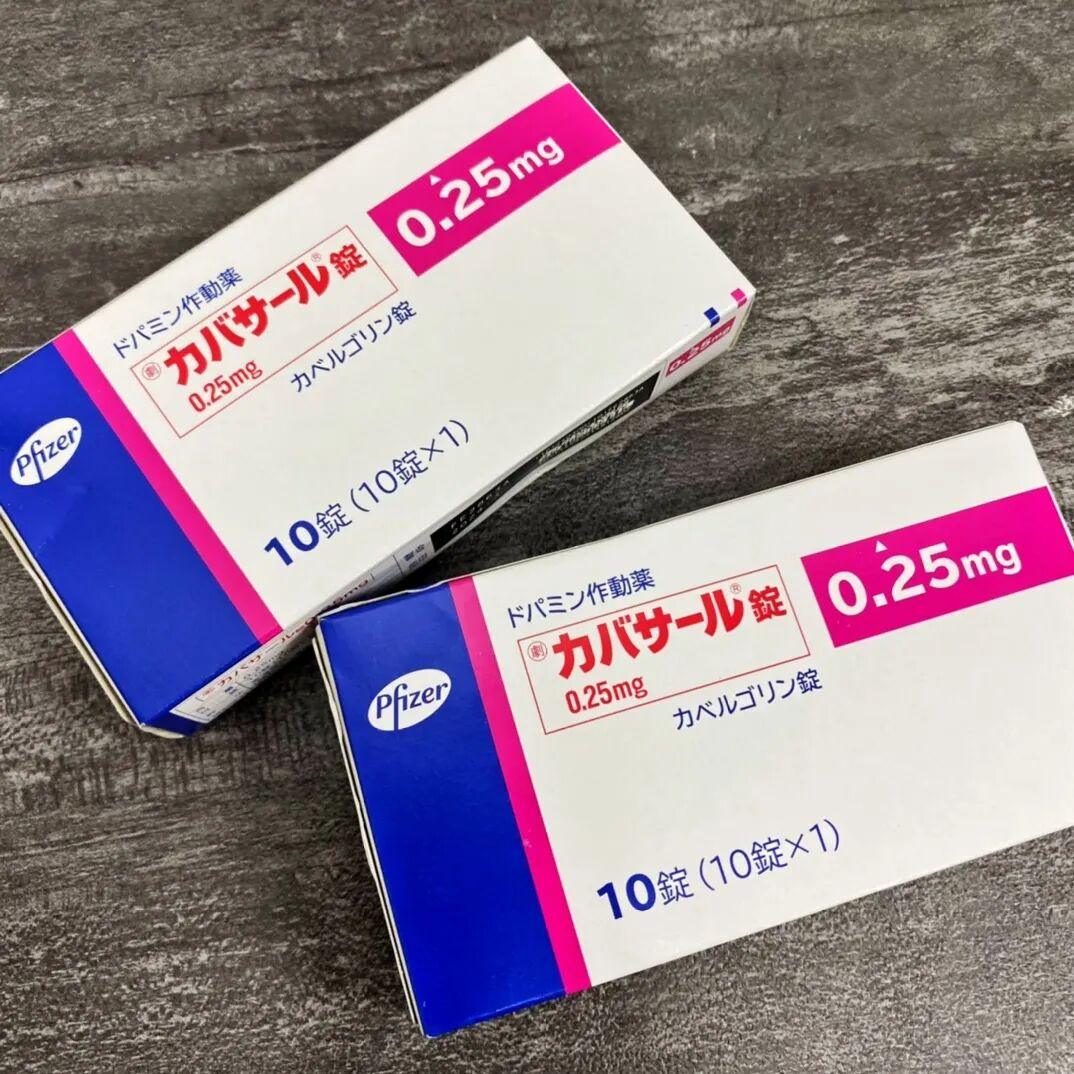
Carergoline 0.25mg 10 capsules
日本語原題:カバサール錠0.25mg
Published2025-03-30 06:19 FormTablet Content9 sections / 1 images Japanese nameカバサール錠0.25mg
Ingredients / strength:
Active ingredient: 1 tablet Chunichi Bureau Cabergolin (0.25mg) Additives: anhydrous lactose, L-leucine
English translation of the Japanese package insert is the main text; the Japanese original is shown alongside for verification. Use the language menu (top right) to read the page in another language. This site is for reference only — consult a doctor or pharmacist before use.
Section 1 · Feature description
English translation
This drug exhibits sustained dopamine D2 receptor stimulation and acts on the central nervous system by acting on dopamine D2 receptors in the substriatum nigra, exhibiting antiparkinsonian effects. Additionally, on the endocrine system, it specifically suppresses prolactin secretion by acting on dopamine D2 receptors in the anterior pituitary gland, exhibiting antiprolactin effects.
日本語 Original
本剤は持続的なドパミンD2受容体刺激作用を有し、中枢神経系に対しては黒質線条体のドパミンD2受容体に作用して抗パーキンソン作用を示す。また、内分泌系に対しては下垂体前葉のドパミンD2受容体に作用してプロラクチン分泌を特異的に抑制し、抗プロラクチン作用を示す。
Section 2 · Specifications
English translation
10 tablets [10 tablets (PTP)×1, with desiccant]
日本語 Original
10錠[10錠(PTP)×1、乾燥剤入り]
Section 3 · Characteristics
English translation
White tablets.
日本語 Original
白色素錠。
Section 4 · Ingredient Description
English translation
Active ingredient: 1 tablet Chunichi Bureau Cabergolin (0.25mg)
Additives: anhydrous lactose, L-leucine
日本語 Original
有効成分:1錠中日局 カベルゴリン(0.25mg)
添加剤:無水乳糖、L-ロイシン
Section 5 · Functions and indications
English translation
〈Common to Formulations〉
1. Parkinson's disease
2. Galactorrhea.
3. Hyperprolactinic ovulation disorders
3. Hyperprolactinic pituitary adenoma (only when surgical treatment is not required)
4. Puerperal milk secretion suppression
〈Kabasar Tablets 0.25mg〉
Suppression of the onset of ovarian hyperstimulation syndrome associated with assisted reproductive technology.
日本語 Original
〈製剤共通〉
1、パーキンソン病
2、乳汁漏出症
3、高プロラクチン血性排卵障害
3、高プロラクチン血性下垂体腺腫(外科的処置を必要としない場合に限る)
4、産褥性乳汁分泌抑制
〈カバサール錠0.25mg〉
生殖補助医療に伴う卵巣過剰刺激症候群の発症抑制。
Section 6 · Usage and dosage
English translation
〈Parkinson's Disease〉
Typically, adults start with 0.25 mg of cabergolin daily, increase to 0.5 mg in the second week, and then monitor the progress, increasing the daily dose by 0.5 mg each week to set a maintenance dose, with the maximum dose set at 3 mg per day. For all dosages, oral administration is administered once daily after breakfast.
〈Galactorrhea, hyperprolactinic ovulation disorders, hyperprolactinic pituitary adenomas (only when surgical treatment is not required)〉
Typically, adults are given orally once a week (on the same day of the week) before bedtime, starting with 0.25 mg of cabergoline per dose. Then, while observing clinical symptoms, the dose is increased by 0.25 mg at intervals of at least two weeks, with a maintenance dose (standard single dose of 0.25~0.75 mg). Adjustments may be made according to age and symptoms, but the maximum dose per dose is set at 1.0 mg.
〈Suppression of Puerperal Milk Secretion〉
Typically, adults receive 1.0 mg of cabergoline orally once after meals after fetal delivery.
〈Suppression of Ovarian Hyperstimulation Syndrome Associated with Assisted Reproduction〉
Typically, 0.5 mg of cabergoline is administered orally once daily for 7 to 8 days after the final follicle maturation induction or egg retrieval, before bedtime.
日本語 Original
〈パーキンソン病〉
通常、成人にはカベルゴリンとして1日量0.25mgから始め、2週目には1日量を0.5mgとし、以後経過を観察しながら、1週間毎に1日量として0.5mgずつ増量し、維持量を定めるが、最高用量は1日3mgとする。いずれの投与量の場合も1日1回朝食後経口投与する。
〈乳汁漏出症、高プロラクチン血性排卵障害、高プロラクチン血性下垂体腺腫(外科的処置を必要としない場合に限る)〉
通常、成人には1週1回(同一曜日)就寝前経口投与とし、カベルゴリンとして1回量0.25mgから始め、以後臨床症状を観察しながら、少なくとも2週間以上の間隔で1回量を0.25mgずつ増量し、維持量(標準1回量0.25~0.75mg)を定める。なお、年齢、症状により適宜増減するが、1回量の上限は1.0mgとする。
〈産褥性乳汁分泌抑制〉
通常、成人にはカベルゴリンとして1.0mgを胎児娩出後に1回のみ食後に経口投与する。
〈生殖補助医療に伴う卵巣過剰刺激症候群の発症抑制〉
通常、カベルゴリンとして1日1回0.5mgを最終的な卵胞成熟の誘発日又は採卵日から7〜8日間、就寝前に経口投与する。
Section 7 · Important notes
English translation
〈Common Effects〉
1. Sudden sleep without warning, drowsiness, or orthostatic hypotension may occur, so avoid engaging in hazardous work such as driving a car, operating machinery, or working at heights.
2. Pathological gambling (a state where gambling persistently repeats despite socially adverse outcomes such as personal life collapse), pathological increased libido, compulsive buying, and binge eating have been reported due to administration of levodopa or dopamine receptor agonists. If such symptoms appear, appropriate measures such as dose reduction or discontinuation of administration should be taken. Also, explain the symptoms of impulse control disorders to patients and their families.
〈Parkinson's disease, galactorrhea, hyperprolactinic ovulation disorders, hyperprolactinic pituitary adenoma (only when surgical treatment is not required)〉
Since valvular heart disease may appear during long-term administration of this drug, perform the following tests before and during administration and closely monitor the condition. There have also been reports of improvement after discontinuing the treatment.
(1) At the start of administration of this drug, observe physical findings such as auscultation and confirm the presence of latent valvular heart disease by echocardiography.
(2) During administration of this drug, perform echocardiography within 3~6 months after starting administration, and at least every 6~12 months thereafter. Also, conduct regular thorough observations (physical findings such as auscultation, chest X-rays, CT scans, etc.).
〈Parkinson's Disease〉
1. Compared to non-ergot preparations, there are more reports of valvular heart disease and fibrosis during administration of ergot preparations containing this drug. Therefore, start this drug under a physician with sufficient knowledge and experience in pharmacotherapy for Parkinson's disease, and consider risks and benefits during continued treatment.
2. If dose reduction or discontinuation of this drug is necessary, tapering it gradually. Malignant syndrome may appear due to rapid weight loss or discontinuation. Additionally, rapid dose reduction or discontinuation of dopamine receptor agonists can lead to drug withdrawal syndrome (characterized by symptoms such as apathy, anxiety, depression, fatigue, sweating, and pain).
〈Galactorrhea, hyperprolactinic ovulation disorders〉
Examination of the Turkish saddle before starting administration.
〈Hyperprolactin-blooded pituitary adenoma (limited to cases not requiring surgical intervention)
r)〉
1. In patients with hyperprolactinic pituitary adenoma spreading extra-turcira, treatment with this drug may cause cerebrospinal fluid nasal discharge due to shrinkage of the adenoma, which may lead to meningitis. If abnormalities are observed, appropriate measures such as dose reduction or discontinuation should be taken.
2. In patients with hyperprolactinic pituitary adenomas with visual field disturbances, administering this drug led to shrinkage of the adenoma. After initial improvement of visual field impairment, the optic chiasm retracted into the sella due to cavitation of the turquoise sella, causing visual field impairment to reappear. If abnormalities are observed, appropriate measures such as dose reduction or discontinuation should be taken.
〈Suppression of Puerperal Milk Secretion〉
Depending on the situation, auxiliary methods such as ice covering may be used in combination.
〈Suppression of Ovarian Hyperstimulation Syndrome Associated with Assisted Reproduction〉
This drug should be used under the guidance of a physician with sufficient knowledge and experience in infertility treatment.
日本語 Original
〈効能共通〉
1、前兆のない突発的睡眠、傾眠、起立性低血圧がみられることがあるので、自動車の運転、機械の操作、高所作業等危険を伴う作業には従事させないよう注意すること。
2、レボドパ又はドパミン受容体作動薬の投与により、病的賭博(個人的生活の崩壊等の社会的に不利な結果を招くにもかかわらず、持続的にギャンブルを繰り返す状態)、病的性欲亢進、強迫性購買、暴食等の衝動制御障害が報告されているので、このような症状が発現した場合には、減量又は投与を中止するなど適切な処置を行うこと。また、患者及び家族等にこのような衝動制御障害の症状について説明すること。
〈パーキンソン病、乳汁漏出症、高プロラクチン血性排卵障害、高プロラクチン血性下垂体腺腫(外科的処置を必要としない場合に限る)〉
本剤の長期投与において心臓弁膜症があらわれることがあるので、投与前・投与中に以下の検査を行い、十分な観察を行うこと。なお、投与中止により改善がみられたとの報告例もある。
(1)本剤投与開始に際しては、聴診等の身体所見の観察、心エコー検査により潜在する心臓弁膜症の有無を確認すること。
(2)本剤投与中は、投与開始後3~6ヵ月以内に、それ以降は少なくとも6~12ヵ月毎に心エコー検査を行うこと。また、十分な観察(聴診等の身体所見、胸部X線、CT等)を定期的に行うこと。
〈パーキンソン病〉
1、非麦角製剤と比較して、本剤を含む麦角製剤投与中の心臓弁膜症、線維症の報告が多いので、パーキンソン病に対する薬物療法について十分な知識・経験を持つ医師のもとで本剤の投与を開始するとともに、投与継続中はリスクとベネフィットを考慮すること。
2、本剤の減量・中止が必要な場合は、漸減すること。急激な減量又は中止により、悪性症候群があらわれることがある。また、ドパミン受容体作動薬の急激な減量又は中止により、薬剤離脱症候群(無感情、不安、うつ、疲労感、発汗、疼痛等の症状を特徴とする)があらわれることがある。
〈乳汁漏出症、高プロラクチン血性排卵障害〉
投与開始前にトルコ鞍の検査を行うこと。
〈高プロラクチン血性下垂体腺腫(外科的処置を必要としない場合に限
る)〉
1、トルコ鞍外に進展する高プロラクチン血性下垂体腺腫の患者において、本剤の投与による腺腫の縮小により髄液鼻漏がみられ、髄膜炎に至ることがあるので、異常が認められた場合には、減量又は中止するなど適切な処置を行うこと。
2、視野障害のみられる高プロラクチン血性下垂体腺腫の患者において、本剤投与により腺腫の縮小がみられ、一旦、視野障害が改善した後、トルコ鞍の空洞化により視交叉部が鞍内に陥入することによって、再び視野障害があらわれたとの報告がある。異常が認められた場合には、減量又は中止するなど適切な処置を行うこと。
〈産褥性乳汁分泌抑制〉
場合により氷罨法等の補助的方法を併用すること。
〈生殖補助医療に伴う卵巣過剰刺激症候群の発症抑制〉
本剤は、不妊治療に十分な知識と経験のある医師のもとで使用すること。
Section 8 · Side effects
English translation
1. Hallucinations (5.5%), delusions (1.8%), fainting (frequency unknown), delirium (frequency unknown), confusion (frequency unknown)
2. Malignant syndrome (frequency unknown)
In Parkinson's disease treatment, rapid dose reduction or discontinuation of this drug may cause high fever, impaired consciousness, severe muscle rigidity, involuntary movements, and elevated serum CK. In such cases, after redosing, gradually reduce the dose and take appropriate measures such as body cooling and hydration. Similar symptoms may appear during continued administration.
3. Interstitial pneumonia (frequency unknown)
If fever, cough, difficulty breathing, abnormal lung sounds (twisting sounds) appear, promptly perform chest X-ray, and if abnormalities are found, discontinue administration and take appropriate measures.
4. Pleurisy (frequency unknown), pleural effusion (frequency unknown), pleural fibrosis (frequency unknown), pulmonary fibrosis (frequency unknown), pericarditis (frequency unknown), pericardial effusion (frequency unknown) Pleurisy, pleural effusion, and pericardial effusion may occur. Additionally, when administered to patients with long-term administration of this drug or treatment history of ergot preparations with dopamine receptor stimulation effects, pleural fibrosis, pulmonary fibrosis, and pericarditis may occur. If chest pain, edema, respiratory symptoms, or other symptoms appear during administration of this drug, promptly perform a chest X-ray, and if abnormalities are found, discontinue administration and take appropriate measures.
5. Valvular heart disease (frequency unknown)
If a heart murmur appears or worsens, promptly perform chest X-rays, echocardiographies, and other examinations. If heart valve apical thickening, limited heart valve motion, or associated stenosis of the heart valve is observed, discontinue administration and take appropriate measures. [
6. Retroperitoneal fibrosis (frequency unknown)
If back pain, lower limb edema, renal dysfunction, or similar symptoms occur, discontinue administration and take appropriate treatment.
7. Sudden sleep breaks (frequency unknown)
Sudden sleep without warning may occur. [See 8.1]
8. Liver dysfunction (frequency unknown), jaundice (frequency unknown)
Liver dysfunction accompanied by elevated AST, ALT, and γ-GTP, as well as jaundice, may occur.
9. Angina pectoris (frequency unknown), extremity redness and pain (frequency unknown)
日本語 Original
1、幻覚(5.5%)、妄想(1.8%)、失神(頻度不明)、せん妄(頻度不明)、錯乱(頻度不明)
2、悪性症候群(頻度不明)
パーキンソン病治療において、本剤の急激な減量又は中止により、高熱、意識障害、高度の筋硬直、不随意運動、血清CK上昇等があらわれることがある。このような場合には、再投与後、漸減し、体冷却、水分補給等の適切な処置を行うこと。なお、投与継続中に同様の症状があらわれることがある。
3、間質性肺炎(頻度不明)
発熱、咳嗽、呼吸困難、肺音の異常(捻髪音)等があらわれた場合には、速やかに胸部X線検査を実施し、異常が認められた場合には投与を中止し、適切な処置を行うこと。
4、胸膜炎(頻度不明)、胸水(頻度不明)、胸膜線維症(頻度不明)、肺線維症(頻度不明)、心膜炎(頻度不明)、心嚢液貯留(頻度不明)胸膜炎、胸水、心嚢液貯留があらわれることがある。また、本剤の長期投与又はドパミン受容体刺激作用を有する麦角製剤の治療歴のある患者に本剤を投与した場合、胸膜線維症、肺線維症、心膜炎があらわれることがある。本剤の投与中に胸痛、浮腫、呼吸器症状等があらわれた場合には、速やかに胸部X線検査を実施し、異常が認められた場合には投与を中止し、適切な処置を行うこと。
5、心臓弁膜症(頻度不明)
心雑音の発現又は増悪等があらわれた場合には、速やかに胸部X線検査、心エコー検査等を実施すること。心臓弁尖肥厚、心臓弁可動制限及びこれらに伴う狭窄等の心臓弁膜の病変が認められた場合には投与を中止し、適切な処置を行うこと。[
6、後腹膜線維症(頻度不明)
背部痛、下肢浮腫、腎機能障害等があらわれた場合には、投与を中止し、適切な処置を行うこと。
7、突発的睡眠(頻度不明)
前兆のない突発的睡眠があらわれることがある。[8.1参照]
8、肝機能障害(頻度不明)、黄疸(頻度不明)
AST、ALT、γ-GTPの上昇等を伴う肝機能障害、黄疸があらわれることがある。
9、狭心症(頻度不明)、肢端紅痛症(頻度不明)
Section 9 · Taboo
English translation
1. Patients with a history of hypersensitivity to ergot preparations
2. Patients with heart valve lesions confirmed by echocardiography such as apical hypertrophy, limited heart valve mobility, and associated stenosis, as well as those with a history of these [may worsen symptoms]. ]
3. Patients with pregnancy-induced hypertension syndrome [There is a risk of seizures, cerebrovascular disorders, heart attacks, and hypertension during the postpartum period. ]
4. Patients with postpartum hypertension [There is a risk of seizures, cerebrovascular disorders, heart attacks, and hypertension during the postpartum period. ]
日本語 Original
1、麦角製剤に対し過敏症の既往歴のある患者
2、心エコー検査により、心臓弁尖肥厚、心臓弁可動制限及びこれらに伴う狭窄等の心臓弁膜の病変が確認された患者及びその既往のある患者[症状を悪化させるおそれがある。]
3、妊娠高血圧症候群の患者[産褥期に痙攣、脳血管障害、心臓発作、高血圧が発現するおそれがある。]
4、産褥期高血圧の患者[産褥期に痙攣、脳血管障害、心臓発作、高血圧が発現するおそれがある。]
Source images
1 imagesThe artwork keeps its original Japanese/Chinese lettering. Open “Text in this image” under a picture to read what it says in your language (machine-read, may contain errors).