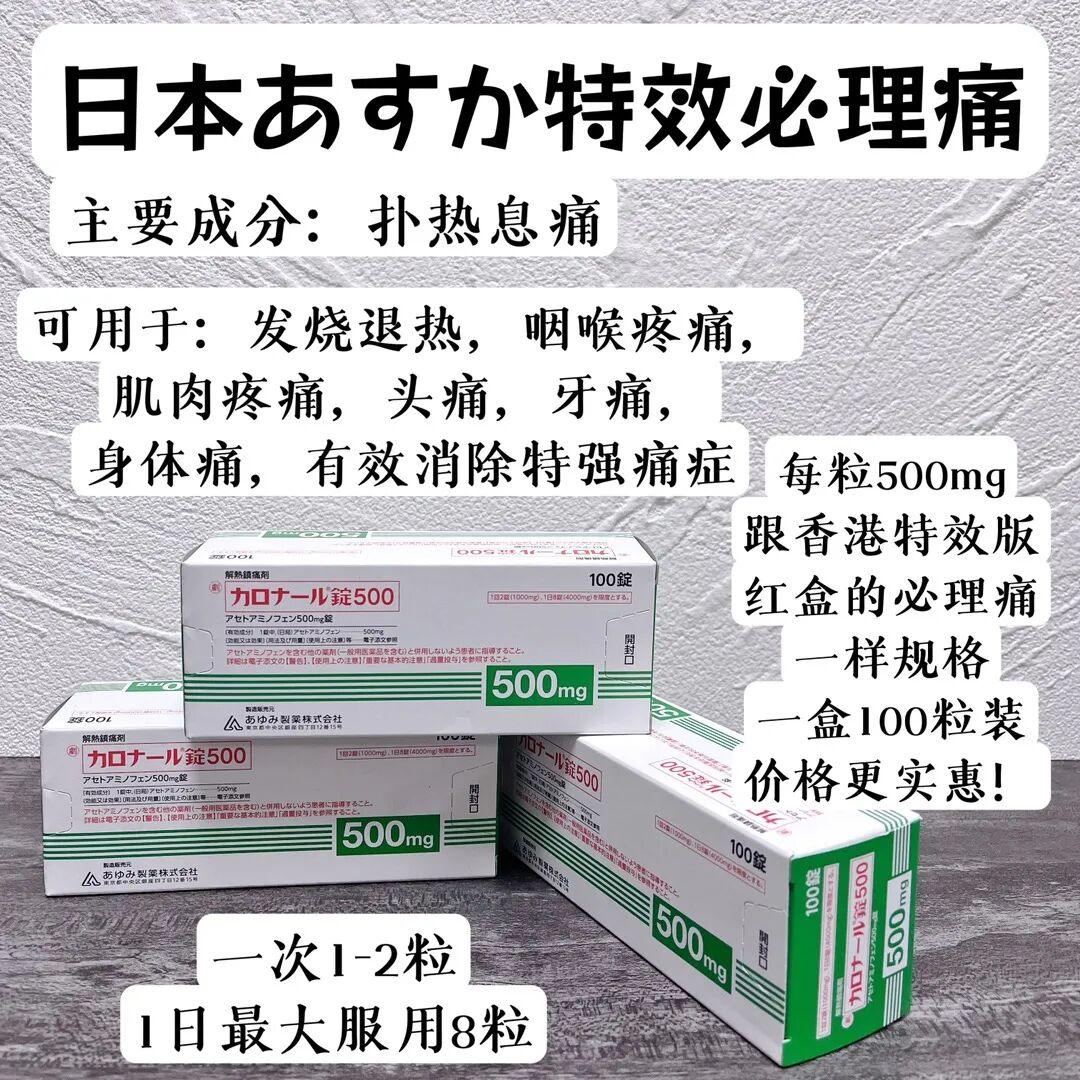
Analgesic & Antipyretic · ANALGESIC

Asuka Hirito 500mg

日本語原題:カロナール錠500

Published2025-03-31 09:22 FormTablet Content10 sections / 1 images Japanese nameカロナール錠500
Ingredients / strength:
Active ingredient: per tablet, (Japanese compound) acetaminophen 500mg. Additives: stearic acid, alpha starch, povidone, crospovidone, magnesium stearate.
English translation of the Japanese package insert is the main text; the Japanese original is shown alongside for verification. Use the language menu (top right) to read the page in another language. This site is for reference only — consult a doctor or pharmacist before use.
Section 1 · Feature description
English translation
The exact site and mechanism of acetaminophen's action are not fully understood, but it is believed to act on the central nervous system and influence prostaglandin synthesis, cannabinoid receptors, and serotonergic systems.
Section 2 · Specifications
English translation
100 tablets [10 tablets (PTP)×10]
Section 3 · Characteristics
English translation
This drug is a white plain tablet with a split line.
Section 4 · Ingredient Description
English translation
Active ingredient: per tablet, (Japanese compound) acetaminophen 500mg. Additives: stearic acid, alpha starch, povidone, crospovidone, magnesium stearate.
Section 5 · Functions and indications
English translation
1. Pain relief for various diseases and symptoms 2. Antipyretic and analgesic treatment for the following diseases Acute upper respiratory tract inflammation (including acute upper respiratory tract inflammation accompanied by acute bronchitis). 3. Antipyretic and analgesic treatment in pediatrics
Section 6 · Usage and dosage
English translation
〈Analgesia for Various Diseases and Symptoms〉 Typically, adults are given 300~1000mg orally as acetaminophen per dose, with intervals of 4~6 hours or more. The daily total dose is limited to 4000 mg depending on age and symptoms. It is also desirable to avoid administration on an empty stomach. 〈Acute upper respiratory tract infection (including acute upper respiratory tract inflammation with acute bronchitis)〉 Typically, adults are given 300~500 mg per dose as acetaminophen. Adjust appropriately according to age and symptoms. However, in principle, it is limited to twice a day, with a maximum of 1500 mg per day. It is also desirable to avoid administration on an empty stomach. 〈Antipyretic and Analgesic Effects in the Field of Pediatrics〉 Typically, infants and children are given 10~15 mg orally per 1 kg of body weight as acetaminophen, with dosing intervals of 4~6 hours or more. The total daily dose is limited to 60 mg/kg depending on age and symptoms. However, it does not exceed the adult dose. It is also desirable to avoid administration on an empty stomach.
Section 7 · Important notes
English translation
1. Treatment with antipyretic analgesics is symptomatic rather than causal therapy, so if causal therapy is available, it should be performed. 2. Since there is a risk of severe liver damage, if the total daily dose exceeds 1500 mg for long-term administration, regular liver function tests should be performed to closely monitor the patient's condition. Even if the dose is not high, regular liver function tests are desirable for long-term administration. Also, when administering at high doses, it is especially important to closely monitor the patient's condition. 3. When using this drug for acute illnesses, consider the following points. ・Administer considering the severity of fever and pain. ・As a general rule, avoid long-term administration of the same drug. 4. When using this drug for chronic diseases, consider therapies other than pharmacotherapy. 5. Excessive drop in body temperature, collapse, or cold limbs may occur, so especially in elderly patients with high fever, children, or patients with wasting diseases, pay close attention to the patient's condition after administration. 6. Instruct patients not to use it concomitantly with other medications containing acetaminophen. 7. Side effects such as abdominal pain and diarrhea may occur due to high-dose administration of acetaminophen. Similar side effects may occur with this drug and may not be distinguishable from gastrointestinal symptoms associated with upper respiratory tract infections; therefore, careful observation and caution should be administered.
Section 8 · Side effects
English translation
1. Shock, anaphylaxis (both with unknown frequency) Shock and anaphylaxis (difficulty breathing, generalized flushing, angioedema, urticaria, etc.) may occur. 2. Toxic epidermal necrolysis (TEN), Stevens-Johnson syndrome, and acute generalized exusculatory pustulosis (all of unknown frequency) 3. Triggering asthma attacks (frequency unknown) 4. Fulminant hepatitis, liver dysfunction, jaundice (all of unknown frequency) Fulminant hepatitis, AST, ALT, liver dysfunction with elevated γ-GTP, and other conditions, Jaundice may occur. 5. Granulocytopenia (frequency unknown) 6. Interstitial pneumonia (frequency unknown) If cough, difficulty breathing, fever, or abnormal lung sounds are observed, promptly perform chest X-ray, chest CT, serum markers, and other tests. If abnormalities are observed, discontinue administration and take appropriate measures such as adrenal corticosteroid therapy. 7. Interstitial nephritis, acute kidney injury (both frequency unknown) 8. Drug-induced hypersensitivity syndrome (frequency unknown) Early symptoms include rash and fever, followed by liver dysfunction, lymphadenopathy, increased white blood cells, eosinophilia, and the appearance of atypical lymphocytes, resulting in delayed, severe hypersensitivity symptoms. Note that reactivation of viruses such as human herpes virus 6 (HHV-6) is often involved, and symptoms such as rash, fever, and liver dysfunction may recur or persist even after discontinuation, so caution is advised.
Section 9 · Taboo
English translation
1. Patients with severe liver impairment. 2. Patients with a history of hypersensitivity to any component of this drug.
Section 10 · Warning
English translation
1. Be aware that this drug may cause severe liver damage. When administering at high doses exceeding 1500 mg daily for long-term use, carefully administer with regular liver function checks. That's what it is. 2. Avoid concurrent use with other drugs containing acetaminophen (including over-the-counter drugs), as there is a risk of severe liver damage due to acetaminophen overdose.

Source images

1 images

Need help sourcing Japanese medicines or OEM production?

💬