Cardiovascular · CARDIOVASCULAR

Talquetamab

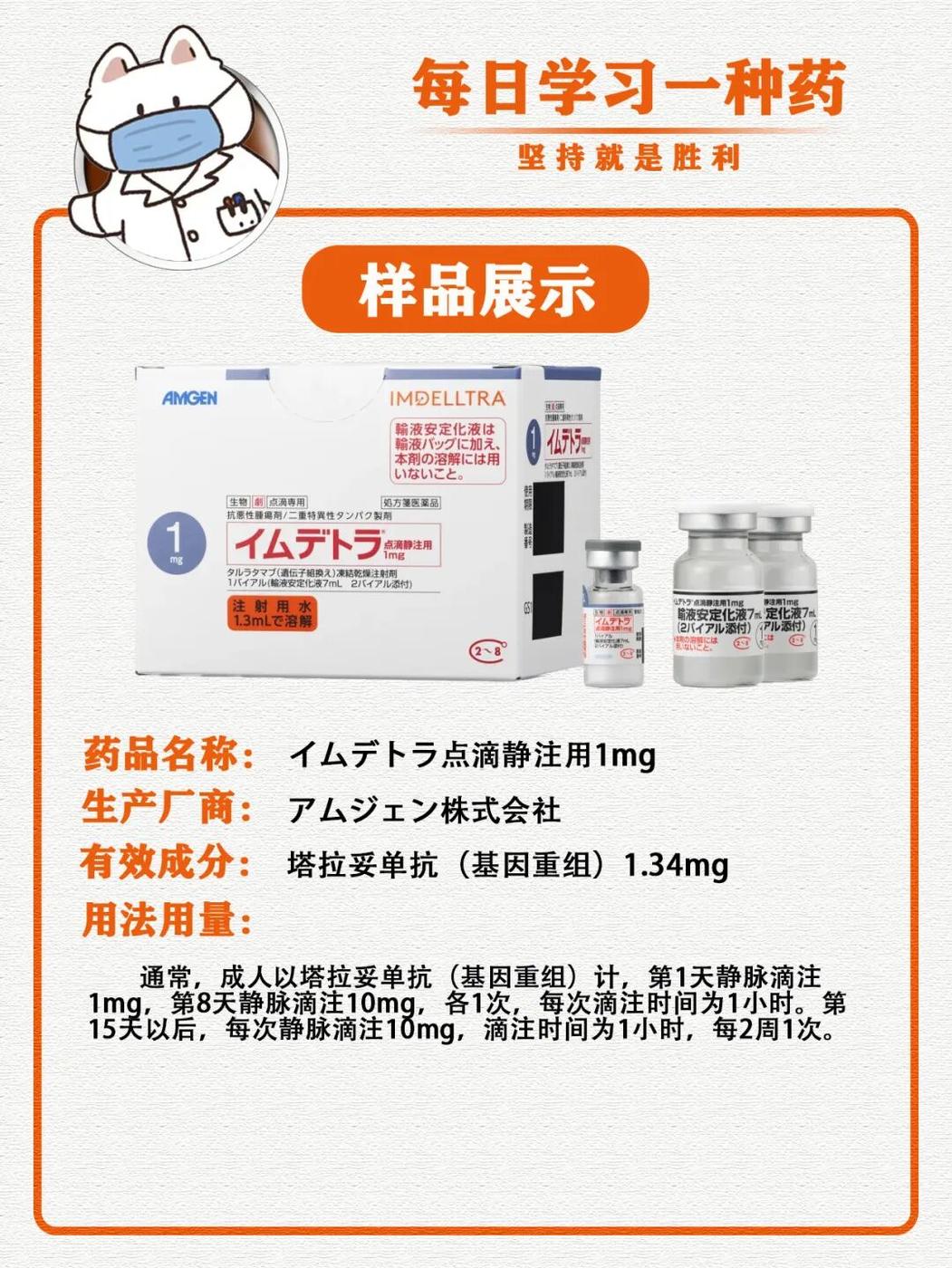
日本語原題:イムデトラ点滴静注用1mg/10mg

Published2025-07-24 10:17 Content10 sections / 2 images
English translation of the Japanese package insert is the main text; the Japanese original is shown alongside for verification. Use the language menu (top right) to read the page in another language. This site is for reference only — consult a doctor or pharmacist before use.
Section 1 · 01
English translation
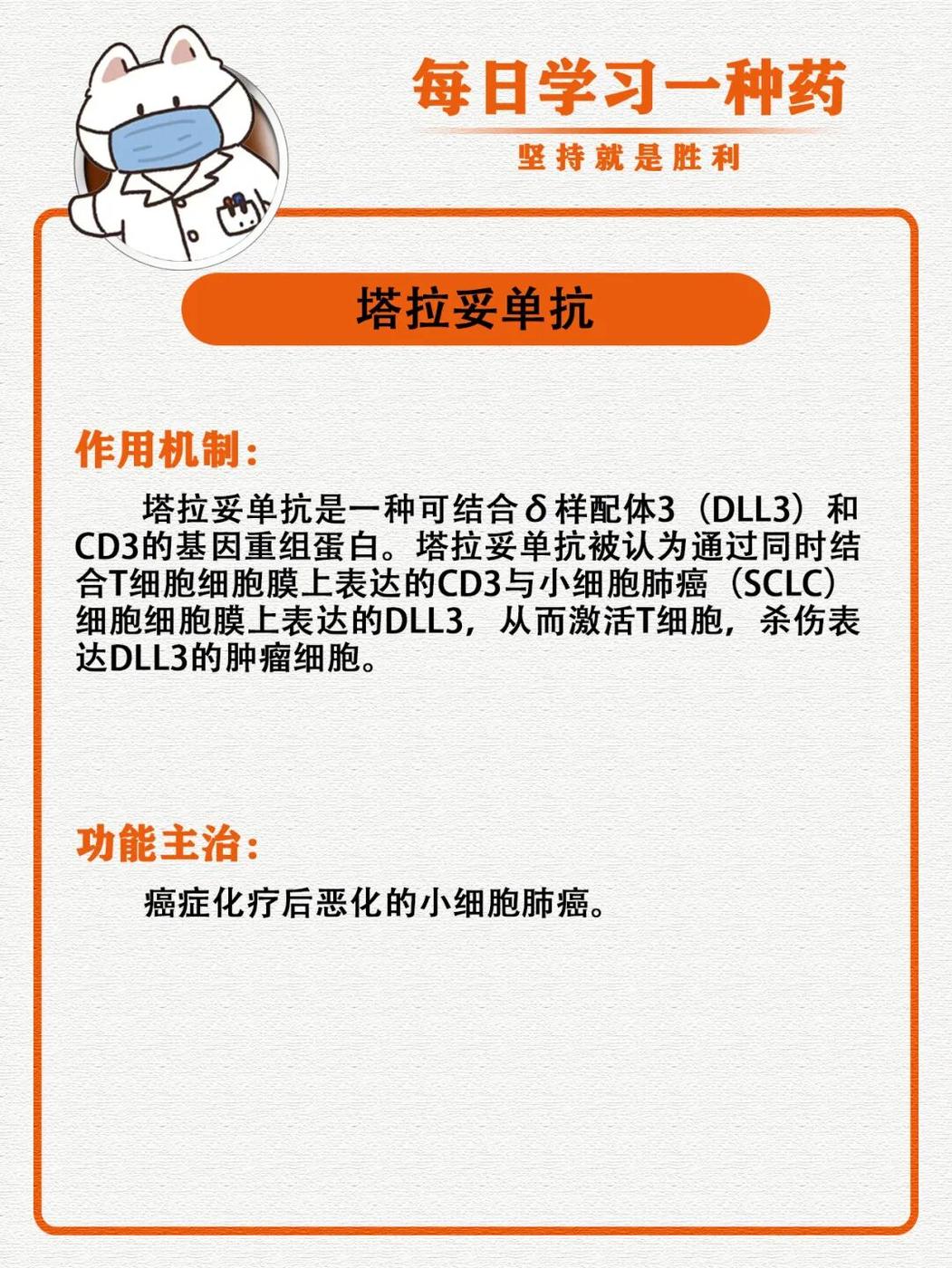
Feature Description Tarratamab is a genetically modified protein that binds to delta-like ligand 3 (DLL3) and CD3. Tallatamab activates T cells by binding to CD3 expressed on T cell membranes and DLL3 expressed on the membranes of small cell lung cancer (SCLC) cells, thereby injuring tumor cells expressing DLL3.
Section 2 · 02
English translation
Specifications 1. Imdetra Intravenous Injection 1mg 1 vial (7mL infusion stabilization solution with 2 vials attached) 2. Imdetra Intravenous 10mg 1 vial (7mL infusion stabilization solution with 2 vials attached)
Section 3 · 03
English translation
Characteristics 1. Imdetra Intravenous Injection 1mg White ~ pale yellow mass (freeze-dried injection). After dissolution, the liquid is colorless ~ pale yellow and clear~milky white. 2. Imdetra Intravenous Injection 10mg White ~ pale yellow mass (freeze-dried injection). After dissolution, the liquid is colorless ~ pale yellow and clear~milky white.
Section 4 · 04
English translation
Ingredient Information 1. Imdetra Intravenous Injection 1mg (1) Active ingredient (per vial): Tarratamab (genetically modified) Note 1) 1.34mg Note 2) (2) Additives (per vial): purified white sugar 37.1mg, L-glutamic acid 0.72mg, polysorbate 80 0.04mg, appropriate amount of sodium hydroxide. 2. Imdetra Intravenous Injection 10mg (1) Active ingredient (per vial): Tarratamab (genetically modified) Note 1) 11.3 mg Note 3). (2) Additives (per vial): 194.4mg refined white sugar, 3.7mg L-glutamate, 0.2mg polysorbate 80, appropriate amount of sodium hydroxide. 3. Infusion stabilization solution Additives (per vial): 36.75 mg of citric acid hydrate, 1598.8 mg of L-lysine hydrochloride, 80 7 mg of polysorbate, appropriate amount of pH adjuster, total 7 mL. Note 1) This drug is manufactured using Chinese hamster ovary cells using genetic modification technology. Note 2) To ensure an injectable amount of 1 mg tarratamab per vial, the amount dissolved in 1.3 mL of water for injection is 0.9 mg/mL. Note 3) One vial is overfilled to ensure an injectable amount of 10 mg of tarratamab, and when dissolved in 4.4 mL of water for injection, the amount is 2.4 mg/mL.
Section 5 · 05
English translation
Indications Small cell lung cancer that worsened after chemotherapy.
Section 6 · 06
English translation
Dosage and Administration Typically, adults receive 1 mg of tarratamab (genetically modified) on day 1 and 10 mg on day 8, administered by intravenous drip over an hour. From day 15 onward, 10 mg is administered by intravenous drip over one hour at two-week intervals.
Section 7 · 07
English translation
Notes 1. Since cytokine release syndrome and immune effector cell-associated neurotoxicity syndrome are frequently observed early in administration, hospitalization management should be required for at least 24 hours from the start of administration on at least day 1 and day 8, and hospitalization management should be considered according to the patient's condition even after 24 hours after administration on day 1 and after day 15. 2. Cytokine release syndrome may occur, so please pay attention to the following points when administering this drug. (1) Preventive measures such as administering prior medications for cytokine release syndrome should be implemented. (2) During administration of this drug, closely monitor for fever, hypotension, hypoxia, fatigue, tachycardia, headache, chills, nausea, vomiting, and similar symptoms. If symptoms suggestive of cytokine release syndrome appear, instruct patients to promptly seek medical attention. (3) Prepare tocilizumab (genetically modified) for prompt use in case of emergencies. 3. Neurological events (including immune effector cell-associated neurotoxic syndrome) may occur, so during administration of this drug, closely monitor for aphasia, changes in consciousness level, cognitive impairment, muscle weakness, ataxia, seizures, cerebral edema, and similar conditions. Also, if symptoms suggestive of immune effector cell-associated neurotoxic syndrome appear, patients should be instructed to promptly seek medical attention. 4. Neurological events (including immune effector cell-associated neurotoxic syndrome) may include changes in consciousness level, seizures, etc.; therefore, patients receiving this drug should exercise caution when operating dangerous machinery such as driving a car. 5. Since blood cell counts may occur, perform regular blood tests before and during administration to closely monitor the patient's condition.
Section 8 · 08
English translation
Side Effects 1. Cytokine release syndrome (52.6%) If abnormalities are observed, discontinue administration of this drug and administer corticosteroids or tocilizumab (genetically modified) according to the cytokine release syndrome management guidance provided by the manufacturer. 2. Neurological events (including immune effector cell-associated neurotoxic syndromes) Neurological events such as immune effector cell-associated neurotoxic syndrome (5.3%), muscle weakness (3.0%), aphasia (0.8%), and decreased consciousness (0.8%) may occur. If abnormalities are detected, discontinue administration of this drug and administer corticosteroids as appropriate in accordance with the management guidance for immune effector cell-associated neurotoxic syndrome provided by the manufacturer. 3. Reduced blood cells Anemia (13.5%), lymphopenia (7.5%), neutropenia (6.0%), thrombocytopenia (4.5%), and febrile neutropenia (0.8%) may occur. 4. Interstitial lung disease Conditions such as pneumonitis (0.8%) may also occur. 5. Other side effects (1) Infections and parasitic infections: Candida infection, cystitis, infections, otitis media, pneumonia. (2) Endocrine disorders: adrenal insufficiency, hypothyroidism, hypopituitary gland. (3) Metabolic and nutritional disorders: loss of appetite (26.3%), hyponatremia. (4) Mental disorders: confusion, delirium. (5) Nervous system disorders: loss of taste (27.1%), tremors, neurotoxicity. (6) Respiratory, thoraco, and mediastinal disorders: difficulty breathing. (7) Gastrointestinal disorders: constipation, nausea. (8) Hepatobiliary system disorders: hyperbilirubinemia, cholestasis, liver dysfunction, hepatitis, hypertransaminasesemia. (9) Skin and subcutaneous tissue disorders: rash, maculopapuloid rash. (10) General and systemic disorders and administration site conditions: fever (32.3%), fatigue, weakness, rash at the injection site. (11) Clinical tests: increased ALT, increased AST, increased blood bilirubin, elevated transaminase, elevated liver enzymes, decreased blood thyroid-stimulating hormone.
Section 9 · 09
English translation
taboo Patients with a history of hypersensitivity to any component of this drug.
Section 10 · 10
English translation
Warning 1. This drug should only be administered in cases where it is deemed appropriate to use this drug under the supervision of a physician with sufficient knowledge and experience in cancer chemotherapy, at a medical facility capable of adequate emergency response. Also, before starting treatment, fully explain the efficacy and risks to the patient or their family, and only administer after obtaining consent. 2. Severe cytokine release syndrome and neurological events (including immune effector cell-associated neurotoxicity syndrome) may occur, so especially in the early stages of treatment, administration of this drug should be conducted under appropriate management such as hospitalization. 3. Severe cytokine release syndrome may occur, so preventive measures such as pre-administration of premedications for cytokine release syndrome should be taken, and thorough observation should be conducted. If abnormalities are detected, appropriate treatment should be taken according to the cytokine release syndrome management guidance provided by the manufacturer or distributor. 4. Severe neurological events (including immune effector cell-associated neurotoxicity syndrome) may occur, so observe carefully, and if abnormalities are found, follow the management guidance provided by the manufacturer and distributor to take appropriate measures.

Source images

2 images

Need help sourcing Japanese medicines or OEM production?

💬