Lansoprazole
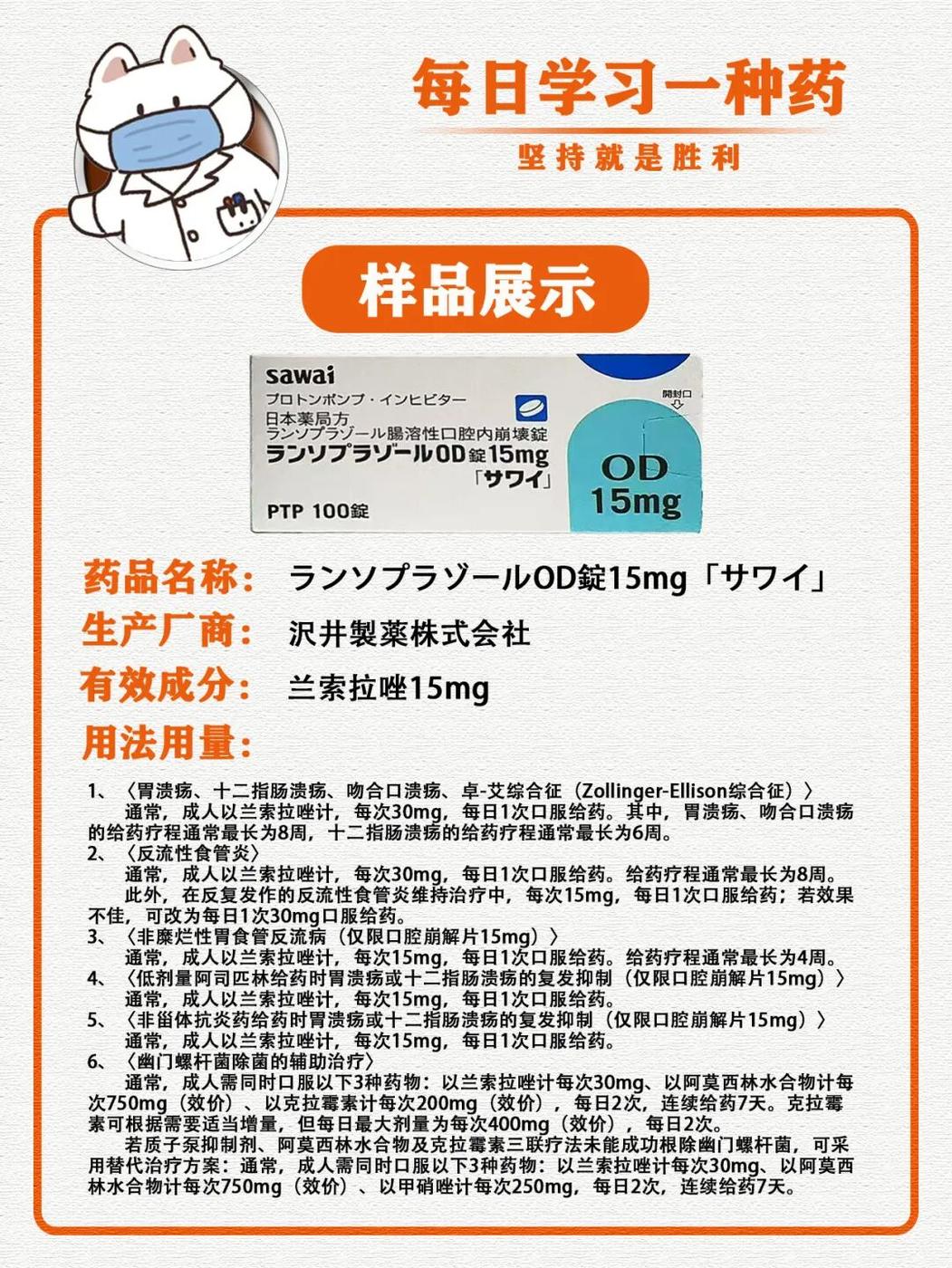
日本語原題:ランソプラゾールOD錠15mg「サワイ」
Source images
2 imagesThe artwork keeps its original Japanese/Chinese lettering. Open “Text in this image” under a picture to read what it says in your language (machine-read, may contain errors).
Text in this image machine-read · may contain errors
sawai Japanese cuisine recipe Lansoprazole enteric-coated Ro-cavity disintegration tablets Lansoprasol OD Tablets 15mg 15mg 100 PTP tablets Drug Name: Lansoprazole OD Tablets 15mg "Sawai" Manufacturer: Active ingredients: Lansoprazole 15mg Dosage and administration: 1. "Gastric ulcer, duodenal ulcer, anastomotic ulcer, Zollinger-Ellison syndrome" Typically, adults take 30mg orally once daily as lansoprazole. Among them, gastric ulcers and anastomotic ulcers The course of administration for duodenal ulcers is usually up to 8 weeks, and for duodenal ulcers, the maximum duration is usually 6 weeks. 2. "Reflux Esophagitis" Typically, adults take 30mg orally once daily as lansoprazole. The course of administration is usually up to 8 weeks. Additionally, in maintenance treatment for recurrent reflux esophagitis, 15mg each time, once daily oral administration: if effective If not satisfactory, it can be changed to oral administration of 30mg once daily. 3. "Non-erosive Gastroesophageal Reflux Disease (Oral Disintegration Tablets 15mg only)" Typically, adults take 15mg orally once daily as lansoprazole. The course of administration is usually up to 4 weeks. 4. "Suppression of Recurrence of Gastric or Duodenal Ulcers with Low-Dose Aspirin Administration (Limited to Oral Disintegration Tablets 15mg)" Typically, adults take 15mg orally once daily as lansoprazole. "Recurrent Suppression of Gastric or Duodenal Ulcers During Non-Stock Anti-inflammatory Drug Administration (Oral Disintegration Tablets 15mg)" "Adjunct Treatment for Helicobacter pylori Eradication" Typically, adults need to take the following three medications orally simultaneously: 30mg of lansoprazole per dose, and amoxicillin hydrate per dose 750mg (potency) per dose, 200mg (potency) per dose calculated as clarithromycin twice daily for 7 consecutive days. Clarzy The dosage can be appropriately increased as needed, but the maximum daily dose is 400 mg (potency) twice daily. If the triple therapy of proton pump inhibitors, amoxicillin hydrate, and clarithromycin fails to eradicate Helicobacter pylori, it can be collected Alternative treatment regimen: Typically, adults need to take three of the following medications simultaneously: lansoprazole 30mg each time, amoxic Lin hydrate is calculated at 750 mg per dose (potency), metronidazole is calculated at 250 mg per dose, twice daily for 7 consecutive days.
sawai 日本菜局方 ランソプラゾール腸溶性ロ腔内崩壊錠 ランソプラソル OD 錠 15mg 15mg PTP100锭 药品名称: ランソプラゾール OD 錠 15mg 「サワイ」 生产厂商: 有效成分: 兰索拉唑15mg 用法用量: 1、《胃溃疡、十二指肠溃疡、吻合口溃疡、卓-艾综合征(Zollinger-Ellison综合征)) 通常,成人以兰索拉唑计,每次30mg,每日1次口服给药。其中,胃溃疡、吻合口溃疡 的给药疗程通常最长为8周,十二指肠溃疡的给药疗程通常最长为6周。 2、《反流性食管炎》 通常,成人以兰索拉唑计,每次30mg,每日1次口服给药。给药疗程通常最长为8周。 此外,在反复发作的反流性食管炎维持治疗中,每次15mg,每日1次口服给药:若效果 不佳,可改为每日1次30mg口服给药。 3、《非糜烂性胃食管反流病(仅限口腔崩解片15mg)) 通常,成人以兰索拉唑计,每次15mg,每日1次口服给药。给药疗程通常最长为4周。 4、《低剂量阿司匹林给药时胃溃疡或十二指肠溃疡的复发抑制(仅限口腔崩解片15mg) 通常,成人以兰索拉唑计,每次15mg,每日1次口服给药。 《非备体抗炎药给药时胃溃疡或十二指肠溃疡的复发抑制(仅限口腔崩解片15mg)) 《幽门螺杆菌除菌的辅助治疗》 通常,成人需同时口服以下3种药物:以兰索拉唑计每次30mg、以阿莫西林水合物计每 次750mg(效价)、以克拉霉素计每次200mg(效价),每日2次,连续给药7天。克拉霉 素可根据需要适当增量,但每日最大剂量为每次400mg(效价),每日2次。 若质子泵抑制剂、阿莫西林水合物及克拉霉素三联疗法未能成功根除幽门螺杆菌,可采 用替代治疗方案:通常,成人需同时口服以下3种药物:以兰索拉唑计每次30mg、以阿莫西 林水合物计每次750mg(效价),以甲硝唑计每次250mg,每日2次,连续给药7天。
sawai Japanese cuisine recipe Lansoprazole enteric-coated Ro-cavity disintegration tablets Lansoprasol OD Tablets 15mg 15mg 100 PTP tablets Drug Name: Lansoprazole OD Tablets 15mg "Sawai" Ma…
Text in this image machine-read · may contain errors
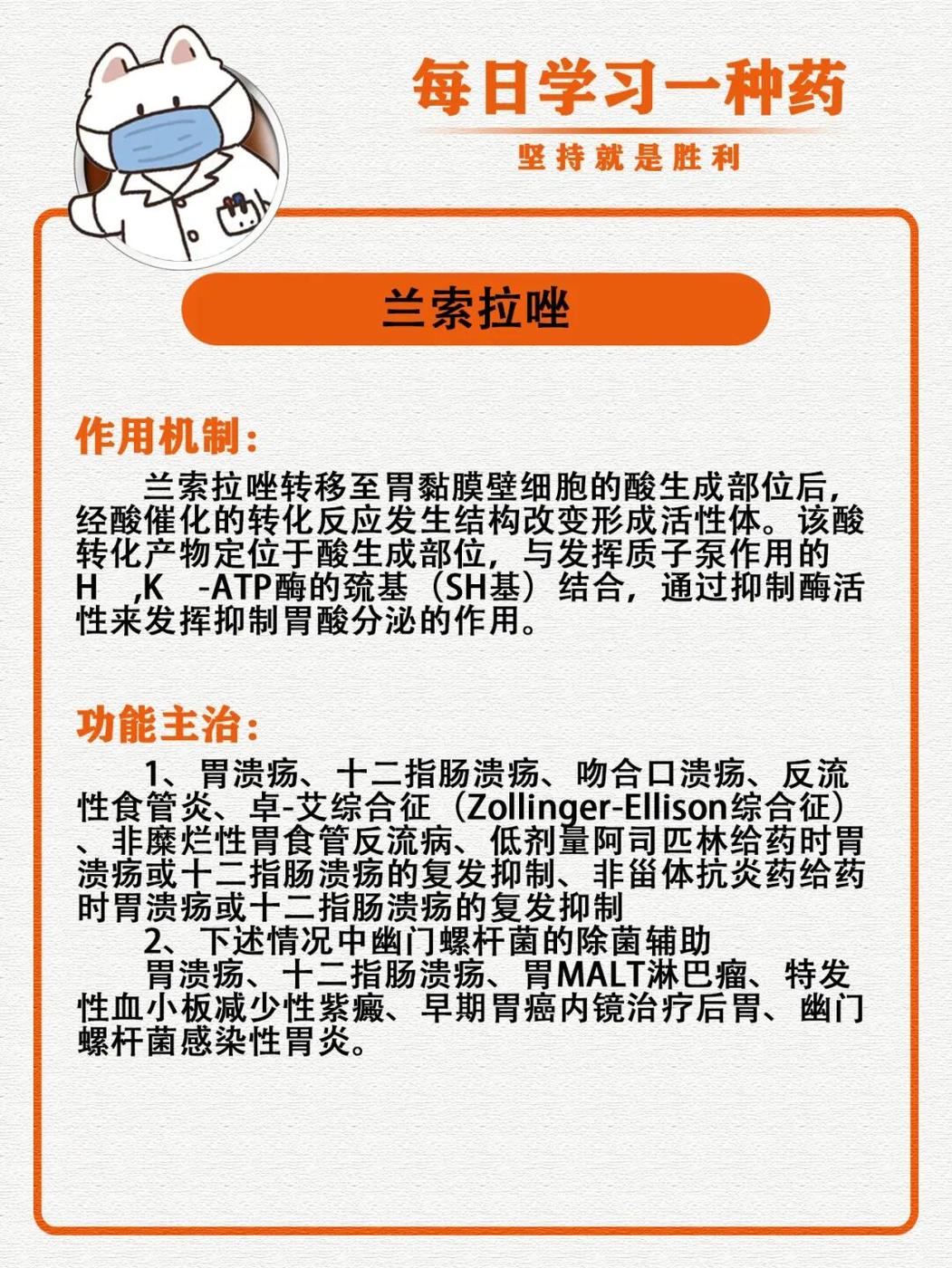
Mechanism of action: After lansoprazole is transferred to the acid-producing site of gastric mucosal parietal cells Acid-catalyzed transformation reactions undergo structural changes to form active organisms. This acid The conversion product is located at the acid-generating site and acts as a proton pump H,K-ATPase binds to the raretic group (SH group), inhibiting enzyme activity to inhibit gastric acid secretion. Functions and indications: 1. Gastric ulcer, duodenal ulcer, anastomotic ulcer, reflux Esophagitis, Zollinger-Ellison syndrome Non-erosive gastroesophageal reflux disease, stomach when low-dose aspirin is administered Suppress recurrence of ulcers or duodenal ulcers, and administer non-spare anti-inflammatory drugs Suppression of recurrence of gastric or duodenal ulcers 2. Assisting in the eradication of Helicobacter pylori in the following cases Gastric ulcer, duodenal ulcer, gastric MALT lymphoma, idiopathic Thrombocytopenic purpura, early gastric cancer after endoscopic treatment of the stomach and pylorus Pylori infectious gastritis. Lansoprazole
作用机制: 兰索拉唑转移至胃黏膜壁细胞的酸生成部位后 经酸催化的转化反应发生结构改变形成活性体。该酸 转化产物定位于酸生成部位,与发挥质子泵作用的 H ,K-ATP酶的疏基 (SH基)结合,通过抑制酶活 性来发挥抑制胃酸分泌的作用。 功能主治: 1、胃溃疡、十二指肠溃疡、吻合口溃疡、反流 性食管炎、卓-艾综合征(Zollinger-Ellison综合征) 、非糜烂性胃食管反流病、低剂量阿司匹林给药时胃 溃疡或十二指肠溃疡的复发抑制、非备体抗炎药给药 时胃溃疡或十二指肠溃疡的复发抑制 2、下述情况中幽门螺杆菌的除菌辅助 胃溃疡、十二指肠溃疡、胃MALT淋巴瘤、特发 性血小板减少性紫癜、早期胃癌内镜治疗后胃、幽门 螺杆菌感染性胃炎。 兰索拉唑
Mechanism of action: After lansoprazole is transferred to the acid-producing site of gastric mucosal parietal cells Acid-catalyzed transformation reactions undergo structural changes to form…