Taurine
日本語原題:タウリン散 98%「大正」
Contains 1.02g of Chinese Japanese taurine (1g).
Source images
4 imagesThe artwork keeps its original Japanese/Chinese lettering. Open “Text in this image” under a picture to read what it says in your language (machine-read, may contain errors).
Text in this image machine-read · may contain errors
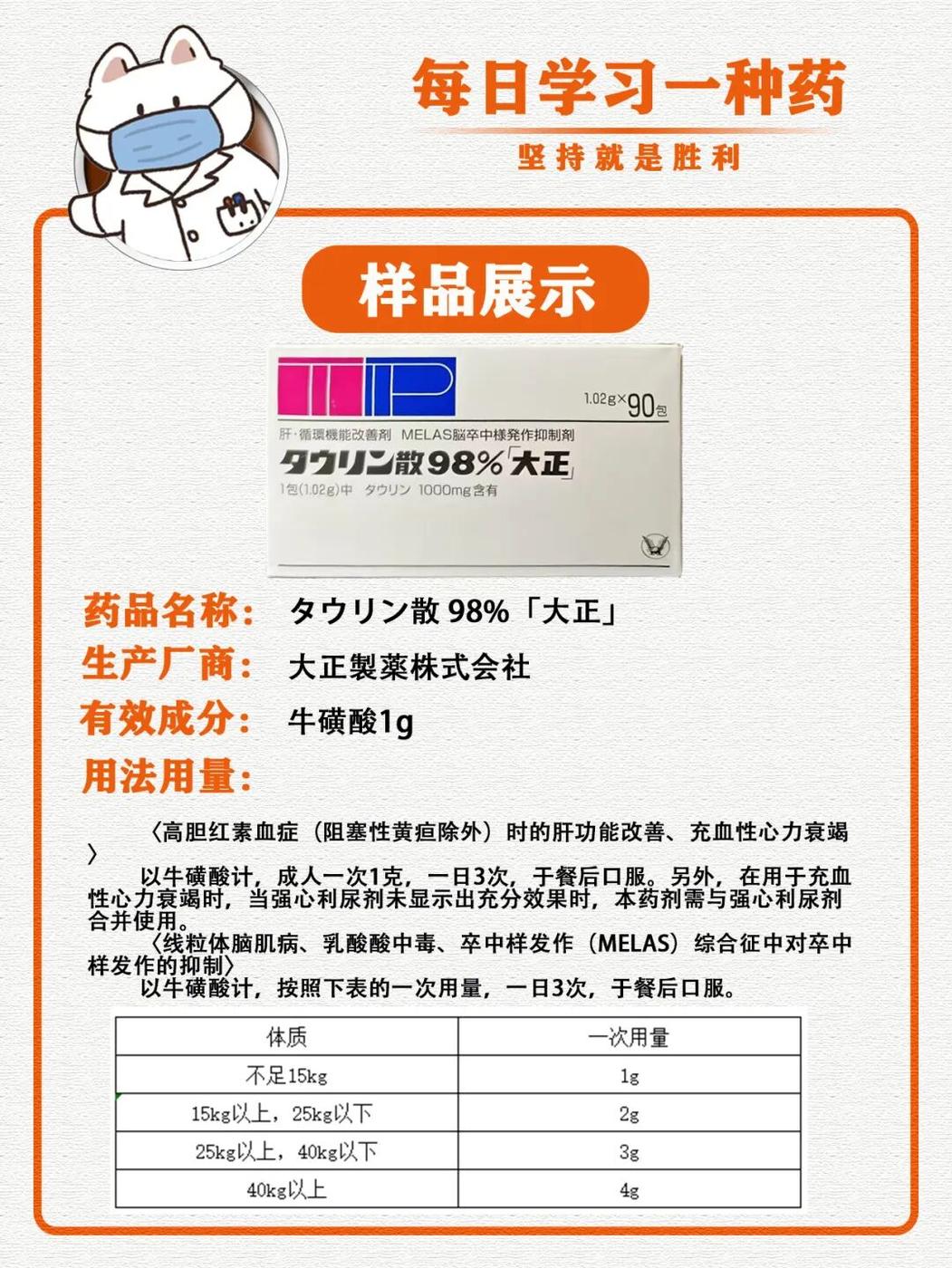
1.02g×90g Liver·Xuncan Energy Improvers: MELAS is a stroke simulation inhibitor 2. Scattered 98% Taisho 1000mg per 1.02g pack Drug Name: Yu no Shosan 98% 'Taisho' Manufacturer: Taisho Seisai Co., Ltd Active ingredient: 1g taurine Dosage and administration: "Improvement in liver function and congestive heart failure in hyperbilirubinemia (excluding obstructive jaundice). Calculated as taurine, adults take 1 gram per dose, three times a day, after meals. Additionally, it is used for congestion In cases of heart failure, if cardiac diuretics have not shown sufficient effect, this drug should be combined with cardiac diuretics Combined use. "Mitochondrial encephalomyopathy, lactic acidosis, and stroke-like seizure (MELAS) syndrome for stroke." Suppression of Flare-Up Episodes Calculated as taurine, take orally three times a day after meals according to the single dose in the table below. Single dose Less than 15kg Above 15kg, under 25kg Over 25kg, under 40kg Over 40kg
1.02g×90g 肝·循璨摄能改善剂 MELAS脑卒中模究作抑制剂 2散98%大正 包(1.02g)中1000mg含有 药品名称:夕之少散98%「大正」 生产厂商: 大正製菜株式会社 有效成分:牛磺酸1g 用法用量: 《高胆红素血症(阻塞性黄疽除外)时的肝功能改善、充血性心力衰竭 以牛磺酸计,成人一次1克,一日3次,于餐后口服。另外,在用于充血 性心力衰竭时,当强心利尿剂未显示出充分效果时,本药剂需与强心利尿剂 合并使用。 《线粒体脑肌病、乳酸酸中毒、卒中样发作(MELAS)综合征中对卒中 样发作的抑制》 以牛磺酸计,按照下表的一次用量,一日3次,于餐后口服。 一次用量 不足15kg 15kg以上,25kg以下 25kg以上,40kg以下 40kg以上
1.02g×90g Liver·Xuncan Energy Improvers: MELAS is a stroke simulation inhibitor 2. Scattered 98% Taisho 1000mg per 1.02g pack Drug Name: Yu no Shosan 98% 'Taisho' Manufacturer: Taisho Seisai…
Text in this image machine-read · may contain errors
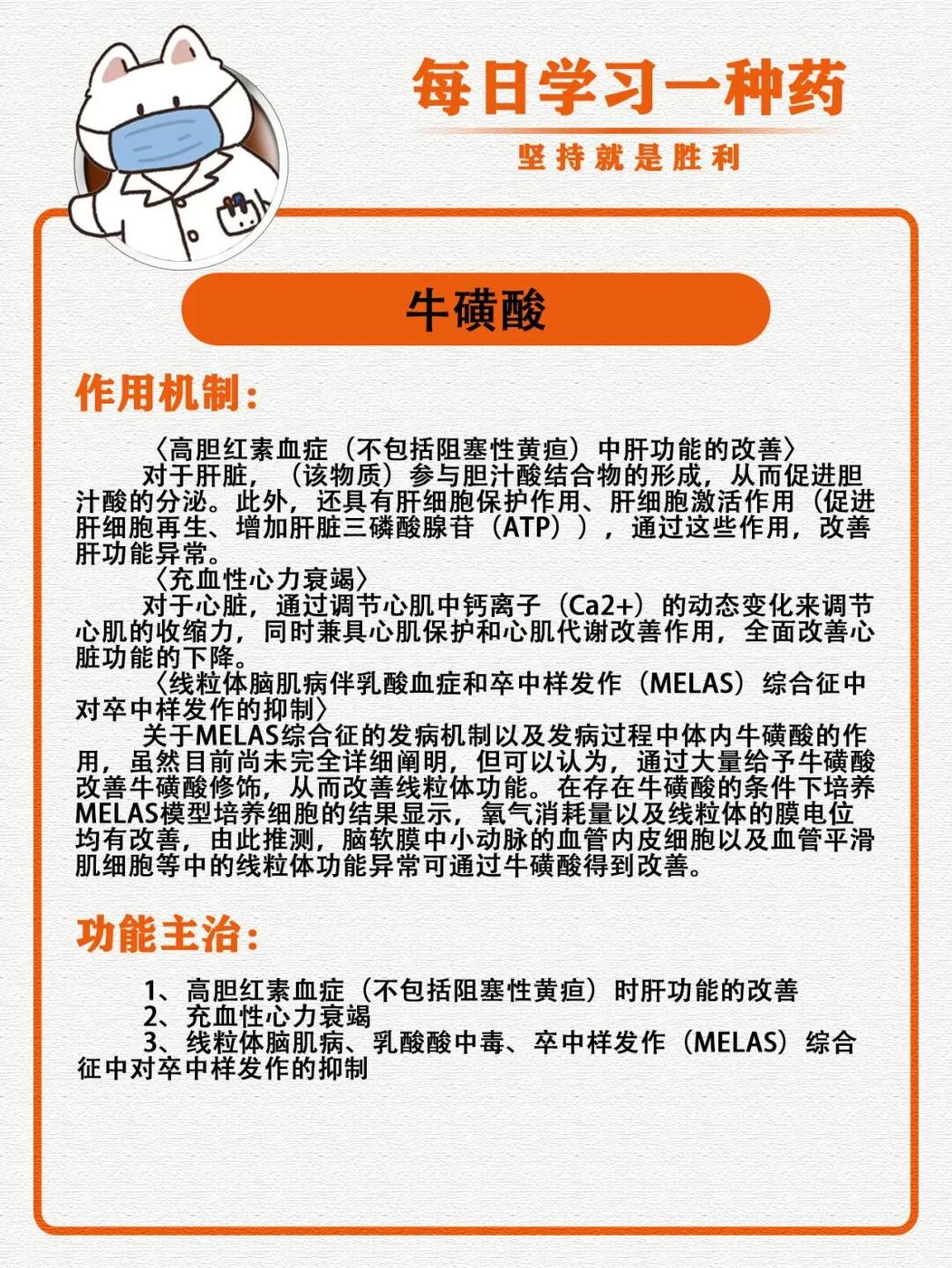
Mechanism of action: "Improvement of Liver Function in Hyperbilirubinemia (excluding obstructive jaundice)" For the liver, this substance participates in the formation of bile acid complexes, thereby promoting the gallbladder Juice and acid secretion. In addition, it also has hepatocyte protective effects and hepatocyte activation effects (promoting). Liver cell regeneration and increased adenosine triphosphate (ATP) in the liver, through these effects, improve Abnormal liver function. Congestive Heart Failure For the heart, regulation is achieved by modulating the dynamic changes of calcium ions (Ca2+) in the myocardium myocardial contractility, while also providing myocardial protection and improving myocardial metabolism, comprehensively improving the heart Decline in viscera function. "Mitochondrial Encephalomyopathy with Lactatemia and Stroke-Like Seizure (MELAS) Syndrome." Suppression of Stroke-like Attacks On the pathogenesis of MELAS syndrome and the role of taurine in the body during its onset Although not yet fully detailed, it can be assumed that a large amount of taurine is given Improves taurine modification, thereby enhancing mitochondrial function. Culture in the presence of taurine Results from cultured cells using the MELAS model show oxygen consumption and membrane potential in mitochondria All have improved, suggesting that the endothelial cells and vascular smoothness of the small arteries in the pia mater are inferred Mitochondrial dysfunction in muscle cells and similar cells can be improved with taurine. Functions and indications: 1. Improvement of liver function in hyperbilirubinemia (excluding obstructive jaundice). 2. Congestive heart failure 3. Mitochondrial encephalomyopathy, lactic acidosis, and stroke-like seizure (MELAS) combined Suppression of stroke-like seizures Taurine
作用机制: 《高胆红素血症(不包括阻塞性黄)中肝功能的改善) 对于肝脏,(该物质)参与胆汁酸结合物的形成,从而促进胆 汁酸的分泌。此外,还具有肝细胞保护作用、肝细胞激活作用(促进 肝细胞再生、增加肝脏三磷酸腺苷(ATP)),通过这些作用,改善 肝功能异常。 《充血性心力衰竭》 对于心脏,通过调节心肌中钙离子(Ca2+)的动态变化来调节 心肌的收缩力,同时兼具心肌保护和心肌代谢改善作用,全面改善心 脏功能的下降。 《线粒体脑肌病伴乳酸血症和卒中样发作(MELAS)综合征中 对卒中样发作的抑制》 关于MELAS综合征的发病机制以及发病过程中体内牛磺酸的作 用,虽然目前尚未完全详细阐明,但可以认为,通过大量给予牛磺酸 改善牛磺酸修饰,从而改善线粒体功能。在存在牛磺酸的条件下培养 MELAS模型培养细胞的结果显示,氧气消耗量以及线粒体的膜电位 均有改善,由此推测,脑软膜中小动脉的血管内皮细胞以及血管平滑 肌细胞等中的线粒体功能异常可通过牛磺酸得到改善。 功能主治: 1、高胆红素血症(不包括阻塞性黄疽)时肝功能的改善 2、充血性心力衰竭 3、线粒体脑肌病、乳酸酸中毒、卒中样发作(MELAS)综合 征中对卒中样发作的抑制 牛磺酸
Mechanism of action: "Improvement of Liver Function in Hyperbilirubinemia (excluding obstructive jaundice)" For the liver, this substance participates in the formation of bile acid complexes…
Text in this image machine-read · may contain errors
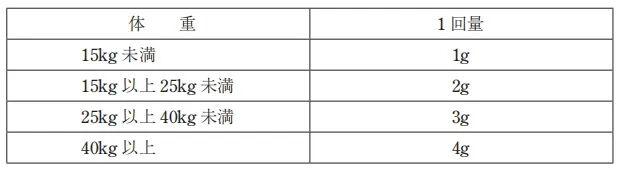
Under 15kg 15kg or more but less than 25kg 25kg or more but less than 40kg Over 40kg 1 serving
15kg未满 15kg以上25kg未满 25kg以上40kg未满 40kg以上 1回量
Under 15kg 15kg or more but less than 25kg 25kg or more but less than 40kg Over 40kg 1 serving…
Text in this image machine-read · may contain errors
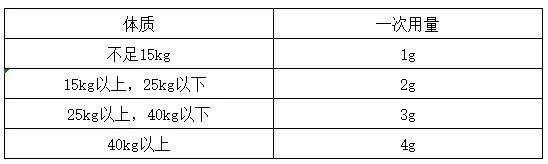
Less than 15kg Above 15kg, under 25kg Over 25kg, under 40kg Over 40kg Single dose
不足15kg 15kg以上,25kg以下 25kg以上,40kg以下 40kg以上 一次用量
Less than 15kg Above 15kg, under 25kg Over 25kg, under 40kg Over 40kg Single dose…