Esomeprazole
日本語原題:エソメプラゾールカプセル20mg「杏林」
Source images
2 imagesThe artwork keeps its original Japanese/Chinese lettering. Open “Text in this image” under a picture to read what it says in your language (machine-read, may contain errors).
Text in this image machine-read · may contain errors
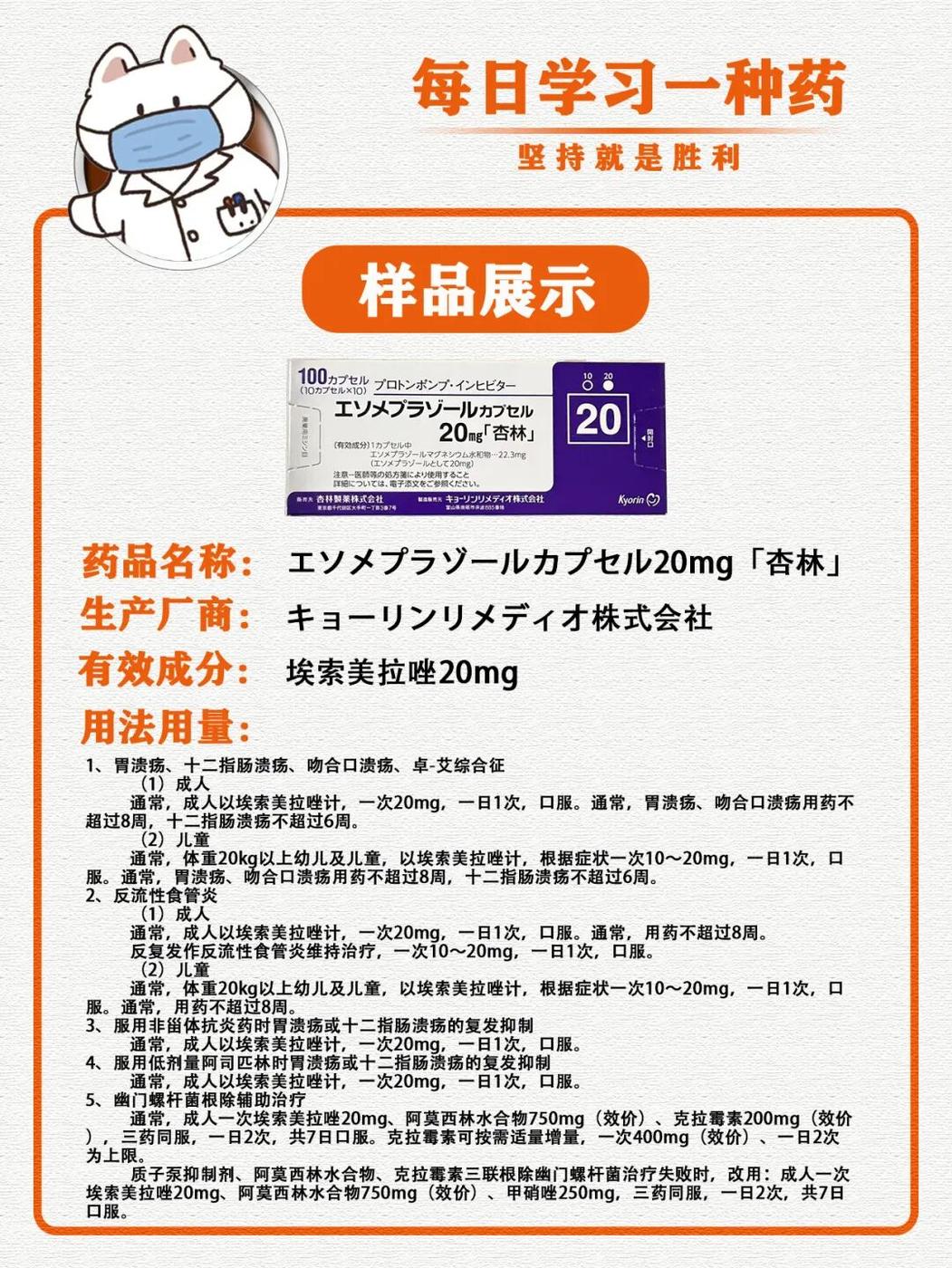
Crafted Somefrasol capsules New shipments are being pulled out The first hollow should be placed in the first position of the first class Kyorin Drug Name: Kosomeprazole Capsules 20mg "Kyorin" Manufacturer: Nichiissai Co., Ltd Active ingredients: Esomeprazole 20mg Dosage and administration: 1. Gastric ulcer, duodenal ulcer, anastomotic ulcer, Zhuo-Ai syndrome Typically, adults take esomeprazole as 20mg once daily, orally. Usually, medication is not used for gastric ulcers and anastomotic ulcers For more than 8 weeks, duodenal ulcers should not exceed 6 weeks. Typically, for infants and children weighing over 20kg, esomeprazole is used, with 10~20mg per dose once daily depending on symptoms, orally Submission. Typically, medication should not exceed 8 weeks for gastric ulcers and anastomotic ulcers, and no more than 6 weeks for duodenal ulcers. 2. Reflux esophagitis Typically, adults take esomeprazole as 20mg once daily, orally. Usually, medication should not exceed 8 weeks. Maintenance treatment for recurrent reflux esophagitis, 10~20mg per dose, once daily, oral. (2) Children Typically, for infants and children weighing over 20kg, esomeprazole is used, with 10~20mg per dose once daily depending on symptoms, orally Submission. Usually, medication should not exceed 8 weeks. 3. Suppression of gastric or duodenal ulcer recurrence when taking non-contraceptive anti-inflammatory drugs Typically, adults take esomeprazole as 20mg once daily, orally. 4. Suppression of gastric or duodenal ulcer recurrence when taking low-dose aspirin 5. Assisted treatment for Helicobacter pylori eradication Typically, adults receive a single dose of esomeprazole 20 mg, amoxicillin hydrate 750 mg (potency), and clarithromycin 200 mg (potency). ), take all three medicines together, twice daily, for a total of 7 days. Clarithromycin can be increased as needed, at 400mg (potency) twice daily This is the upper limit. If the triple treatment of proton pump inhibitors, amoxicillin hydrate, and clarithromycin to eradicate Helicobacter pylori fails, switch to: once for adults Esomeprazole 20mg, amoxicillin hydrate 750mg (potency), metronidazole 250mg, all three drugs taken together, twice daily for a total of 7 days Oral.
工ソメフラソールカプセル 新ま分いおプル中 窪第一を第等のい方第にまリ慢用ーること Kyorin 药品名称: 工ソメプラゾールカプセル 20mg 「杏林」 生产厂商:日一才株式会社 有效成分: 埃索美拉唑20mg 用法用量: 1、胃溃疡、十二指肠溃疡、吻合口溃疡、卓-艾综合征 通常,成人以埃索美拉唑计,一次20mg,一日1次,口服。通常,胃溃疡、吻合口溃疡用药不 超过8周,十二指肠溃疡不超过6周。 通常,体重20kg以上幼儿及儿童,以埃索美拉唑计,根据症状一次10~20mg,一日1次,口 服。通常,胃溃疡、吻合口溃疡用药不超过8周,十二指肠溃疡不超过6周。 2、反流性食管炎 通常,成人以埃索美拉唑计,一次20mg,一日1次,口服。通常,用药不超过8周。 反复发作反流性食管炎维持治疗,一次10~20mg,一日1次,口服。 (2)儿童 通常,体重20kg以上幼儿及儿童,以埃索美拉唑计,根据症状一次10~20mg,一日1次,口 服。通常,用药不超过8周。 3、服用非备体抗炎药时胃溃疡或十二指肠溃疡的复发抑制 通常,成人以埃索美拉唑计,一次20mg,一日1次,口服。 4、服用低剂量阿司匹林时胃溃疡或十二指肠溃疡的复发抑制 5、幽门螺杆菌根除辅助治疗 通常,成人一次埃索美拉唑20mg、阿莫西林水合物750mg(效价)、克拉霉素200mg(效价 ),三药同服,一日2次,共7日口服。克拉霉素可按需适量增量,一次400mg(效价)、一日2次 为上限。 质子泵抑制剂、阿莫西林水合物、克拉霉素三联根除幽门螺杆菌治疗失败时,改用:成人一次 埃索美拉唑20mg、阿莫西林水合物750mg(效价)、甲硝唑250mg,三药同服,一日2次,共7日 口服。
Crafted Somefrasol capsules New shipments are being pulled out The first hollow should be placed in the first position of the first class Kyorin Drug Name: Kosomeprazole Capsules 20mg "Kyori…
Text in this image machine-read · may contain errors
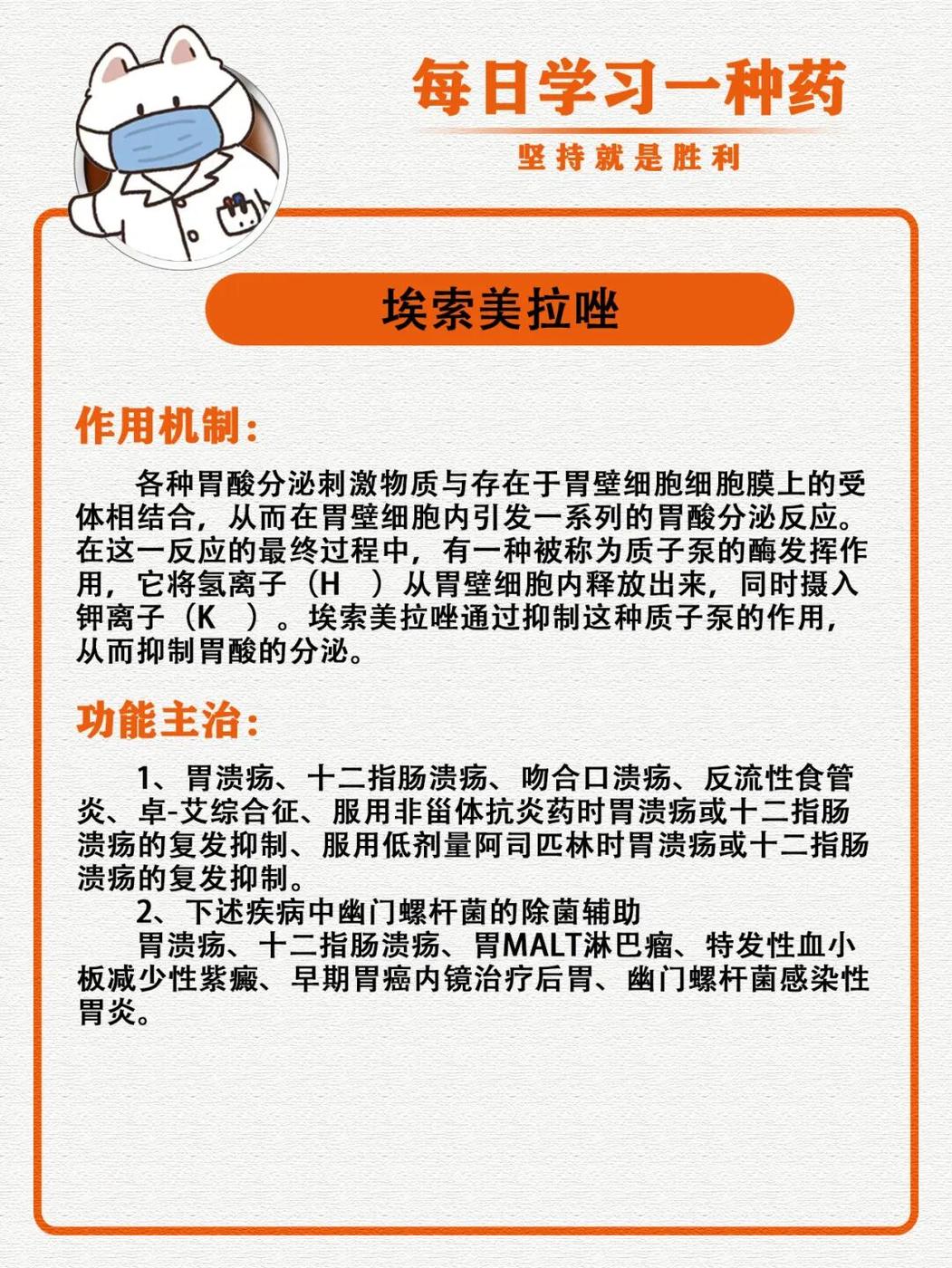
Mechanism of action: Various gastric acid secretion stimulants are associated with receptors present on the cell membranes of the gastric parietal cells This process triggers a series of gastric acid secretion reactions within the cells of the stomach wall. In the final process of this reaction, an enzyme called the proton pump is active It releases hydrogen ions (H) from inside the cells of the stomach wall and ingests them simultaneously Potassium ions (K). Esomeprazole works by inhibiting the action of this proton pump, This inhibits the secretion of stomach acid. Functions and indications: 1. Gastric ulcer, duodenal ulcer, anastomotic ulcer, reflux esophageal reflux Inflammation, Zoe-Ai syndrome, gastric ulcers or duodenal ulcers when taking non-retaining anti-inflammatory drugs Suppression of ulcer recurrence is inhibited when taking low-dose aspirin for gastric ulcers or dry bidenum Suppression of ulcer recurrence. 2. Assisting in eradicating Helicobacter pylori in the following diseases Gastric ulcer, duodenal ulcer, gastric MALT lymphoma, idiopathic hypoemia Plate-reducing purpura, early gastric cancer after endoscopic treatment of the stomach, and Helicobacter pylori infection Gastritis. Esomeprazole
作用机制: 各种胃酸分泌刺激物质与存在于胃壁细胞细胞膜上的受 体相结合,从而在胃壁细胞内引发一系列的胃酸分泌反应。 在这一反应的最终过程中,有一种被称为质子泵的酶发挥作 用,它将氢离子(H)从胃壁细胞内释放出来,同时摄入 钾离子(K)。埃索美拉唑通过抑制这种质子泵的作用, 从而抑制胃酸的分泌。 功能主治: 1、胃溃疡、十二指肠溃疡、吻合口溃疡、反流性食管 炎、卓-艾综合征、服用非留体抗炎药时胃溃疡或十二指肠 溃疡的复发抑制、服用低剂量阿司匹林时胃溃疡或干二指肠 溃疡的复发抑制。 2、下述疾病中幽门螺杆菌的除菌辅助 胃溃疡、十二指肠溃疡、胃MALT淋巴瘤、特发性血小 板减少性紫癜、早期胃癌内镜治疗后胃、幽门螺杆菌感染性 胃炎。 埃索美拉唑
Mechanism of action: Various gastric acid secretion stimulants are associated with receptors present on the cell membranes of the gastric parietal cells This process triggers a series of gas…