Exemestane
日本語原題:アロマシン錠25mg
Each tablet contains 25,000 mg of Exemestan.
Source images
2 imagesThe artwork keeps its original Japanese/Chinese lettering. Open “Text in this image” under a picture to read what it says in your language (machine-read, may contain errors).
Text in this image machine-read · may contain errors
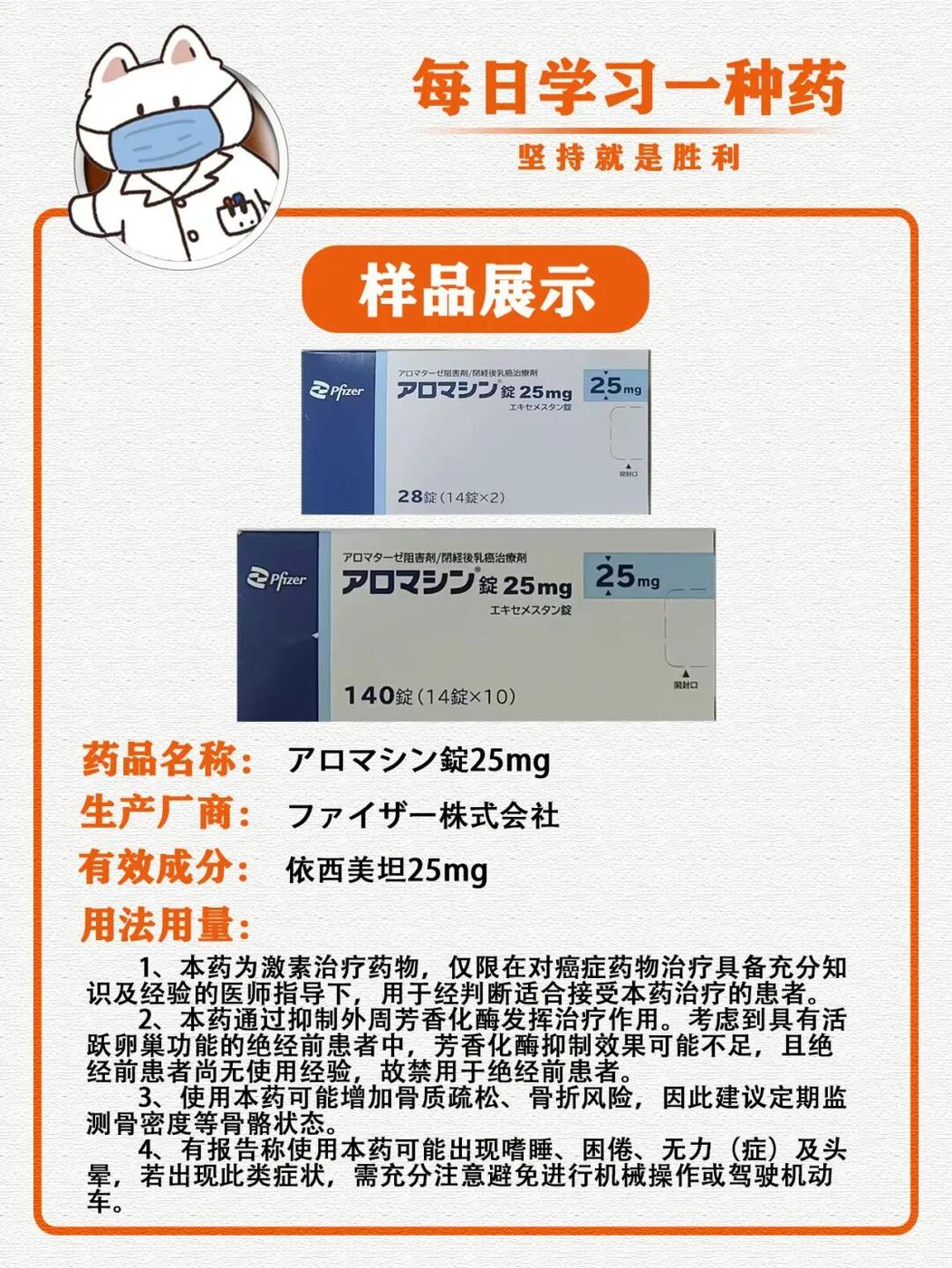
25mg Aromasin tablets 25mg エキメスタン 0 28 ingots (14 ingots ×2) Aromatase group injury postmenopausal breast treatment drug Exemestan nip 140 ingots (14 ingots ×10) Drug name: Diaokou 7 tablets 25mg Manufacturer: 7 Sunichi Co., Ltd Active ingredient: Exemettane 25mg Dosage and administration: 1. This drug is a hormone therapy drug, limited to sufficient knowledge of cancer drug treatment Used under the guidance of experienced physicians who are deemed suitable for this drug treatment. 2. This drug exerts therapeutic effects by inhibiting peripheral aromatase. Consider having a living experience In premenopausal patients with ovarian function, the inhibitory effect of aromatase may be insufficient and may be completely absent Premenstrual patients have no prior experience using it, so it is contraindicated for premenopausal patients. 3. Use of this drug may increase the risk of osteoporosis and fractures; therefore, regular monitoring is recommended Measuring bone density and other bone conditions. 4. There have been reports that using this medicine may cause drowsiness, drowsiness, weakness, and headaches If such symptoms occur, be sure to avoid mechanical operations or maneuvers
25mg アロマシン錠 25mg エキメスタン 0 28锭(14锭×2) アロマターゼ組害聊閉経後乳優治療剤 エキセメスタン齪 140锭(14锭×10) 药品名称:刁口7锭25mg 生产厂商:7个寸一株式会社 有效成分:依西美坦25mg 用法用量: 1、本药为激素治疗药物,仅限在对癌症药物治疗具备充分知 识及经验的医师指导下,用于经判断适合接受本药治疗的患者。 2、本药通过抑制外周芳香化酶发挥治疗作用。考虑到具有活 跃卵巢功能的绝经前患者中,芳香化酶抑制效果可能不足,且绝 经前患者尚无使用经验,故禁用于绝经前患者。 3、使用本药可能增加骨质疏松、骨折风险,因此建议定期监 测骨密度等骨骼状态。 4、有报告称使用本药可能出现嗜睡、困倦、无力(症)及头 若出现此类症状,需充分注意避免进行机械操作或驾驶机动
25mg Aromasin tablets 25mg エキメスタン 0 28 ingots (14 ingots ×2) Aromatase group injury postmenopausal breast treatment drug Exemestan nip 140 ingots (14 ingots ×10) Drug name: Diaokou 7 tablets…
Text in this image machine-read · may contain errors
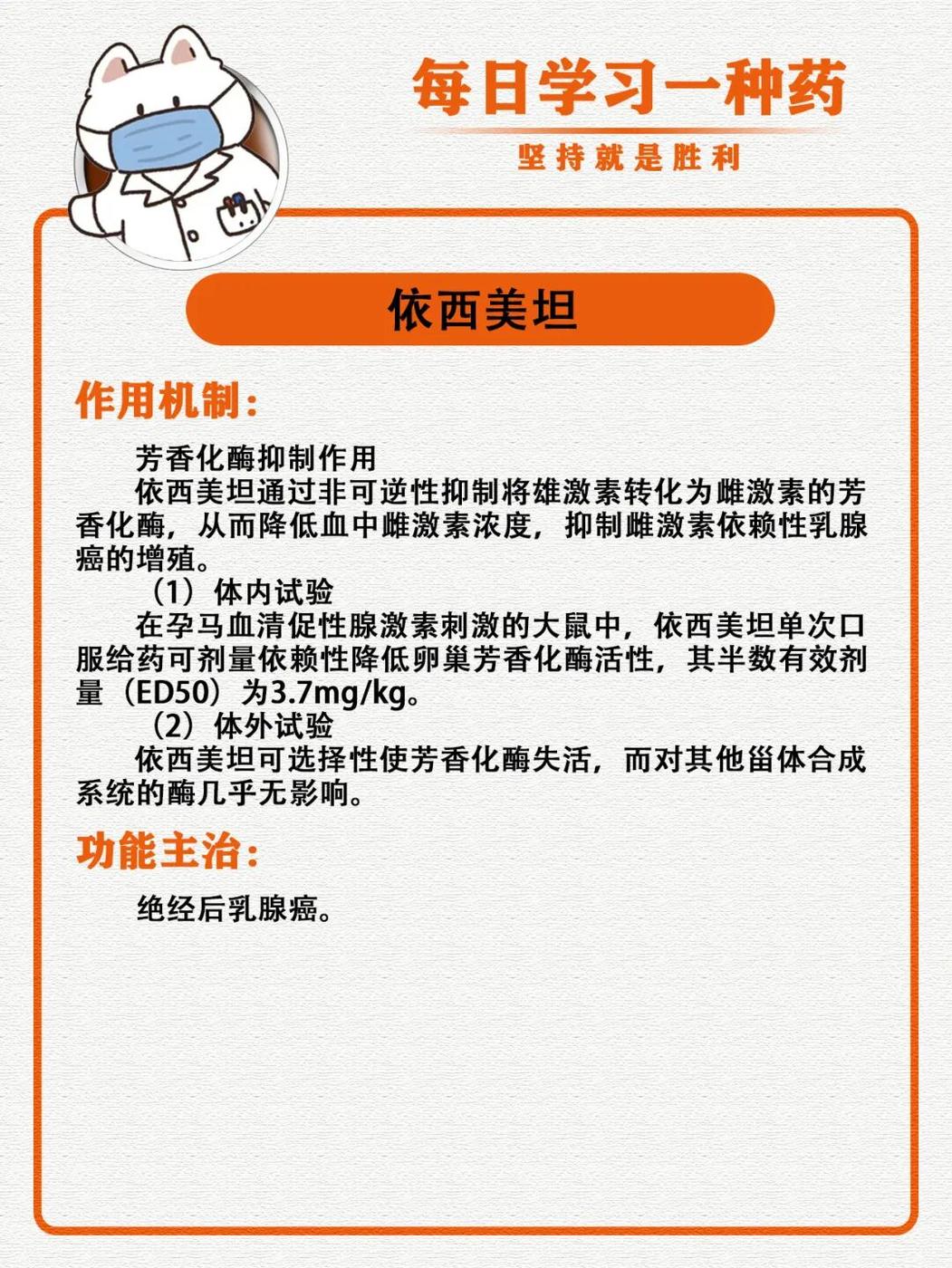
Mechanism of action: Aromatase inhibitory effect Ishimettane irreversibly inhibits aromas that convert androgens into estrogen aromatase, thereby lowering estrogen concentration in the blood and inhibiting estrogen-dependent mammary glands Cancer proliferation. (1) In vivo tests In gonadotropin-stimulated mice in pregnant horses, a single oral dose of exemestan was used Administration can dose-dependently reduce ovarian aromatase activity, with half of the effective agents being effective Dose (ED50) is 3.7 mg/kg. (2) In vitro tests Exemettane selectively inactivates aromatase and synthesizes it on other retaining molecules Enzymes in the system have almost no effect. Functions and indications: Postmenopausal breast cancer. Exemestane
作用机制: 芳香化酶抑制作用 依西美坦通过非可逆性抑制将雄激素转化为雌激素的芳 香化酶,从而降低血中雌激素浓度,抑制雌激素依赖性乳腺 癌的增殖。 (1)体内试验 在孕马血清促性腺激素刺激的大鼠中,依西美坦单次口 服给药可剂量依赖性降低卵巢芳香化酶活性,其半数有效剂 量(ED50)为3.7mg/kg。 (2)体外试验 依西美坦可选择性使芳香化酶失活,而对其他留体合成 系统的酶几乎无影响。 功能主治: 绝经后乳腺癌。 依西美坦
Mechanism of action: Aromatase inhibitory effect Ishimettane irreversibly inhibits aromas that convert androgens into estrogen aromatase, thereby lowering estrogen concentration in the blood…