Galcanezumab
日本語原題:エムガルティ皮下注120mgシリンジ
1 mL per syringe contains 120 mg of galcanezumab (genetically modified).
Source images
1 imagesThe artwork keeps its original Japanese/Chinese lettering. Open “Text in this image” under a picture to read what it says in your language (machine-read, may contain errors).
Text in this image machine-read · may contain errors
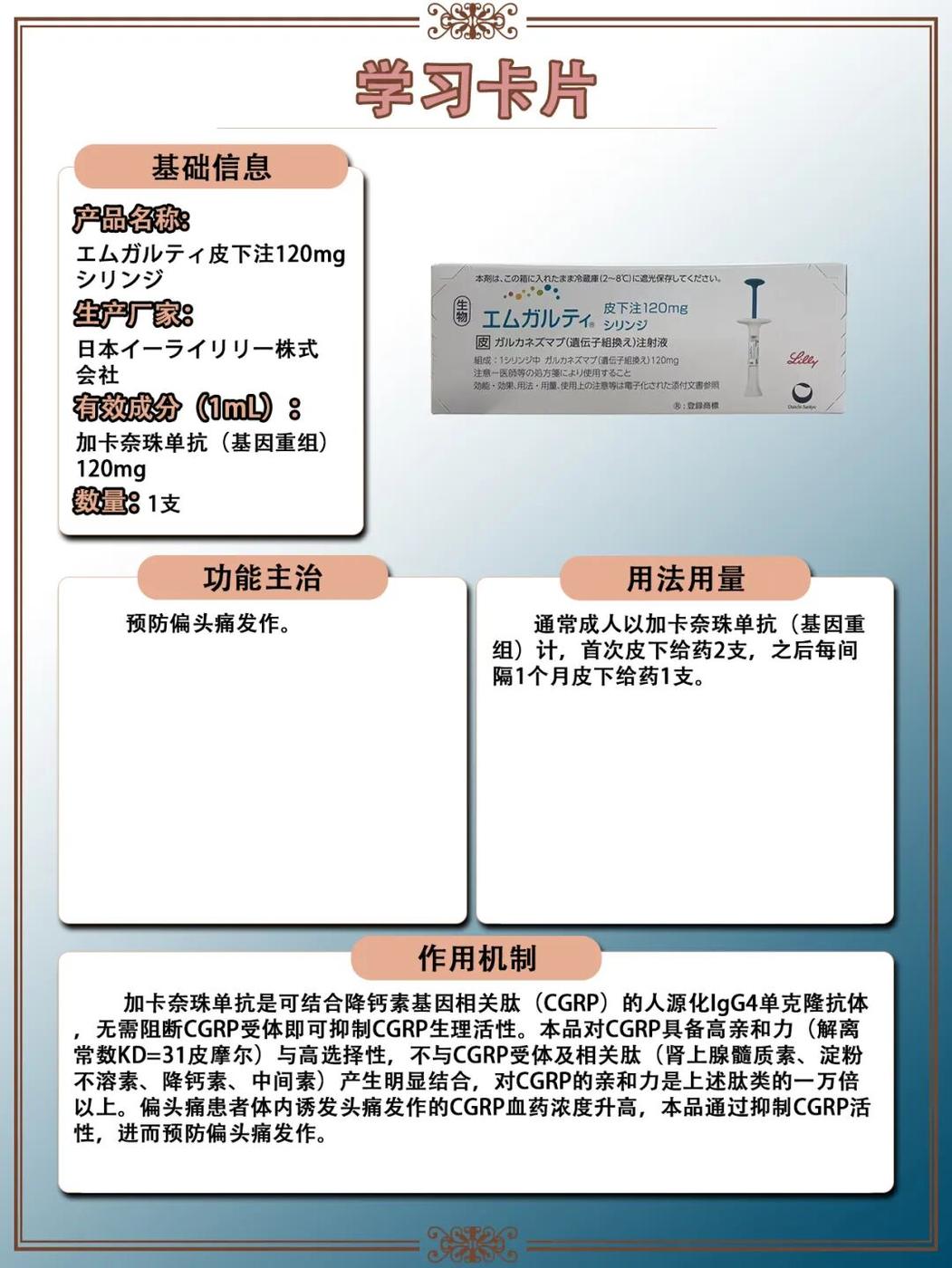
Basic information Product Name: Emgarti subcutaneous injection 120mg シリンジ Manufacturer: Subcutaneous injection of 120mg Pi is Erlige Dayou (Yizi Xiang Huanyuan) injection Japan Eli Lilly shares At the station, I went to the Garnezumapu School Caution: For use in a medical or other manner Active ingredient (1mL): Gacanezumab (recombinant) 120mg Quantity: 1 piece Functions and indications Usage and dosage Prevent migraine attacks. Typically, adults are given canezumab (gene weight). For the first dose, 2 vials are administered subcutaneously, followed by each session thereafter One vial is administered subcutaneously every 1 month. Mechanism of action Gacanezumab is a humanized IgG4 monoclonal antibody that can bind to calcitonin gene-associated peptide (CGRP). Inhibiting CGRP physiological activity without blocking the CGRP receptor. This product has a high affinity for CGRP (dissociation constant KD=31 picomoles) and high selectivity, not related to CGRP receptors or related peptides (adrenal medullin, starch). Insoluble, calcitonin, intermediates) form a significant binding, and its affinity for CGRP is ten thousand times greater than that of the aforementioned peptides That's all. Migraine patients have elevated blood concentrations of CGRP that triggers headache attacks, and this product works by inhibiting CGRP activity and thereby prevent migraine attacks.
基础信息 产品名称: エムガルティ皮下注 120mg シリンジ 生产厂家: 皮下注120mg 皮为儿力个大又(遗子相换元)注射液 日本イーライリリー株式 駅成鸞シリン第ガルネズマプ子第授に On 注意一医的等の美方等使用寸 有效成分(1mL): 加卡奈珠单抗(基因重组) 120mg 数量:1支 功能主治 用法用量 预防偏头痛发作。 通常成人以加卡奈珠单抗(基因重 组)计,首次皮下给药2支,之后每间 隔1个月皮下给药1支。 作用机制 加卡奈珠单抗是可结合降钙素基因相关肽(CGRP)的人源化IgG4单克隆抗体 无需阻断CGRP受体即可抑制CGRP生理活性。本品对CGRP具备高亲和力(解离 常数KD=31皮摩尔)与高选择性,不与CGRP受体及相关肽(肾上腺髓质素、淀粉 不溶素、降钙素、中间素)产生明显结合,对CGRP的亲和力是上述肽类的一万倍 以上。偏头痛患者体内诱发头痛发作的CGRP血药浓度升高,本品通过抑制CGRP活 性,进而预防偏头痛发作。
Basic information Product Name: Emgarti subcutaneous injection 120mg シリンジ Manufacturer: Subcutaneous injection of 120mg Pi is Erlige Dayou (Yizi Xiang Huanyuan) injection Japan Eli Lilly sha…