Cardiovascular · CARDIOVASCULAR

Cyclophosphamide

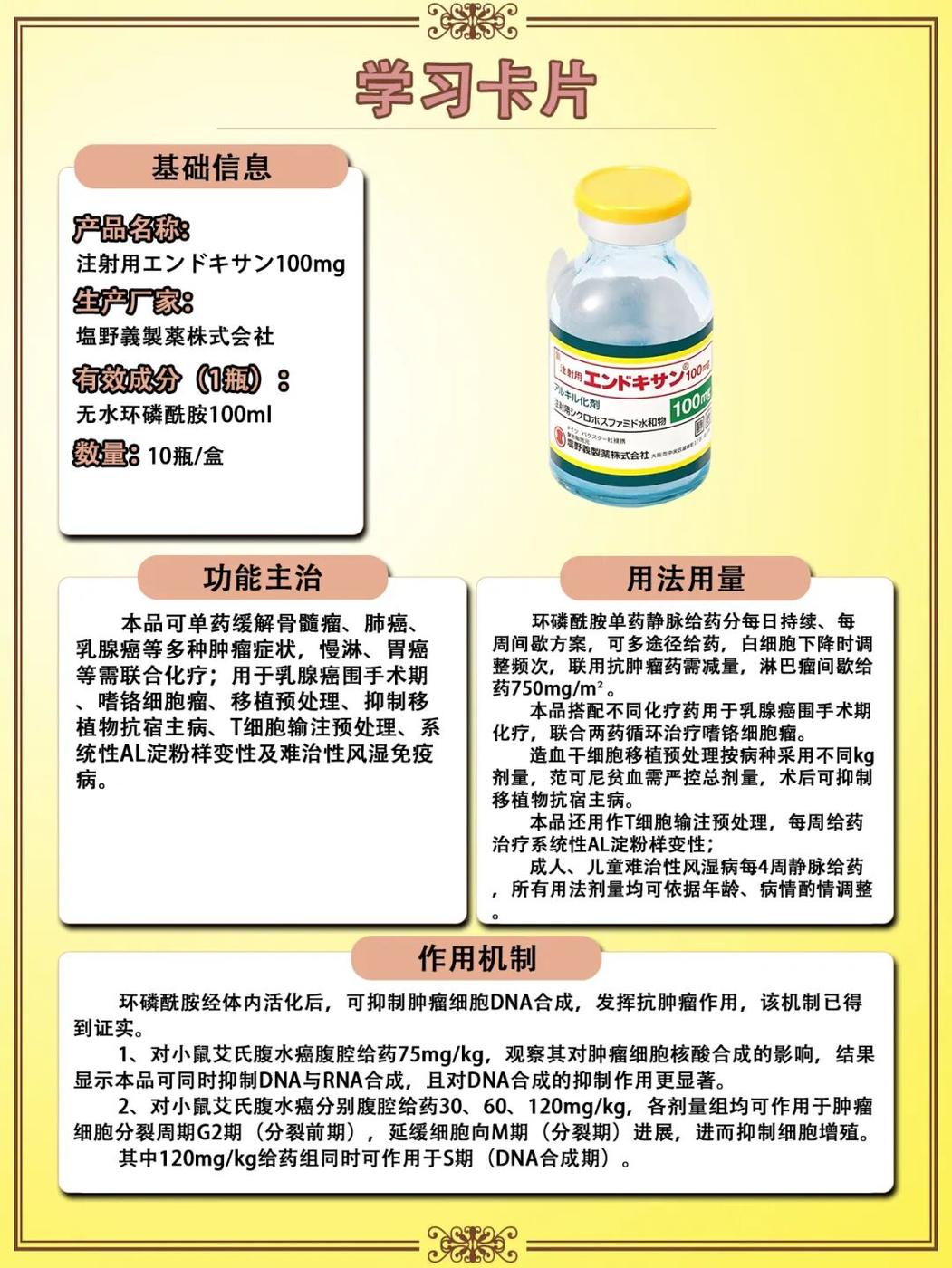
日本語原題:注射用エンドキサン100mg

Published2026-07-10 14:57 FormPowder Content10 sections / 1 images
Ingredients / strength:
One bottle contains 106.9mg of cyclophosphamide hydrate (equivalent to 100mg as an anhydrous substance).
English translation of the Japanese package insert is the main text; the Japanese original is shown alongside for verification. Use the language menu (top right) to read the page in another language. This site is for reference only — consult a doctor or pharmacist before use.
Section 1 · 01
English translation
Feature Description After activating in vivo, cyclophosphamide has been shown to inhibit DNA synthesis in tumor cells, exhibiting antitumor effects. 1. In mouse Ehrlich carcinoma (ascites type), intraperitoneal administration of 75 mg/kg was observed on nucleic acid synthesis in tumor cells, and both DNA and RNA synthesis were suppressed, but DNA synthesis was more markedly suppressed. 2. When 30, 60, and 120 mg/kg intraperitoneally were administered intraperitoneally to mouse Ehrlich carcinoma (ascitic type), all doses acted on the G2 phase (pre-mitotic phase) of the tumor cell division cycle, delaying the transition to the M phase (mitotic phase), thereby suppressing cell proliferation. In the 120 mg/kg group, it also acted during the S phase (DNA synthesis phase).
Section 2 · 02
English translation
10 bottles [100mg×10].
Section 3 · 03
English translation
Characteristics It is a white crystalline or crystalline powder. It dissolves somewhat easily in water. (Injection)
Section 4 · 04
English translation
Feature Description Active ingredient: 106.9mg of cyclophosphamide hydrate per bottle (equivalent to 100mg as anhydrous).
Section 5 · 05
English translation
Indications 1. Relief of both subjective and objective symptoms of the following diseases Multiple myeloma, malignant lymphoma, lung cancer, breast cancer, acute leukemia, polycythemia vera, cervical cancer, endometrial cancer, ovarian cancer, neuroneoplasms (neuroblastoma, retinoblastoma), bone tumors. However, for the following diseases, it is necessary to use them in combination with other antineoplastic agents. Chronic lymphocytic leukemia, chronic myeloid leukemia, pharyngeal cancer, stomach cancer, pancreatic cancer, liver cancer, colon cancer, testicular tumors, villous diseases (chorionic carcinoma, destructive follicular form, erythromyosis), rhabdomyosarcoma, malignant melanoma. 2. Combination therapy with other antineoplastic agents for the following malignant tumors Breast cancer (preoperative or postoperative chemotherapy in operable cases). 3. Pheochromocytoma 4. Pre-treatment for hematopoietic stem cell transplantation in the following diseases Acute leukemia, chronic myeloid leukemia, myelodysplastic syndrome, severe aplastic anemia, malignant lymphoma, hereditary diseases (immunodeficiency, congenital metabolic disorders, and congenital blood disorders: Fanconi anemia, Wiskott-Aldrich syndrome, Hunter's disease, etc.). 5. Suppression of graft-versus-host disease in hematopoietic stem cell transplantation 6. Pretreatment for tumor-specific T-cell infusion therapy 7. Systemic AL amyloidosis 8. The following rheumatic diseases resistant to treatment Systemic lupus erythematosus, systemic vasculitis (microscopic polyangiitis, polyangiitis granulomatosis, nodosal polyarteritis, eosinophilic polyangiitis granulomatosis, Takayasu arteritis, etc.), polymyositis/dermatomyositis, scleroderma, mixed connective tissue disease, and refractory rheumatic diseases with vasculitis.
Section 6 · 06
English translation
Dosage and Administration 1. Relief of both subjective and objective symptoms. (1) When used alone Typically, adults receive 100 mg intravenously once daily as cyclophosphamide (anhydrous equivalent), and if the patient tolerates it, the daily dose is increased to 200 mg. Administer a total dose of 3000~8000 mg, but if efficacy is recognized, it should be maintained for as long as possible. If the white blood cell count decreases, administration is administered every 2~3 days; if it drops to less than half of normal, the medication is temporarily suspended and resumed after recovery. Intermittently, adults typically inject 300~500mg intravenously 1~2 times a week. If necessary, it can be injected or injected into the muscle, pleural, abdominal cavity, or tumor. Additionally, 200~1000 mg per day may be rapidly or continuously injected by intravenous drip into the main artery perfused through the lesion, or 1000~2000 mg per dose can be administered locally via extracorporeal circulation. Adjust appropriately according to age and symptoms. (2) When used in combination with other antineoplastic agents Reduce the dose as needed when used alone. When used for malignant lymphoma, adults are typically given cyclophosphamide (anhydrous equivalent) intermittently intravenously once daily at 750 mg/m2 (body surface area). Adjust appropriately according to age and symptoms. 2. Combination therapy with other antineoplastic agents for breast cancer (preoperative or postoperative chemotherapy in operable cases)〉 (1) When used in combination with doxorubicin hydrochloride, the standard dosage and administration method of cyclophosphamide (anhydrous equivalent) is intravenous administration of 600 mg/m2 (body surface area) once daily as cyclophosphamide, followed by a cessation for 13 or 20 days. This is called one cour, and the process repeats four times. Dose reduction is appropriate according to age and symptoms. (2) When used in combination with epirubicin hydrochloride, the standard dosage and administration method of cyclophosphamide (anhydrous equivalent) is 600 mg/m2 (body surface area) once daily intravenously, followed by a 20-day discontinuation. This is considered one cour, and the cycle repeats for 4~6 cours. Dose reduction is appropriate according to age and symptoms. (3) When used in combination with epirubicin hydrochloride and fluorouracil, the standard dosage and administration method of cyclophosphamide (anhydrous equivalent) is intravenous administration of 500 mg/m2 (body surface area) once daily followed by a 20-day break. This is called one cour, and the cycle repeats for 4~6 cours. Dose reduction is appropriate according to age and symptoms. 3. Pheochromocytoma When used in combination with vincristine sulfate and dacarbazine, adults are typically given intravenous cyclophosphamide (anhydrous equivalent) at 750 mg/m2 (body surface area) once daily, followed by a cessation for at least 20 days. This is considered one cycle, and the administration is repeated. Dose reduction is adjusted as needed depending on the patient's condition. 4. Pretreatment for hematopoietic stem cell transplantation (1) In cases of acute leukemia, chronic myeloid leukemia, and myelodysplastic syndrome Typically, adults receive cyclophosphamide (anhydrous equivalent) as 60 mg/kg once daily by intravenous infusion over 2~3 hours, administered continuously for two days. (2) In cases of severe aplastic anemia Typically, adults receive cyclophosphamide (anhydrous equivalent) as 50 mg/kg once daily by intravenous infusion over 2~3 hours, for four consecutive days. (3) In the case of malignant lymphoma Typically, adults receive cyclophosphamide (anhydrous equivalent) as 50 mg/kg once daily by intravenous infusion over 2~3 hours, for four consecutive days. Reduce the dose appropriately according to the patient's condition and the medications being used. (4) In cases of hereditary diseases (immunodeficiency, congenital metabolic disorders, and congenital blood disorders: Wiskott-Aldrich syndrome, Hunter's disease, etc.) Typically, as cyclophosphamide (anhydrous equivalent), 50 mg/kg is administered once daily by intravenous infusion over 2~3 hours, then administered daily for 4 days or once daily at 60 mg/kg over 2~3 hours for 2 consecutive days, with dose reduction as needed depending on disease and patient condition. When administered to Fanconi anemia, there are reports that graft-related toxicity increases due to cell fragility, so the total dose should not exceed 40 mg/kg (5~10 mg/kg for 4 days). 5. "Suppression of graft-versus-host disease in hematopoietic stem cell transplantation" Typically, as cyclophosphamide (anhydrous equivalent), 50 mg/kg is administered once daily by intravenous drip over 2~3 hours, and is administered for two days after transplantation: days 3 and 4, or days 3 and 5 after transplantation. Dose reduction is adjusted as needed depending on the patient's condition. 6. Pre-treatment for Tumor-Specific T Cell Infusion Therapy Use based on the dosage or method of use for regenerative medicine products. 7. Systemic AL Amyloidosis In combination with other drugs, it is usually administered intravenously once weekly as cyclophosphamide (anhydrous equivalent) at 300 mg/m2 (body surface area) once a week. The upper dose limit is 500 mg per dose. 8. "Treatment-Resistant Rheumatic Diseases" (1) Typically, adults receive intravenous injection of cyclophosphamide (anhydrous equivalent) at 500~1000 mg/m2 (body surface area) once daily. In principle, the dosing interval is set at four weeks. Adjust appropriately according to age and symptoms. (2) Typically, children receive a weekly intravenous injection of cyclophosphamide (anhydrous equivalent) at 500 mg/m2 (body surface area) once daily. In principle, the dosing interval is set at four weeks. Adjust appropriately according to age and symptoms.
Section 7 · 07
English translation
Notes 1. "Common Efficacy" (1) Serious side effects such as bone marrow suppression and hemorrhagic cystitis may occur, so frequently perform clinical tests (blood tests, urine tests, liver and kidney function tests, etc.) to closely monitor the patient's condition. Increase urine output to prevent hemorrhagic cystitis. Also, prolonged use can cause severe side effects and prolonged effects, so administration should be done with caution. (2) Be fully cautious about the onset or worsening of infections or bleeding tendencies. (3) Since there have been reports of secondary malignancies (acute leukemia, myelodysplastic syndrome, malignant lymphoma, bladder tumors, renal pelvis/ureter tumors, etc.), caution is advised by monitoring the course for a long period even after discontinuation of this drug. There are reports that increasing the total dose of cyclophosphamide raises the risk of cancer. 2. "Pre-treatment for hematopoietic stem cell transplantation and graft-versus-host disease suppression in hematopoietic stem cell transplantation" (1) Since the frequency of urinary system disorders such as hemorrhagic cystitis may increase, clinical tests (such as urine tests) should be performed frequently. 3) (2) Pay attention to the manifestation of hepatic veno-occlusive disease (VOD). Early symptoms include weight gain, liver swelling, and liver tenderness, so pay attention to weight and liver swelling. (No appropriate treatment for VOD has been established.) 3. Pheochromocytoma Carefully read relevant literature (such as the "Report on Applicability to the Public Notice Application of the Review Council on Unapproved and Off-label Drugs with High Medical Need: Cyclophosphamide hydrate (pheochromocytoma including paragangliocytoma)").
Section 8 · 08
English translation
Side Effects 1. Shock, anaphylaxis (both with unknown frequency) Symptoms such as low blood pressure, difficulty breathing, wheezing, hives, and discomfort may occur. 2. Bone marrow suppression (frequency unknown) Pancytopenia, anemia, leukopenia, thrombocytopenia, and bleeding may occur; therefore, during the administration period, closely monitor peripheral blood and take appropriate measures such as extending the dosing interval, reducing the dose, or discontinuing the drug if abnormalities are observed. 3. Hemorrhagic cystitis, urinary disorders (both frequency unknown*) [*: When this drug was administered without metsuna as a pretreatment for hematopoietic stem cell transplantation, the incidence of hemorrhagic cystitis was reported to be 35% (gross hematuria). 〕 4. Ileus, gastrointestinal bleeding (less than 5% note) 5. Interstitial pneumonia, pulmonary fibrosis (both frequency unknown) 6. Myocardial injury, heart failure (less than 5% note), cardiac tamponade, pericarditis (frequency unknown) Myocardial disorders, heart failure, cardiac tamponade, pericarditis, and pericardial effusion may occur. Exercise special caution when administering this drug at high doses (such as before hematopoietic stem cell transplantation). 7. Antidiuretic hormone malfunction secretion syndrome (SIADH) (frequency unknown) Antidiuretic hormone malregulation syndrome (SIADH), which may occur with hyponatremia, hypoosmolality, increased urinary sodium excretion, hypertonia, seizures, and impaired consciousness, should be discontinued in such cases. 8. Toxic Epidermal Necrolysis (TEN), Stevens-Johnson syndrome (both frequency unknown) 9. Liver dysfunction and jaundice (both frequency unknown) 10. Acute kidney injury (frequency unknown) Severe kidney damage, such as acute kidney injury, may occur. 11. Rhabdomyolysis (frequency unknown) Rhabdomyolysis, characterized by muscle pain, weakness, increased CK, and elevated myoglobin in blood and urine, may appear. 12. Other side effects (1) Other adverse reactions due to reassessment results and voluntary reports (1) Liver: liver dysfunction, jaundice, decreased cholinesterase. (2) Kidneys: proteinuria, edema. (3) Gastrointestinal: nausea and vomiting (20.7%), dry mouth, ulcerative stomatitis, abdominal pain, constipation, diarrhea, loss of appetite, taste disturbances, heartburn, nausea, abdominal bloating. (4) Hypersensitivity: rash. (5) Skin: hair loss (24.3%), dermatitis, pigmentation, nail deformity and discoloration. (6) Psychiatric nervous system: headache, dizziness, insomnia, motor dysfunction, fatigue. (7) Respiratory: pulmonary edema, nasal irritation. (8) Cardiovascular system: ECG abnormalities, palpitations, hypotension, elevated blood pressure. (9) Endocrine system: adrenal cortex insufficiency, hyperthyroidism. (10) Gonads: amenorrhea, azoospermia, ovarian dysfunction. (11) Others: fever, heat sensation upon injection, localized pain, increased CK (Cough Fever), delayed wound healing, hyperglycemia, hyponatremia. (2) Compilation of safety evaluation cases in Phase II clinical trials prior to hematopoietic stem cell transplantation (1) Blood: serum, increased FDP, decreased AT-3, disseminated intravascular coagulation syndrome. (2) Liver: increased AST (23.9%), increased ALT (38.8%), increased bilirubin levels, increased Al-P, increased LDH. (3) Kidneys: increased creatinine and BUN. (4) Gastrointestinal: nausea and vomiting (91.0%), diarrhea (62.7%), stomatitis (62.7%), constipation, stomach pain. (5) Skin: hair loss (56.7%), itching, pigmentation. (6) Mental and nervous system: headache. (7) Circulatory system: ECG abnormalities, arrhythmias. (8) Others: fever (34.3%), infection (37.3%), decreased serum sodium, pharyngitis, sore throat, pain in the body, viral encephalitis, elevated serum potassium, decreased serum chlorochlor, decreased total serum protein, decreased serum magnesium.
Section 9 · 09
English translation
taboo 1. Patients receiving pentostatin 2. Patients with a history of severe hypersensitivity to any component of this drug 3. Patients with severe infectious diseases [especially when this drug is administered as pretreatment for hematopoietic stem cell transplantation or to suppress graft-versus-host disease in hematopoietic stem cell transplantation, the infection may worsen and become fatal.] ]
Section 10 · 10
English translation
Warning 1. "Common Efficacy" (1) Do not use this drug together with pentostatin. Cases of cardiotoxicity and death have been reported abroad due to the combination of cyclophosphamide and pentostatin. (2) Cancer chemotherapy containing this drug must be administered only in cases where this therapy is deemed appropriate at medical facilities capable of handling emergencies under the guidance of physicians with sufficient knowledge and experience in cancer chemotherapy. When selecting eligible patients, be very careful by referring to the electronic appendix of each combination drug. Also, before starting treatment, fully explain the efficacy and risks to the patient or their family, and only administer after obtaining consent. 2. "Pre-treatment for hematopoietic stem cell transplantation and graft-versus-host disease suppression in hematopoietic stem cell transplantation" (1) Performed under the guidance of a physician with sufficient knowledge and experience in hematopoietic stem cell transplantation. (2) Severe bone marrow suppression may cause fatal infections and other infections, so please be very careful as follows. (3) Do not administer to patients with severe infectious diseases. (4) After administration of this drug, closely observe the patient and take measures to prevent infection (such as administration of anti-infective drugs). 3. Systemic AL Amyloidosis Use in medical facilities capable of handling emergencies under the guidance of a physician with sufficient knowledge of this drug and experience in treating systemic AL amyloidosis. 4. Treatment-resistant rheumatic diseases Performed in a medical facility capable of adequate emergency response, under the guidance of a physician with sufficient knowledge of this drug and experience in treating treatment-resistant rheumatic diseases.

Source images

1 images

Need help sourcing Japanese medicines or OEM production?

💬