Cardiovascular · CARDIOVASCULAR

Furosemide

日本語原題:ラシックス錠40mg

Published2026-08-08 12:31 FormTablet Content9 sections / 1 images
Ingredients / strength:
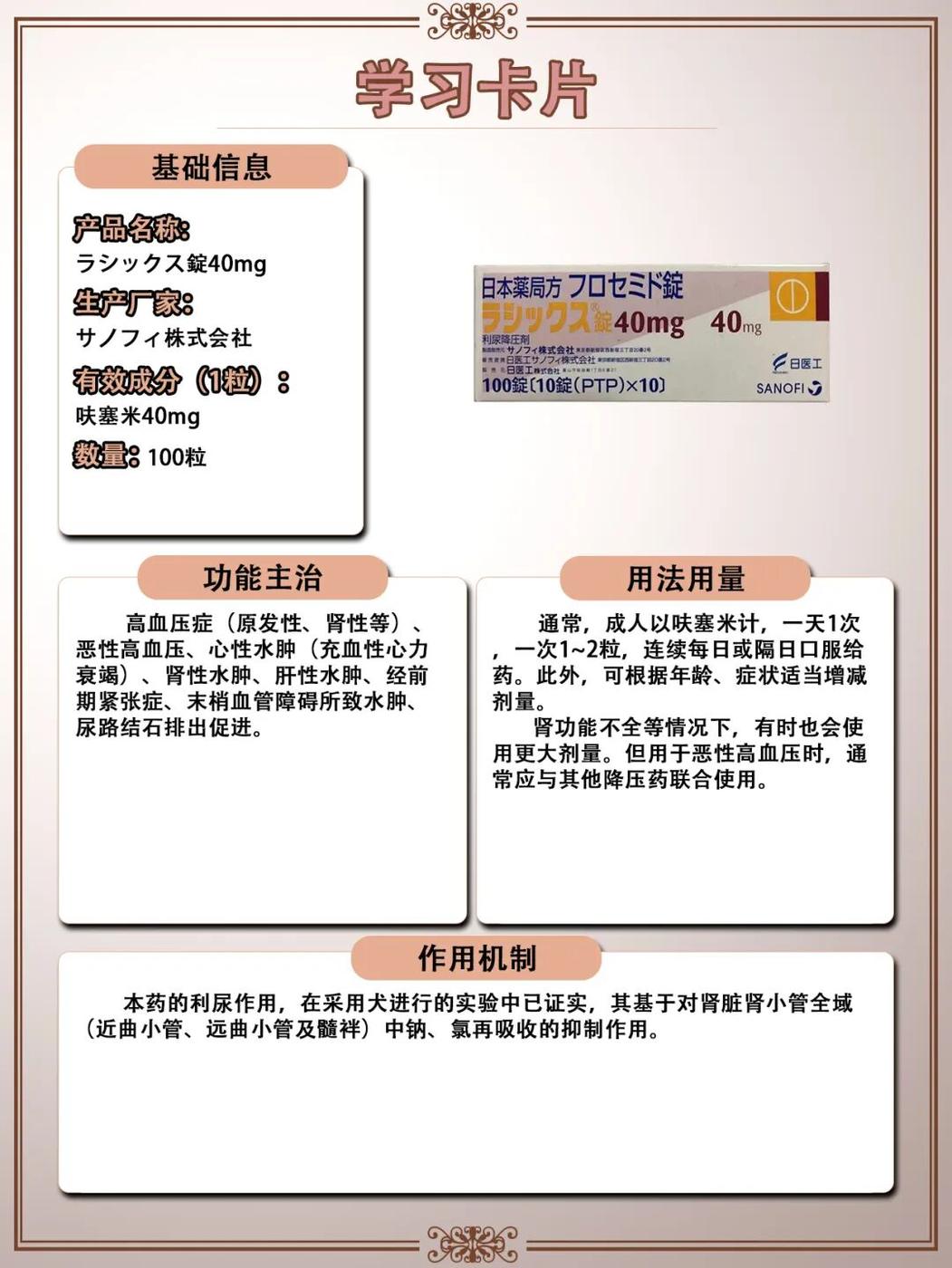
Nippon Furosemide 40mg (per tablet).
English translation of the Japanese package insert is the main text; the Japanese original is shown alongside for verification. Use the language menu (top right) to read the page in another language. This site is for reference only — consult a doctor or pharmacist before use.
Section 1 · 01
English translation
Feature Description The diuretic effect of this drug has been confirmed in experiments in dogs to inhibit the reabsorption of Na and Cl throughout the renal tubules (proximal and distal tubules and Henle's astringent hooves).
Section 2 · 02
English translation
100 tablets [10 tablets (PTP aluminum-plastic blister packaging)×10].
Section 3 · 03
English translation
Characteristics White, bare tablet.
Section 4 · 04
English translation
Ingredient Information Active ingredient: Japanese furosemide 40mg (per tablet). Additives: lactose hydrate, corn starch, partially alpha-starch, talc, magnesium stearate, light anhydrous silica.
Section 5 · 05
English translation
Indications Hypertension (essential, nephronic, etc.), malignant hypertension, cardiac edema (congestive heart failure), renal edema, hepatic edema, premenstrual tonicity, edema due to peripheral vascular disorders, and urinary stone expulsion are promoted.
Section 6 · 06
English translation
Dosage and Administration Typically, adults are given 40~80 mg orally once daily as furosemide daily or every other day. Adjust appropriately according to age and symptoms. In cases of renal insufficiency, even larger doses may be used. However, when used for malignant hypertension, it is usually used in combination with other antihypertensive agents.
Section 7 · 07
English translation
Notes 1. The diuretic effect of this drug may appear suddenly, so be very careful to prevent electrolyte imbalance and dehydration. Start with a small amount and gradually increase the dose. 2. If you continue to use it, electrolyte imbalances may occur, so regular check-ups are essential. 3. Dizziness and unsteadiness caused by blood pressure-lowering may occur, so exercise caution when operating dangerous machinery such as working at heights or driving automobiles. 4. For patients who especially need nighttime rest, it is administerable during the day to avoid nighttime urination.
Section 8 · 08
English translation
Side Effects 1. Shock, anaphylaxis (both with unknown frequency) 2. Aplastic anemia, pancytopenia, agranulocytosis, thrombocytopenia, erythroblastic tuberculosis (all of which have unknown frequency) 3. Bullous Pemphigoid (frequency unknown) 4. Hearing loss (frequency unknown) 5. Toxic epidermal necrolysis (TEN), Stevens-Johnson syndrome, erythema multiforme, acute generalized exusculous pustulosis (all of unknown frequency) 6. Ventricular arrhythmias (Torsade de pointes) (frequency unknown) Ventricular arrhythmias accompanied by hypokalemia may appear. 7. Interstitial nephritis (frequency unknown) 8. Interstitial pneumonia (frequency unknown) If cough, difficulty breathing, fever, abnormal lung sounds (twisted sounds), or similar abnormalities are observed, promptly undergo chest X-ray, chest CT, or other examinations. If interstitial pneumonia is suspected, discontinue administration and take appropriate measures such as administering corticosteroids. 9. Other side effects (1) Blood: anemia, leukopenia, eosinophils, hemolytic anemia. (2) Metabolic abnormalities: hyponatremia, hypokalemia, hypocalcemia, metabolic alkalosis, hyperuricemia, hyperglycemia, hypertriglyceridemia, hypercholesterolemia, pseudo-barter syndrome. (3) Skin: rash, urticaria, redness, photosensitivity, pruritus, bullous dermatitis, purpura, lichen-like rash. (4) Gastrointestinal: loss of appetite, diarrhea, nausea and vomiting, dry mouth, pancreatitis) (elevated serum amylase levels). (5) Liver: jaundice, liver dysfunction, cholestasis. (6) Kidneys: increased BUN, increased creatinine. (7) Neuropsychiatric system: dizziness, headache, sensory disturbances, hearing impairment. (8) Others: weakness, fatigue, orthostatic hypotension, muscle cramps, taste disturbances, vasculitis, fever.
Section 9 · 09
English translation
taboo 1. Patients with anuria [No expected effect of this drug. ] 2. Patients with hepatic coma 3. Patients with a clear decrease in sodium and potassium in body fluids [there is a risk of electrolyte imbalance.] ] 4. Patients with a history of hypersensitivity to sulfonamide derivatives 5. Patients receiving desmopressin acetate hydrate (nocturia causing frequent urination in men)

Source images

1 images

Need help sourcing Japanese medicines or OEM production?

💬