Musculoskeletal · MUSCULOSKELETAL

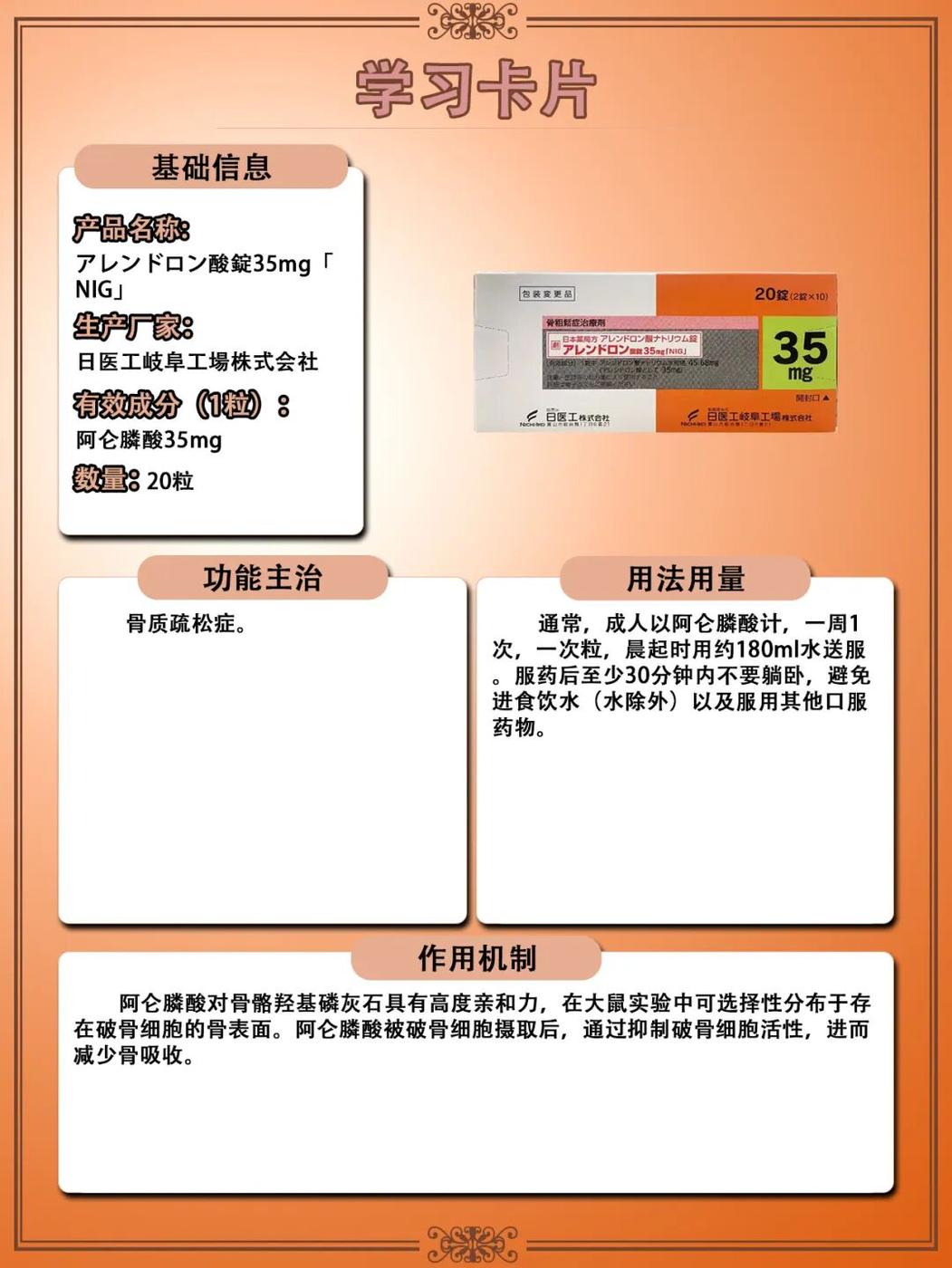
Alendronate Sodium

日本語原題:アレンドロン酸錠35mg「NIG」

Published2026-08-13 09:10 FormTablet Content9 sections / 1 images
Ingredients / strength:
Each tablet contains 45.68 mg of sodium alendronate hydrate. (35mg as alendronic acid).
English translation of the Japanese package insert is the main text; the Japanese original is shown alongside for verification. Use the language menu (top right) to read the page in another language. This site is for reference only — consult a doctor or pharmacist before use.
Section 1 · 01
English translation
Feature Description Alendronic acid has a strong affinity for bone hydroxyapatite and was selectively distributed on the bone surface where osteoclasts are present in rats. Alendronic acid reduces bone resorption by inhibiting its activity after being uptaken by osteoclasts.
Section 2 · 02
English translation
Specifications 20 tablets [2 tablets (with instructions for administration indicated PTP)×10].
Section 3 · 03
English translation
Characteristics White oval tablets.
Section 4 · 04
English translation
Ingredient Information Active ingredient: 45.68mg of sodium alendronate hydrate per tablet. (35mg as alendronic acid). Additives: sodium croscarmellos, crystalline cellulose, magnesium stearate, D-mannitol.
Section 5 · 05
English translation
Osteoporosis.
Section 6 · 06
English translation
Dosage and Administration Typically, adults are given 35 mg of alendronic acid orally once a week upon waking with about 180 mL of water. Do not lie down for at least 30 minutes after taking the medication, and avoid eating, drinking, or taking other medications orally.
Section 7 · 07
English translation
Notes 1. This drug may cause local irritation symptoms on mucous membranes such as the pharynx and esophagus. Especially in patients who do not take it properly, severe side effects may occur in the esophagus and oral cavity, so patients should be thoroughly guided and understood about the dosage. 2. Adverse reactions related to the upper gastrointestinal tract have been reported due to administration of this drug. Monitor carefully and pay attention to signs or symptoms of adverse effects (such as difficulty swallowing, painful swallowing, substernal pain, or the onset or worsening of heartburn). If these symptoms appear, instruct patients to discontinue this drug and seek medical attention. 3. Ensure patients consume sufficient calcium through diet and other sources. 4. If hypocalcemia is present, treat hypocalcemia before administration of this drug. Also, if there are mineral metabolism disorders such as vitamin D deficiency or vitamin D metabolism disorders, treatment should be provided in advance. 5. Patients receiving bisphosphonate treatment may develop jawbone necrosis and jawbone osteomyelitis. Many reported cases are associated with invasive dental procedures on the jawbone, such as tooth extraction, or local infections. Known risk factors include malignant tumors, chemotherapy, angiogenesis inhibitors, corticosteroid therapy, radiation therapy, oral hygiene, and a history of dental procedures. Before starting administration of this drug, check the oral management status and, if necessary, instruct patients to undergo appropriate dental examinations and complete invasive dental procedures as much as possible. If invasive dental procedures become necessary during administration of this drug, consider discontinuing the medication or similar measures. Also, thoroughly explain to patients the importance of keeping the oral cavity clean, undergoing regular dental examinations, informing dentists about the use of this drug during dental visits, and avoiding invasive dental procedures as much as possible. If abnormalities are detected, immediately instruct patients to seek dental or oral surgery consultation. 6. There have been reports of osteonecrosis of the external auditory canal in patients using bisphosphonate drugs. These reports also show cases related to ear infections or trauma, so if symptoms such as otitis externa, ear leakage, or ear pain persist, advise consulting an ENT specialist. 7. In patients using bisphosphonate drugs for a long time, there have been reports of atypical fractures caused by non-traumatic or minor external force in the subtrochanteric femoral region, proximal femoral shaft, and proximal ulnar shaft. In these reports, prodromal pain is observed in the thigh, groin, forearm, and other areas weeks to months before a complete fracture occurs. Therefore, if such symptoms are observed, X-ray examinations and other procedures should be performed and appropriate measures taken. Also, since bilateral fractures may occur, if an atypical fracture occurs on one side, symptoms on the opposite side should be checked and X-rays performed, with careful observation. X-rays may reveal characteristic imaging findings such as thickening of the cortical bone, and appropriate treatment should be taken in such cases.
Section 8 · 08
English translation
Side Effects 1. Esophageal and oral disorders Esophageal disorders [esophageal perforation (frequency unknown), esophageal stricture (frequency unknown), esophageal ulcers (frequency unknown), esophagitis (0.3%), esophageal erosion (frequency unknown), may be accompanied by bleeding. ] and oral ulcers (frequency unknown) may appear. Pay attention to signs or symptoms (vomiting blood, bleeding, anemia, difficulty swallowing, dysphagia, substernal pain, heartburn, oral discomfort, onset or worsening of mouth pain, etc.). 2. Stomach and duodenal disorders (Hemorrhagic) Gastric and duodenal ulcers (0.3%) and hemorrhagic gastritis (0.2%) may occur. Pay attention to signs or symptoms (vomiting blood, blood from the lower body, anemia, upper abdominal pain, epigastric pain, manifestation or worsening of upper abdominal discomfort, etc.). 3. Liver dysfunction and jaundice (both unknown frequency) Liver dysfunction accompanied by elevated AST and ALT levels, and jaundice may occur. 4. Hypocalcemia (0.09%) Hypocalcemia accompanied by convulsions, tetany, numbness, disorientation, and QT prolongation may occur. If abnormalities are observed, consider intravenous administration of calcium medications. 5. Toxic Epidermal Necrolysis (TEN), Stevens-Johnson syndrome (both frequency unknown) 6. Jawbone necrosis and mandibular osteomyelitis (0.03%) 7. External auditory canal bone necrosis (frequency unknown) 8. Atypical fractures such as subtrochanteric femoral fractures, proximal femoral shaft, proximal ulnar shaft, etc. (frequency unknown) 9. Other side effects (1) Digestive system: stomach pain, epigastric pain, stomach discomfort, heaviness in the stomach, abdominal discomfort, abdominal pain, vomiting, loss of appetite, abdominal bloating, stomatitis, stomach Acid reflux, sore throat, throat discomfort, yawning, nausea, constipation, diarrhea, gastritis, indigestion, bloating and flatulence, dry mouth, difficulty swallowing, and swollen gums. (2) Skin and skin appendages: rash, itching, hair loss, urticaria, erythema, eczema. (3) Blood: anemia (reduced red blood cell count, decreased hemoglobin, etc.), decreased white blood cell count, decreased platelet count. (4) Liver: abnormal liver function (elevated AST, elevated ALT, elevated γ-GTP, etc.). (5) Kidneys: Increased BUN, frequent urination, and difficulty urinating. (6) Central and peripheral nervous system: floating vertigo, headache, rotational vertigo, decreased perception. (7) Muscle and skeletal system: joint pain, back pain, muscle pain, bone pain, muscle spasms. (8) Mental and nervous system: insomnia. (9) Electrolyte metabolism: serum phosphorus decreases, serum potassium rises. (10) Eyes: ocular symptoms (blurredness, discomfort, etc.), scleritis, uveitis, episcleritis. (11) Others: chest pain, fatigue, taste disorders, peripheral edema, facial edema, palpitations, weakness, fever, mood decline, hot flashes (facial flushing, heat sensation, etc.), increased CK (Cough Fever), elevated blood pressure, angioedema, increased LDH, elevated total cholesterol, decreased serum albumin, lower limb pain.
Section 9 · 09
English translation
taboo 1. Patients with esophageal stricture or acalasia (esophageal atalysis) that delays esophageal passage [delayed passage of this drug increases the risk of adverse effects locally in the esophagus. ] 2. Patients who have been elevated for more than 30 minutes or cannot stand. 3. Patients with a history of hypersensitivity to any component of this drug or other bisphosphonate drugs 4. Patients with hypocalcemia

Source images

1 images

Need help sourcing Japanese medicines or OEM production?

💬