Musculoskeletal · MUSCULOSKELETAL

Iguratimod

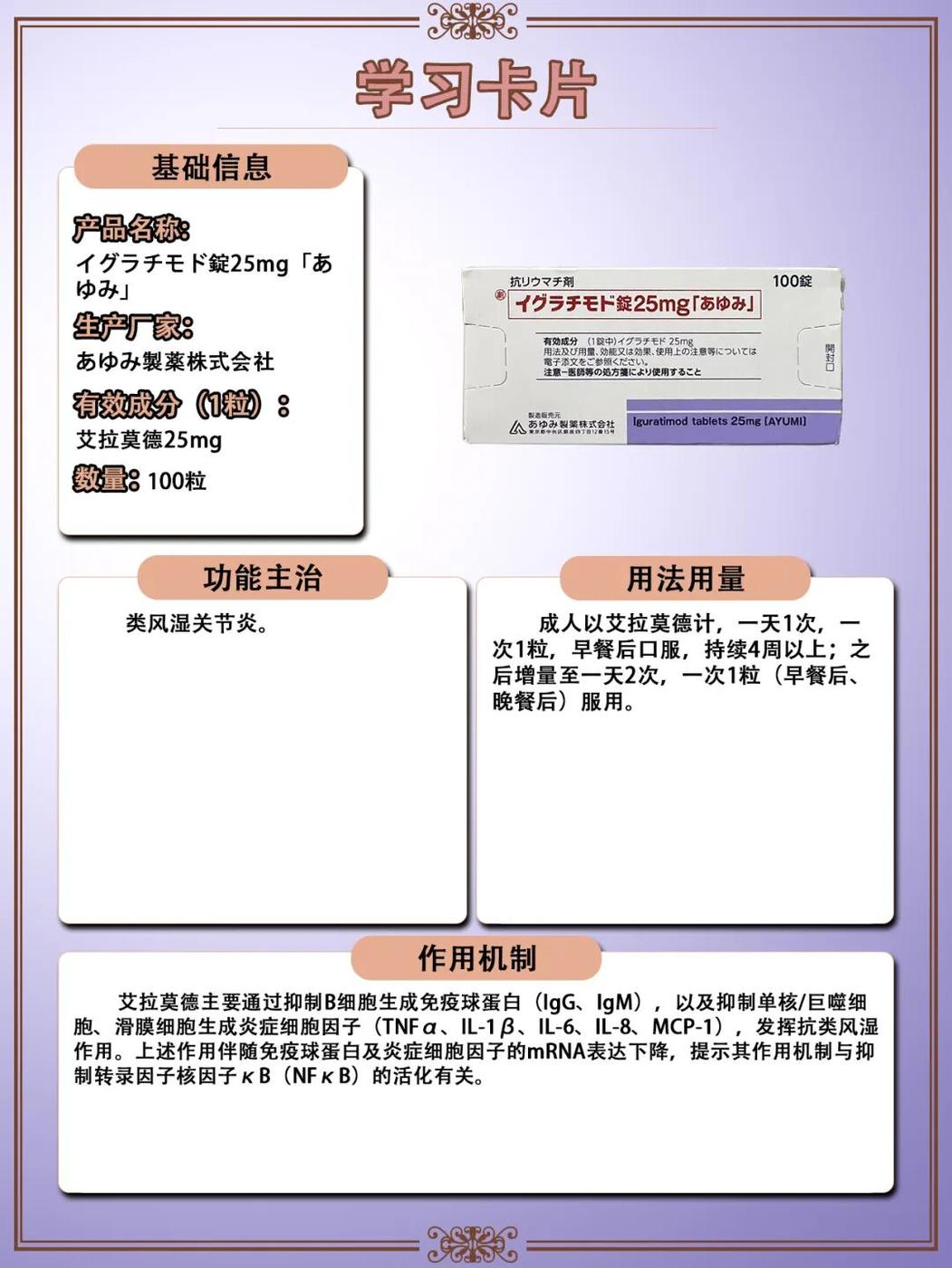
日本語原題:イグラチモド錠25mg「あゆみ」

Published2026-08-31 09:07 FormTablet Content10 sections / 1 images
Ingredients / strength:
Each tablet contains 25mg of igratimod.
English translation of the Japanese package insert is the main text; the Japanese original is shown alongside for verification. Use the language menu (top right) to read the page in another language. This site is for reference only — consult a doctor or pharmacist before use.
Section 1 · 01
English translation
Feature Description Igratimod primarily exhibits anti-rheumatic effects by suppressing the production of immunoglobulins (IgG, IgM) by B cells and the production of inflammatory cytokines (TNFα, IL-β, IL-IL-6, IL-IL-8, MCP-1) by monocytes/macrophages and synovial cells. These effects involve reduced mRNA expression of immunoglobulins and inflammatory cytokines, and are suggested to be mediated by inhibiting the activation of the transcription factor Nuclear Factor κB (NFκB).
Section 2 · 02
English translation
100 tablets [10 tablets (blister packaging) ×10].
Section 3 · 03
English translation
Characteristics White, film-coated tablets.
Section 4 · 04
English translation
Ingredient Information Active ingredient: 25mg of iGratimod per tablet. Additives: Carnauba Wax, Carmellose Calcium, Crystalline Cellulose, Titanium Oxide, Magnesium Stearate, Talc, Hydroxypropyl Cellulose, Hypromellose, Polyoxyethylene (105), Polyoxypropylene (5) Glycol.
Section 5 · 05
English translation
Indications Rheumatoid arthritis.
Section 6 · 06
English translation
Dosage and Administration Typically, adults are given 25 mg orally once daily after breakfast for more than four weeks as igratimod, then increased to 25 mg twice daily (after breakfast and dinner).
Section 7 · 07
English translation
Notes 1. Always perform a liver function test before administration of this drug. During administration, clinical symptoms should be closely monitored, and liver function tests should be conducted regularly during the first two months after starting administration, such as once every two weeks, and thereafter once a month. 2. Before administering this drug, be sure to perform tests on blood and kidney function. During administration, clinical symptoms should be closely monitored, and regular blood and kidney function tests should be performed for the first two months after starting treatment, such as once every two weeks, and thereafter once a month. 3. Considering the characteristics of this drug and the disease, carefully monitor the course of treatment and do not continue administration indiscriminately.
Section 8 · 08
English translation
Side Effects 1. Liver dysfunction (0.5%), jaundice (0.1%) Liver dysfunction accompanied by increased AST and ALT may occur, and jaundice may occur. Additionally, regarding liver function, clinical trials have shown Since the incidence of increased AST and ALT was high, if abnormalities are observed, consider whether to continue administration, and especially As a guideline, discontinue administration if it increases to 100 IU or more. 2. Pancytopenia (0.1%), agranulocytosis (frequency unknown), leukopenia (0.1%) If abnormalities are observed, consider whether to continue administration and take appropriate measures. If blood disorders such as erythrocytopenia, leukopenia, or thrombocytopenia are observed, discontinue or discontinue administration of this drug as necessary and take appropriate measures. 3. Peptic ulcers (0.7%) Peptic ulcers believed to be caused by cyclooxygenase inhibitory effects may occur; if gastrointestinal symptoms such as diarrhea appear, discontinue administration and provide appropriate treatment. 4. Interstitial pneumonia (0.3%) Pay attention to symptoms such as fever, cough, and difficulty breathing. If abnormalities are detected, promptly check clinical tests such as chest X-rays or KL-6 or CRP, discontinue administration, and consider differential diagnosis from pneumonia pneumonia (such as β-D glucan measurement) and take appropriate measures such as administering corticosteroids. 5. Infectious Diseases (0.2%) Infections such as sepsis and empyema may occur. 6. Other side effects (1) Liver: increased AST, increased ALT, increased Al-P, increased γ-GTP, increased total bile acid, increased blood bilirubin, increased urinary urobilinogen. (2) Blood: decreased hemoglobin, decreased hematocrit, eosinophils, lymphopenia, leukopenia, leukopenia, decreased red blood cells, anemia, thrombocytopenia, thrombocytosis, increased basophils, increased neutrophils, decreased neutrophils, increased monocytes, decreased monocytes, decreased monocytes, abnormal lymphocyte morphology. (3) Digestive system: abdominal pain, stomatitis, positive occult blood in the stool, nausea, abdominal discomfort, diarrhea, peptic ulcers, gastritis, indigestion, vomiting, loss of appetite, cheilitis, constipation, abdominal bloating, glossitis, esophagitis, epigastric discomfort, gastroenteritis, gastrointestinal disorders, periodontitis. (4) Kidneys: increased NAG, increased β2-microglobulin in urine, increased blood urea, increased β2-microglobulin in blood, positive protein in urine, positive red blood cells in urine, positive white blood cells in urine, urine columns, positive urine sediment, increased creatinine in blood, pyelonephritis, frequent urination (5) Hypersensitivity: rash, pruritus, eczema, urticaria, erythema, photosensitivity reactions. (6) Metabolic abnormalities: decreased blood iron, increased BNP, decreased blood cholinesterase, decreased total protein, positive urine glucose, decreased serum albumin, decreased total iron-binding capacity, increased unsaturated iron-binding capacity. (7) Psychoneurological system: dizziness, headaches, insomnia, drowsiness, abnormal sensations. (8) Others: elevated blood pressure, nasopharyngitis, increased KL-6, fever, hair loss, taste abnormalities, upper respiratory tract inflammation, edema, shingles, fatigue, tinnitus, cough, menstrual disorders, candidiasis, bronchitis, perionychomycitis, pharyngitis, dry skin, palpitations, oral and pharyngeal pain, back pain, muscle spasms, chills, cystitis, fungal infections.
Section 9 · 09
English translation
Feature Description 1. Pregnant women or women who may be pregnant 2. Patients with severe liver impairment 3. Patients with peptic ulcers [Peptic ulcers may appear as a side effect, which may worsen the condition. ] 4. Patients with a history of hypersensitivity to any component of this drug 5. Patients receiving warfarin
Section 10 · 10
English translation
Warning In overseas clinical trials, cases administering 125 mg per day have resulted in fatal pancytopenia. This drug should be used by physicians with sufficient knowledge and experience in rheumatism treatment at medical facilities where adequate emergency measures are possible.

Source images

1 images

Need help sourcing Japanese medicines or OEM production?

💬