Neuro & Psychiatric · NERVOUS

Biperiden

日本語原題:アキネトン錠1mg

Published2026-10-20 12:38 FormTablet Content9 sections / 1 images
Ingredients / strength:
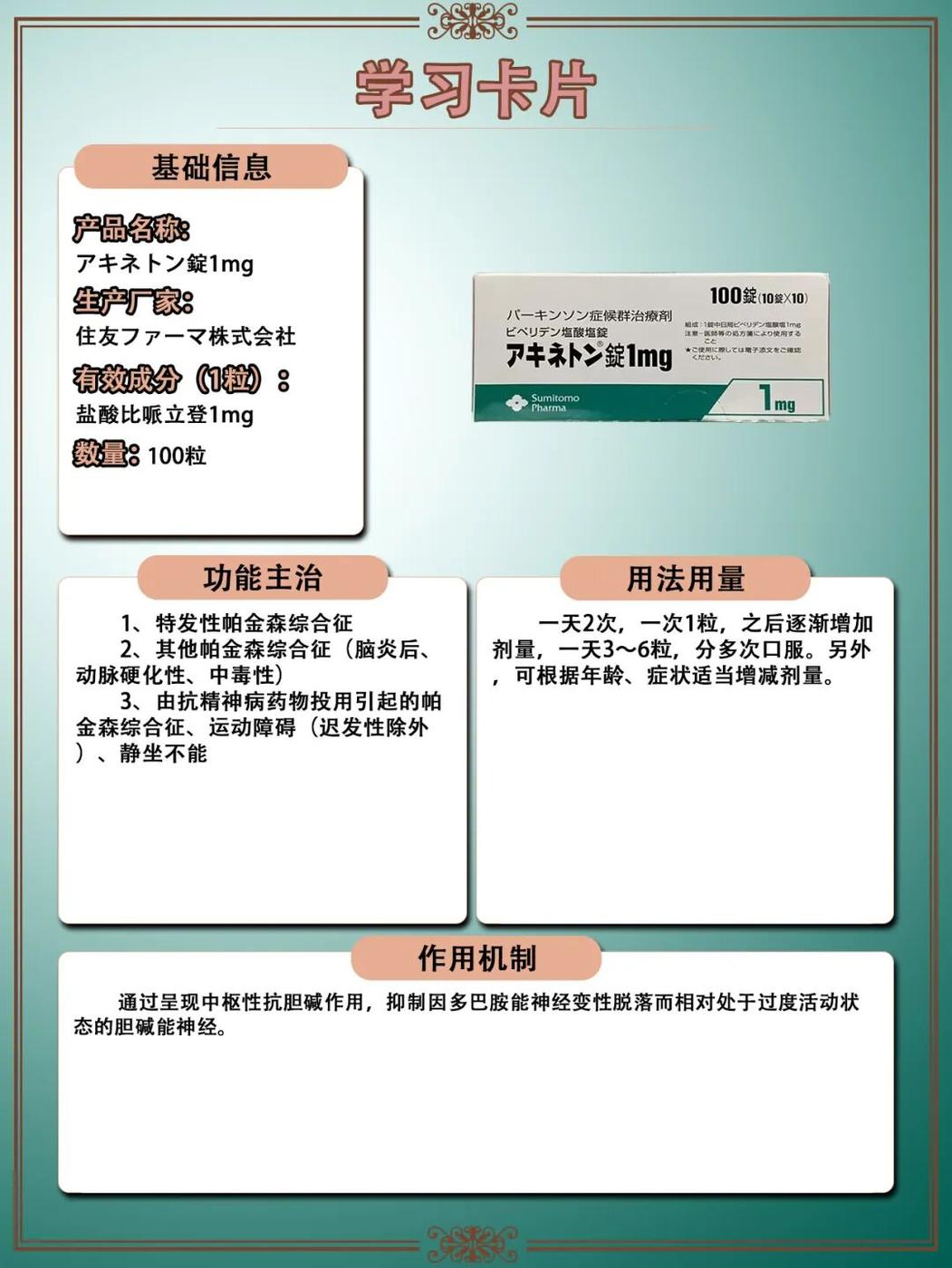
1 Tablet Chunichi Biperiden Hydrochloride 1mg.
English translation of the Japanese package insert is the main text; the Japanese original is shown alongside for verification. Use the language menu (top right) to read the page in another language. This site is for reference only — consult a doctor or pharmacist before use.
Section 1 · 01
English translation
Feature Description By exerting anticholinergic effects centrally, it suppresses cholinergic nerves, which have become relatively overactive due to degeneration and shedding of dopaminergic nerves.
Section 2 · 02
English translation
100 tablets [10 tablets (PTP aluminum-plastic packaging) ×10 boards].
Section 3 · 03
English translation
Characteristics White split-line blank tablets.
Section 4 · 04
English translation
Ingredient Information Active ingredient: 1 tablet China-Japan Bureau Biperidene Hydrochloride 1mg. Additives: crystalline cellulose, corn starch, hydrogenated oil, light anhydride silica, magnesium stearate.
Section 5 · 05
English translation
Indications 1. Idiopathic Parkinsonism 2. Other types of parkinsonism (post-encephalitis, arteriosclerosis, addiction) 3. Parkinsonism, dyskinesia (excluding delayed onset), and akathisia caused by psychotropic drug administration
Section 6 · 06
English translation
Dosage and Administration As biperidene hydrochloride, adults usually start with 1 mg twice daily, gradually increasing to 3~6 mg orally divided into doses. Adjust appropriately according to age and symptoms.
Section 7 · 07
English translation
Notes 1. It is desirable to perform regular angle and intraocular pressure measurements during administration of this drug. 2. Excessive administration of this drug may worsen Parkinson's symptoms; in such cases, appropriate measures such as dose reduction should be taken. 3. There have been reports of mood elevation caused by this drug, which may lead to dependence; therefore, administer with caution. 4. Drowsiness, dysregulation, and decreased attention, concentration, and reflex functions may occur; therefore, patients receiving this drug should be cautioned to avoid operating dangerous machinery such as driving a car.
Section 8 · 08
English translation
Side Effects 1. Malignant syndrome (frequency unknown) When used in combination with antipsychotics, antidepressants, and dopaminergic antiparkinsonian agents, reducing or discontinuing this drug or concomitant drugs may cause fever, agitation mutism, impaired consciousness, severe muscle rigidity, involuntary movements, difficulty swallowing, tachycardia, blood pressure fluctuations, sweating, and other symptoms. If such symptoms appear, appropriate measures such as overall management such as body cooling and hydration, and carefully tapering the dose of this drug after temporarily returning to its original state. At the onset of this disease, increases in white blood cells and serum CK often occur, and renal function decline accompanied by myoglobinuria may also occur. 2. Dependency (frequency unknown) 3. Other side effects (1) Neuropsychiatric system: hallucinations, delirium, confusion, anxiety, drowsiness, memory impairment. (2) Digestive system: dry mouth, nausea, vomiting, loss of appetite, stomach discomfort, diarrhea, constipation, stomatitis. (3) Urinary system: difficulty urinating, urinary retention. (4) Hypersensitivity: rash. (5) Cardiovascular system: Blood pressure drops or rises. (6) Eye; Eye accommodation disorders. (7) Liver: liver damage.
Section 9 · 09
English translation
taboo 1. Patients with angle-closure glaucoma [anticholinergic effects may increase intraocular pressure and worsen symptoms. ] 2. Patients with hypersensitivity to any component of this drug 3. Patients with myasthenia gravis [The anticholinergic effect of this drug may worsen symptoms. ]

Source images

1 images

Need help sourcing Japanese medicines or OEM production?

💬