Azilsartan
日本語原題:アジルサルタン錠20mg「TCK」
Source images
1 imagesThe artwork keeps its original Japanese/Chinese lettering. Open “Text in this image” under a picture to read what it says in your language (machine-read, may contain errors).
Text in this image machine-read · may contain errors
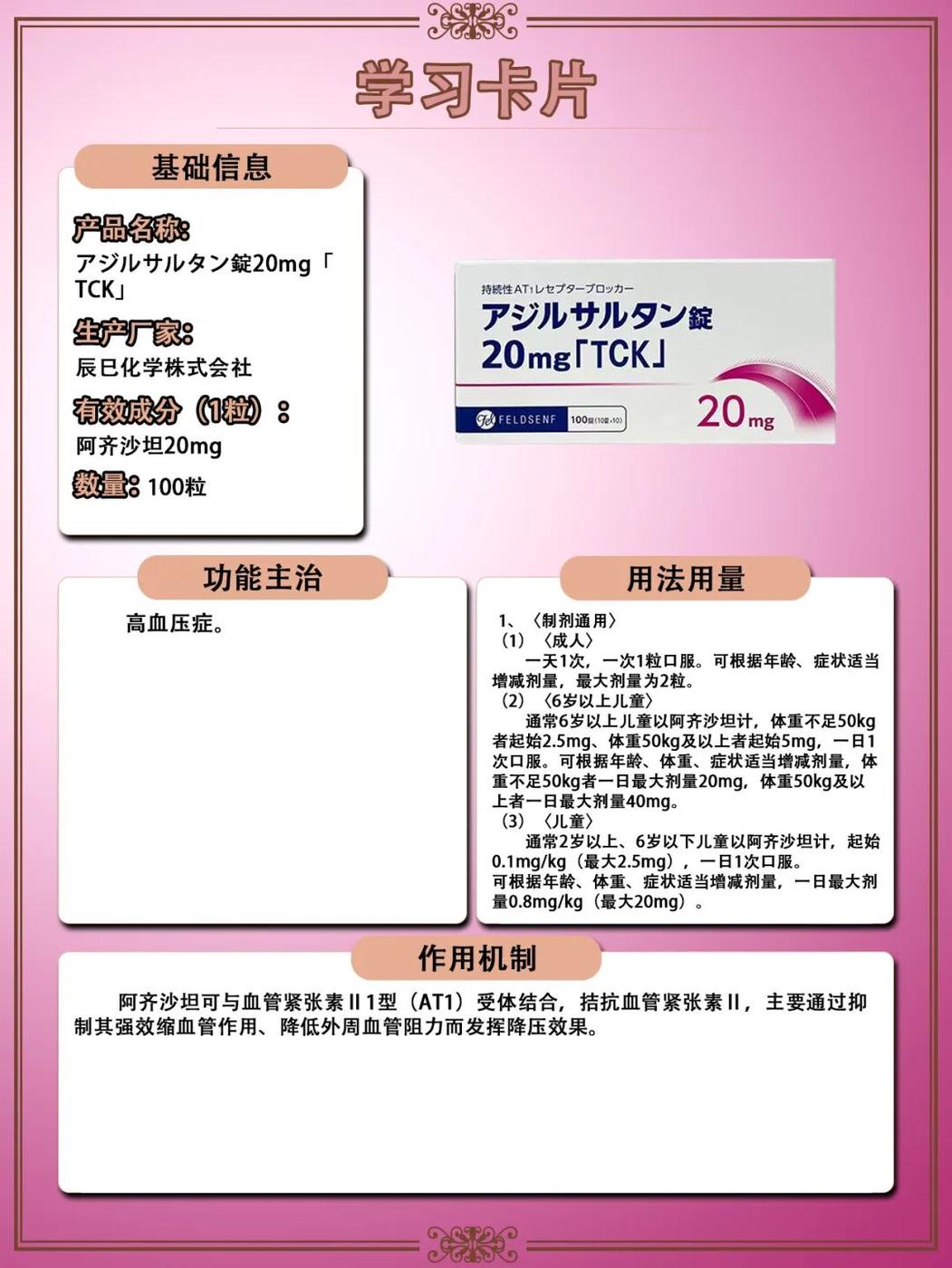
Basic information Product Name: Azilsartan Tablets 20mg " Durability A receptor procker Azil Sartan tablets Manufacturer: 20mg「TCK] Tatsui Chemical Co., Ltd 20mg Active ingredient (1 capsule): FELDSENF Azisartan 20mg Quantity: 100 capsules Functions and indications Usage and dosage 1. "General Formulations" Hypertension. (1) "Adult" Take 1 capsule orally once a day. Appropriate treatment can be based on age and symptoms Increase or decrease the dosage, with a maximum dose of 2 capsules. (2) "Children Aged 6 and Above" Typically, children over 6 years old weigh less than 50 kg when calculated by azisartan start at 2.5mg; for those weighing 50kg or more, start at 5mg, 1 dose per day Next is oral administration. Dosage can be adjusted appropriately according to age, weight, and symptoms For those weighing less than 50 kg, the maximum daily dose is 20 mg, and for body weight 50 kg and above The maximum daily dose for the above is 40mg. (3) "Children" Typically, children aged 2 to 6 years old start with azisartan 0.1mg/kg (maximum 2.5mg), once daily orally. Dosage can be adjusted appropriately according to age, weight, and symptoms, with the maximum dose per day Dose: 0.8 mg/kg (maximum 20 mg). Mechanism of action Azisartan can bind to angiotensin type II (AT1) receptors and antagonize angiotensin II, mainly by inhibiting It effectively reduces vasodilation and peripheral vascular resistance, thereby exerting a blood pressure-lowering effect.
基础信息 产品名称: アジルサルタン錠 20mg 「 持続性 A レセプタープロッカー アジルサルタン錠 生产厂家: 20mg「TCK] 辰已化学株式会社 20mg 有效成分(1粒): FELDSENF 阿齐沙坦20mg 数量:100粒 功能主治 用法用量 1、《制剂通用》 高血压症。 (1)《成人) 一天1次,一次1粒口服。可根据年龄、症状适当 增减剂量,最大剂量为2粒。 (2)《6岁以上儿童) 通常6岁以上儿童以阿齐沙坦计,体重不足50kg 者起始2.5mg、体重50kg及以上者起始5mg,一日1 次口服。可根据年龄、体重、症状适当增减剂量,体 重不足50kg者一日最大剂量20mg,体重50kg及以 上者一日最大剂量40mg。 (3)《儿童) 通常2岁以上、6岁以下儿童以阿齐沙坦计,起始 0.1mg/kg(最大2.5mg),一日1次口服。 可根据年龄、体重、症状适当增减剂量,一日最大剂 量0.8mg/kg(最大20mg)。 作用机制 阿齐沙坦可与血管紧张素II1型(AT1)受体结合,拮抗血管紧张素II,主要通过抑 制其强效缩血管作用、降低外周血管阻力而发挥降压效果。
Basic information Product Name: Azilsartan Tablets 20mg " Durability A receptor procker Azil Sartan tablets Manufacturer: 20mg「TCK] Tatsui Chemical Co., Ltd 20mg Active ingredient (1 capsule…