Endocrine & Metabolic · ENDOCRINE

Conjugated Estrogens

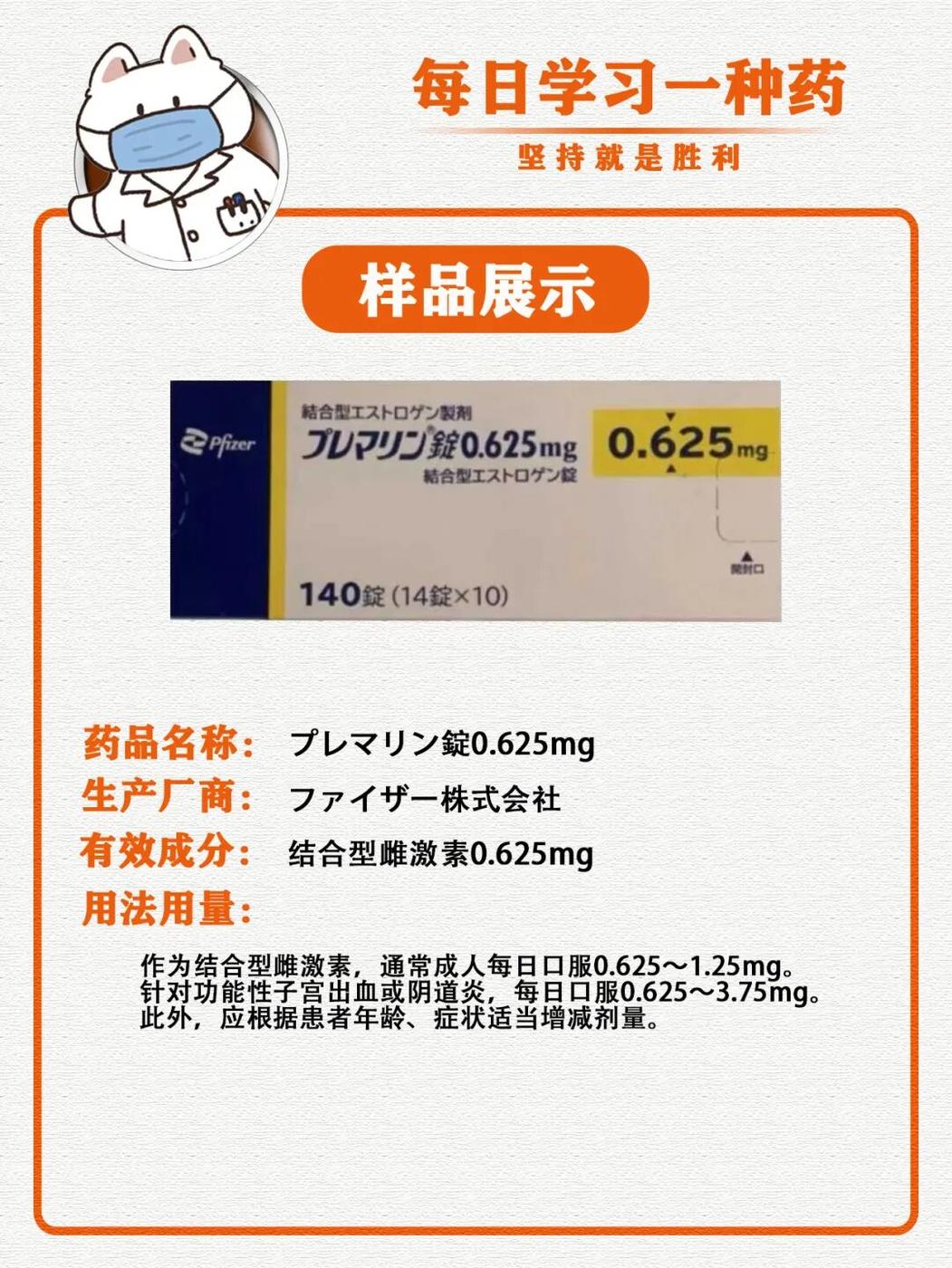
日本語原題:プレマリン錠0.625mg

Published2025-10-30 08:16 FormTablet Content9 sections / 2 images
Ingredients / strength:
Each tablet contains 0.625mg of conjugated estrogen.
English translation of the Japanese package insert is the main text; the Japanese original is shown alongside for verification. Use the language menu (top right) to read the page in another language. This site is for reference only — consult a doctor or pharmacist before use.
Section 1 · 01
English translation
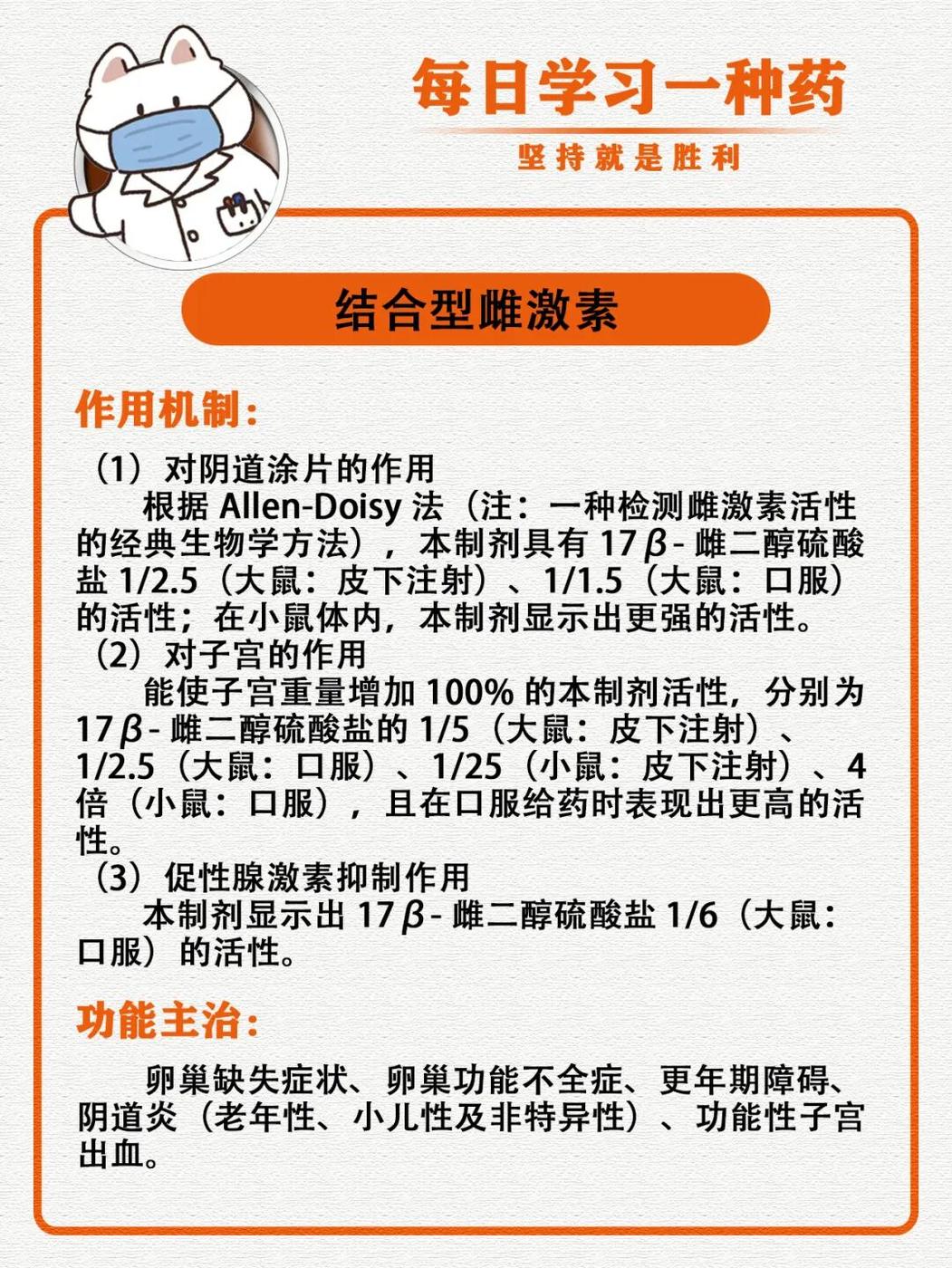
Feature Description (1) Effects on vaginal smear According to the Allen-Doisy method, this drug has activity of 1/2.5 (subcutaneous in rats) and 1/1.5 (orally in rats) of 17β-estradiol sulfate, with this drug showing stronger activity in mice. (2) Effects on the Uterus The activity of this drug, which increases uterine weight by 100%, is 1/5 (rats: subcutaneous), 1/2.5 (rats: oral), 1/25 (mice: subcutaneous), and 4 times (mice: oral) of 17β-estradiol sulfate, showing high activity when administered orally. (3) Gonadotropin inhibition This drug exhibits 1/6 the activity of 17β-estradiol sulfate (rats: oral).
Section 2 · 02
English translation
140 tablets [14 tablets (aluminum-plastic blister packaging) ×10 blisters].
Section 3 · 03
English translation
White sugar-coated tablets.
Section 4 · 04
English translation
Ingredient Information Active ingredient: 0.625 mg of conjugated estrogen per tablet. Additives: lactose hydrate, calcium tertiary phosphate, crystalline cellulose, powdered cellulose, hypromellose, magnesium stearate, white sugar, hydroxypropyl cellulose, macrogol 400, titanium dioxide, polysorbate 80, carnauba low.
Section 5 · 05
English translation
Indications Ovarian deficiency symptoms, ovarian insufficiency, menopausal disorders, vaginitis (in the elderly, children, and nonspecific), and functional uterine bleeding.
Section 6 · 06
English translation
Dosage and Administration As a conjugated estrogen, adults typically receive 0.625–1.25 mg orally per day. For functional uterine bleeding or vaginitis, oral administration of 0.625 to 3.75 mg per day is administered. Adjust appropriately according to age and symptoms.
Section 7 · 07
English translation
Notes 1. In foreign countries, women who have been using follicular hormone agents and progesterone agents for a long time have a higher risk of breast cancer compared to women in the control group, and this risk increases as the duration of combination therapy increases. Therefore, when administering this drug, patients should be thoroughly informed about the risks and benefits of this drug and use it to the minimum necessary. Do not take long-term administration indiscriminately. 2. Before administration, medical history, family predisposition, breast examination, and gynecological examination (including endometrial cytology and ultrasound measurement of endometrial thickness for patients with uterus) should be performed, and regular breast and gynecological examinations should be performed after starting administration. 3. Thrombosis may occur with this medication; discontinue administration if the following symptoms or conditions appear. Also, patients should be informed in advance to consult a doctor immediately if any of the following symptoms or conditions are observed. (1) Early symptoms of thrombosis Pain and swelling in the lower limbs, sudden difficulty breathing, shortness of breath, chest pain, central nervous system symptoms (dizziness, impaired consciousness, paralysis of the limbs, etc.), acute vision impairment, etc. (2) Conditions that increase the risk of thrombosis Such as inability to move the body or noticeable elevation of blood pressure.
Section 8 · 08
English translation
Side Effects 1. Thrombosis (frequency unknown) Thrombosis or thromboembolism (limbs, lungs, heart, brain, retina, etc.) may occur, so close observation is required, and if early symptoms such as lower limb pain or swelling, sudden difficulty breathing, shortness of breath, chest pain, central nervous system symptoms (dizziness, consciousness disturbance, limb paralysis, etc.), or acute visual impairment appear, discontinue administration and take appropriate measures. 2. Other side effects (1) Electrolyte metabolism: Storage of sodium and body fluids (edema, weight gain, etc.). (2) Genitals: increased vaginal leukorrhea, irregular bleeding, changes in menstrual volume. (3) Breasts: breast pain, feeling of breast tightness. (4) Hypersensitivity: rash, urticaria, angioedema. (5) Gastrointestinal: abdominal pain, nausea and vomiting, loss of appetite, pancreatitis. (6) Skin: pigmentation, hair loss. (7) Neuropsychiatric system: headache, dizziness. (8) Liver: liver dysfunction (AST, ALT, Al-P elevation, etc.). (9) Respirator: difficulty breathing. (10) Cardiovascular system: Lowers blood pressure.
Section 9 · 09
English translation
taboo 1. Patients with estrogen-dependent tumors (such as breast cancer or endometrial cancer) and suspected of having them [may promote tumor worsening or manifestation]. ] 2. Patients with a history of breast cancer 3. Patients with thrombophlebitis or pulmonary embolism, or a history of the same [estrogen has been reported to increase coagulation factors and promote thrombotic tendency. ] 4. Patients with arterial thromboembolic disease (e.g., coronary heart disease, stroke) or a history thereof 5. Patients with a history of hypersensitivity to any component of this drug 6. Pregnant women or women who may be pregnant 7. Patients with severe liver impairment 8. Patients with abnormal genital bleeding for which a diagnosis has not been confirmed [If the bleeding is caused by endometrial cancer, it may promote cancer progression or manifestation.] ] 9. Patients with untreated endometrial hyperplasia [Endometrial hyperplasia may be accompanied by cellular atypia). ]

Source images

2 images

Need help sourcing Japanese medicines or OEM production?

💬