Estradiol
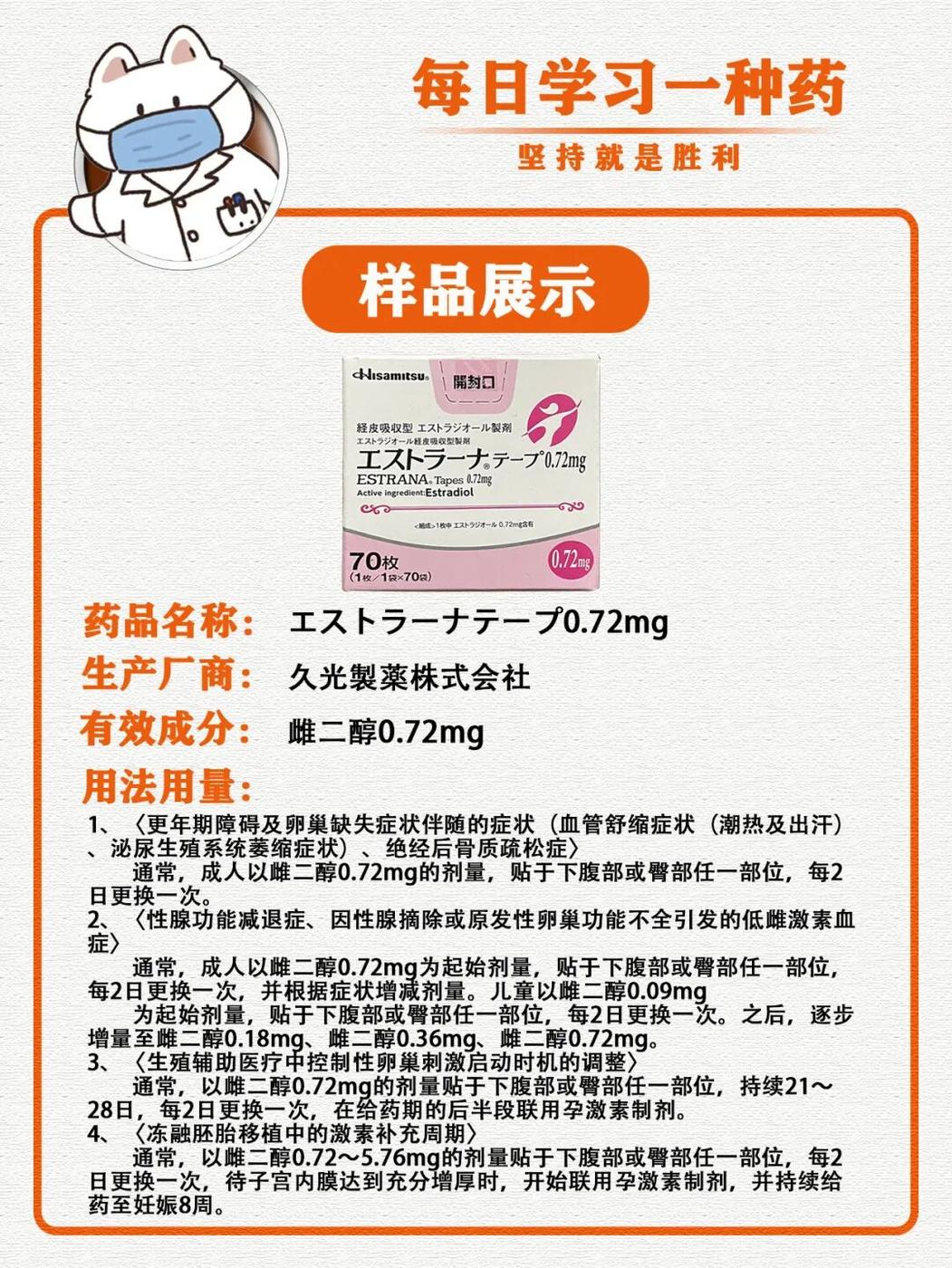
日本語原題:エストラーナテープ0.72mg
Each tablet contains 0.72mg of estradiol.
Source images
2 imagesThe artwork keeps its original Japanese/Chinese lettering. Open “Text in this image” under a picture to read what it says in your language (machine-read, may contain errors).
Text in this image machine-read · may contain errors
Nisamitsu. Transdermal absorption type for Strathiol steel Construction by Stotsun O No. 1 Artificial strana tape 0.72mg ESTRANA. Tapes 0.72mg Active ingredient:Estradiol 0.72mg 70 sheets Drug Name: Manufacturer: Hisamitsu Pharmaceutical Co., Ltd Active ingredients: Estradiol 0.72 mg Dosage and administration: 1. "Symptoms Accompanying Menopausal Disorders and Ovarian Loss Symptoms (Vasomotor Symptoms (Hot Flashes and Sweating)" Symptoms of Genitourinary System Atrophy, Postmenopausal Osteoporosis" Typically, adults use a dose of 0.72 mg estradiol applied to either the lower abdomen or buttocks, every 2 doses Change once daily. 2. "Hypoestrogen Blood Caused by Gonadectomy or Primary Ovarian Insufficiency." Typically, adults start with estradiol 0.72 mg and apply it to either the lower abdomen or buttocks, Change every 2 days and adjust the dose according to symptoms. Children receive 0.09 mg estradiol Starting dose, apply to the lower abdomen or buttocks, change every 2 days. Afterwards, gradually Increase to 0.18 mg estradiol, 0.36 mg estradiol, 0.72 mg estradiol. 3. (Adjustment of the timing for initiating controlled ovarian stimulation in assisted reproductive medicine) Typically, a dose of 0.72mg estradiol is applied to either the lower abdomen or buttocks for 21~ On the 28th, change every two days, and during the latter half of the administration period, use progesterone preparations in combination. 4. (Hormone Supplementation Cycle in Frozen Embryo Transfer) Typically, estradiol is applied at a dose of 0.72~5.76mg to either the lower abdomen or buttocks, every 2 Change once daily, and when the endometrium is sufficiently thickened, start combining progesterone preparations and continue administration Medication until 8 weeks of pregnancy.
Nisamitsu. 経皮吸収型工ストラシオール製用 工ストつンオー第第製第 工ストラーナテープ 0.72mg ESTRANA.Tapes 0.72mg Active ingredient:Estradiol 0.72mg 70枚 药品名称: 生产厂商: 久光藥株式会社 有效成分: 雌二醇0.72mg 用法用量: 1、《更年期障碍及卵巢缺失症状伴随的症状(血管舒缩症状(潮热及出汗) 泌尿生殖系统萎缩症状、绝经后骨质疏松症》 通常,成人以雌二醇0.72mg的剂量,贴于下腹部或臀部任一部位,每2 日更换一次。 2、《性腺功能减退症、因性腺摘除或原发性卵巢功能不全引发的低雌激素血 通常,成人以雌二醇0.72mg为起始剂量,贴于下腹部或臀部任一部位, 每2日更换一次,并根据症状增减剂量。儿童以雌二醇0.09mg 为起始剂量,贴于下腹部或臀部任一部位,每2日更换一次。之后,逐步 增量至雌二醇0.18mg、雌二醇0.36mg、雌二醇0.72mg。 3、(生殖辅助医疗中控制性卵巢刺激启动时机的调整》 通常,以雌二醇0.72mg的剂量贴于下腹部或臀部任一部位,持续21~ 28日,每2日更换一次,在给药期的后半段联用孕激素制剂。 4、(冻融胚胎移植中的激素补充周期》 通常,以雌二醇0.72~5.76mg的剂量贴于下腹部或臀部任一部位,每2 日更换一次,待子宫内膜达到充分增厚时,开始联用孕激素制剂,并持续给 药至妊娠8周。
Nisamitsu. Transdermal absorption type for Strathiol steel Construction by Stotsun O No. 1 Artificial strana tape 0.72mg ESTRANA. Tapes 0.72mg Active ingredient:Estradiol 0.72mg 70 sheets Dr…
Text in this image machine-read · may contain errors
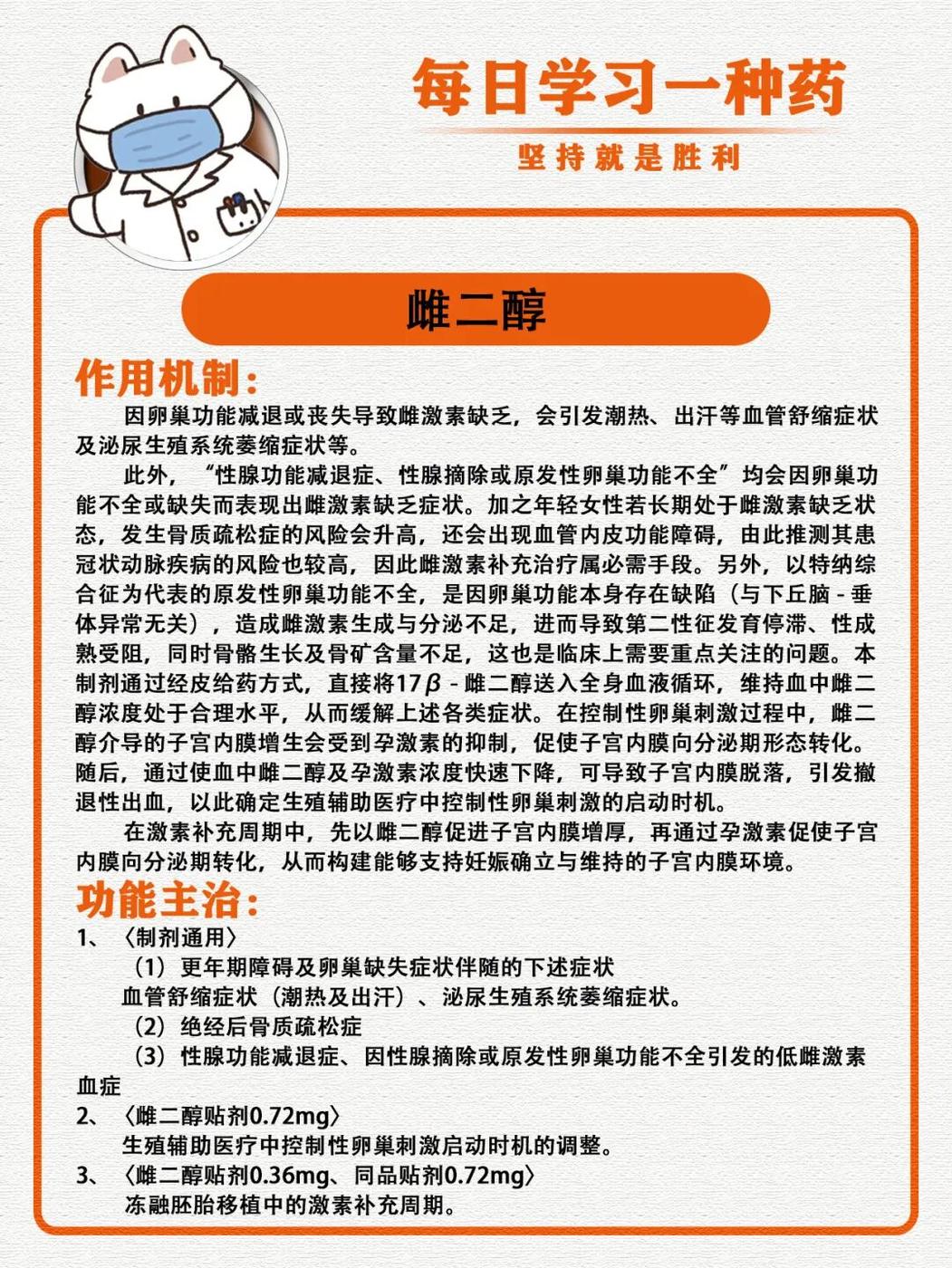
Mechanism of action: Estrogen deficiency caused by decreased or lost ovarian function can trigger vasomotor symptoms such as hot flashes and sweating and symptoms of genitourinary system atrophy, etc. In addition, "hypogonadism, gonadectomy, or primary ovarian insufficiency" can all be caused by ovarian dysfunction Incomplete or missing estrogen deficiency symptoms. Additionally, if young women are long-term deficient in estrogen, The risk of osteoporosis increases, and vascular endothelial dysfunction may occur, which suggests the risk of The risk of coronary artery disease is also high, so estrogen replacement therapy is essential. Additionally, Turner is a comprehensive feature Primary ovarian insufficiency represented by the combined syndrome is caused by defects in ovarian function and hypothalamus and uvulary dysfunction causing insufficient estrogen production and secretion, which in turn leads to stagnation of secondary sexual characteristics and sexual development Ripening is hindered, and bone growth and bone mineral content are insufficient, which are also issues that require clinical attention. Original The formulation is administered transdermally, directly delivering 17β-estradiol into the systemic bloodstream to maintain metrin levels The alcohol concentration is at a reasonable level, which helps alleviate the symptoms mentioned above. During controlled ovarian stimulation, the second female is affected Alcohol-mediated endometrial hyperplasia is inhibited by progesterone, promoting the transformation of the endometrium toward the secretory phase. Subsequently, by rapidly lowering the concentrations of estradiol and progesterone in the blood, endometrial shedding can occur, triggering shedding Degenerate bleeding to determine the timing of initiating controlled ovarian stimulation in assisted reproductive care. During the hormone replacement cycle, estradiol is first used to promote endometrial thickening, followed by progesterone to stimulate the uterus The endometrium transitions to the secretory phase, thereby creating an endometrial environment that supports the establishment and maintenance of pregnancy. Functions and indications: 1. "General Formulations" (1) The following symptoms accompanying menopausal disorders and ovarian loss symptoms Vasomotor symptoms (hot flashes and sweating), genitourinary system atrophy. (2) Postmenopausal osteoporosis (3) Hypogonadism, low estrogen caused by gonadectomy or primary ovarian insufficiency 2. <estradiol patch 0.72mg) Adjustment of the timing for initiating controlled ovarian stimulation in assisted reproductive medicine. "Estradiol Patch 0.36mg, Equivalent Patch 0.72mg" Hormone replacement cycles in frozen embryo transfer.
作用机制: 因卵巢功能减退或丧失导致雌激素缺乏,会引发潮热、出汗等血管舒缩症状 及泌尿生殖系统萎缩症状等。 此外,“性腺功能减退症、性腺摘除或原发性卵巢功能不全”均会因卵巢功 能不全或缺失而表现出雌激素缺乏症状。加之年轻女性若长期处于雌激素缺乏状 态,发生骨质疏松症的风险会升高,还会出现血管内皮功能障碍,由此推测其患 冠状动脉疾病的风险也较高,因此雌激素补充治疗属必需手段。另外,以特纳综 合征为代表的原发性卵巢功能不全,是因卵巢功能本身存在缺陷与下丘脑垂 体异常无关),造成雌激素生成与分泌不足,进而导致第二性征发育停滞、性成 熟受阻,同时骨骼生长及骨矿含量不足,这也是临床上需要重点关注的问题。本 制剂通过经皮给药方式,直接将17β-雌二醇送入全身血液循环,维持血中雌二 醇浓度处于合理水平,从而缓解上述各类症状。在控制性卵巢刺激过程中,雌二 醇介导的子宫内膜增生会受到孕激素的抑制,促使子宫内膜向分泌期形态转化。 随后,通过使血中雌二醇及孕激素浓度快速下降,可导致子宫内膜脱落,引发撤 退性出血,以此确定生殖辅助医疗中控制性卵巢刺激的启动时机。 在激素补充周期中,先以雌二醇促进子宫内膜增厚,再通过孕激素促使子宫 内膜向分泌期转化,从而构建能够支持妊娠确立与维持的子宫内膜环境。 功能主治: 1、《制剂通用》 (1)更年期障碍及卵巢缺失症状伴随的下述症状 血管舒缩症状(潮热及出汗)、泌尿生殖系统萎缩症状。 (2)绝经后骨质疏松症 (3)性腺功能减退症、因性腺摘除或原发性卵巢功能不全引发的低雌激素 2、<雌二醇贴剂0.72mg) 生殖辅助医疗中控制性卵巢刺激启动时机的调整。 《雌二醇贴剂0.36mg、同品贴剂0.72mg) 冻融胚胎移植中的激素补充周期。
Mechanism of action: Estrogen deficiency caused by decreased or lost ovarian function can trigger vasomotor symptoms such as hot flashes and sweating and symptoms of genitourinary system atr…