Mecobalamin
日本語原題:ロゼバラミン筋注用25mg
Source images
2 imagesThe artwork keeps its original Japanese/Chinese lettering. Open “Text in this image” under a picture to read what it says in your language (machine-read, may contain errors).
Text in this image machine-read · may contain errors
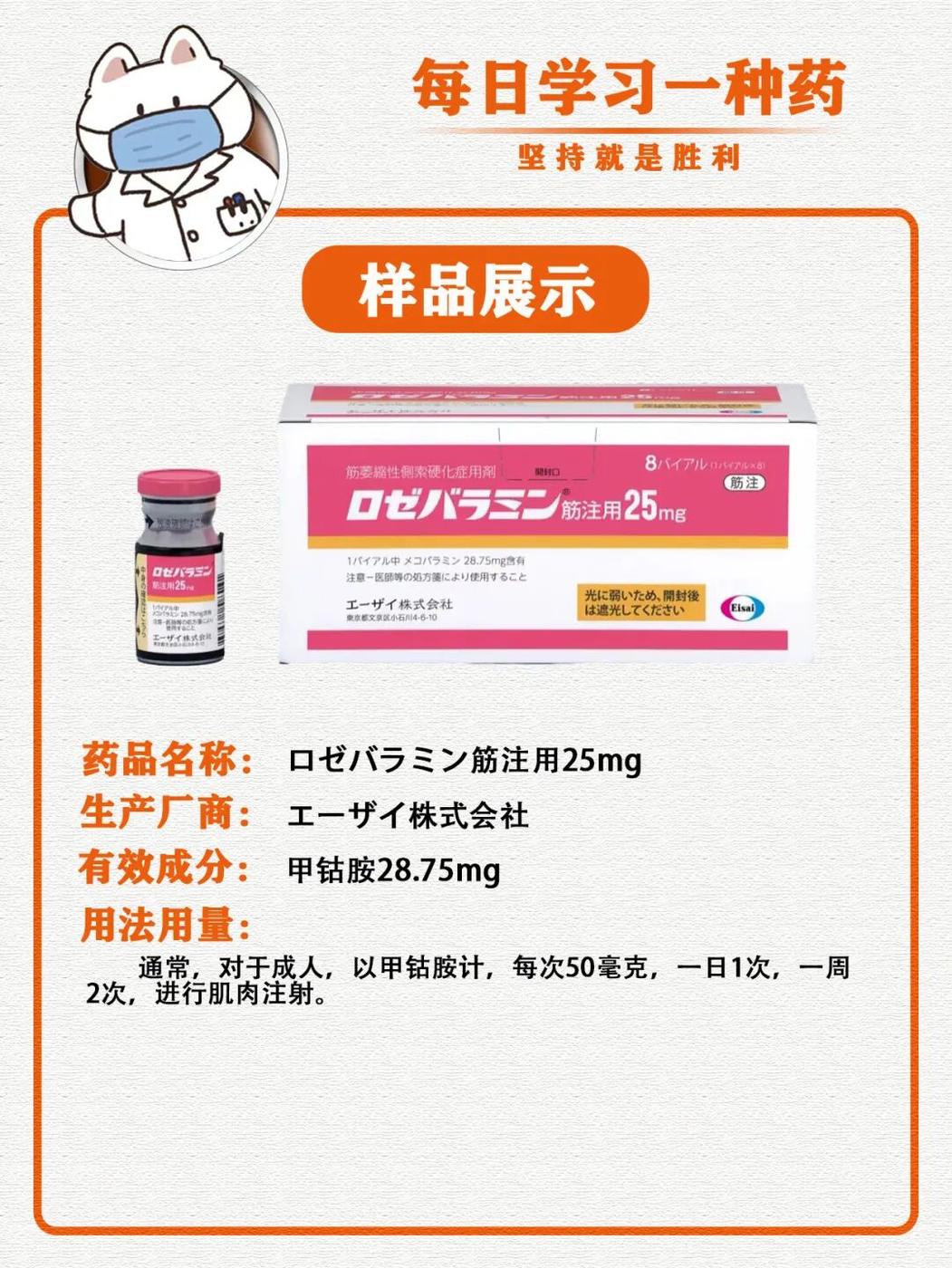
Agents for Lateral Sclerosis 25mg for intramuscular injection 1 vial of Branded Mecobalamin 2875" Please light up Koichi Co., Ltd. Jingjing Tao, 4-6-10 Koishikawa, Bunkyo-ku Drug Name: Kou Qibamen San Jin Injection 25mg Manufacturer: Koichisa Co., Ltd. Active ingredient: Japanese Mecobalamin 28.75mg Dosage and administration: Typically, for adults, 50 mg per dose is measured as methyl dazami, once daily for one week Twice, intramuscular injection.
筋韬性侧索硬化症用剂 筋注用25mg 1 バイアル印メコバラミン 2875 " 物物 は光してください 工一一株式会社 京京桃文京区小石川4-6-10 药品名称:口七八门三筋注用25mg 生产厂商:工一サ个株式会社 有效成分:日 甲钴胺28.75mg 用法用量: 通常,对于成人,以甲钻胺计,每次50毫克,一日1次,一周 2次,进行肌肉注射。
Agents for Lateral Sclerosis 25mg for intramuscular injection 1 vial of Branded Mecobalamin 2875" Please light up Koichi Co., Ltd. Jingjing Tao, 4-6-10 Koishikawa, Bunkyo-ku Drug Name: Kou Q…
Text in this image machine-read · may contain errors
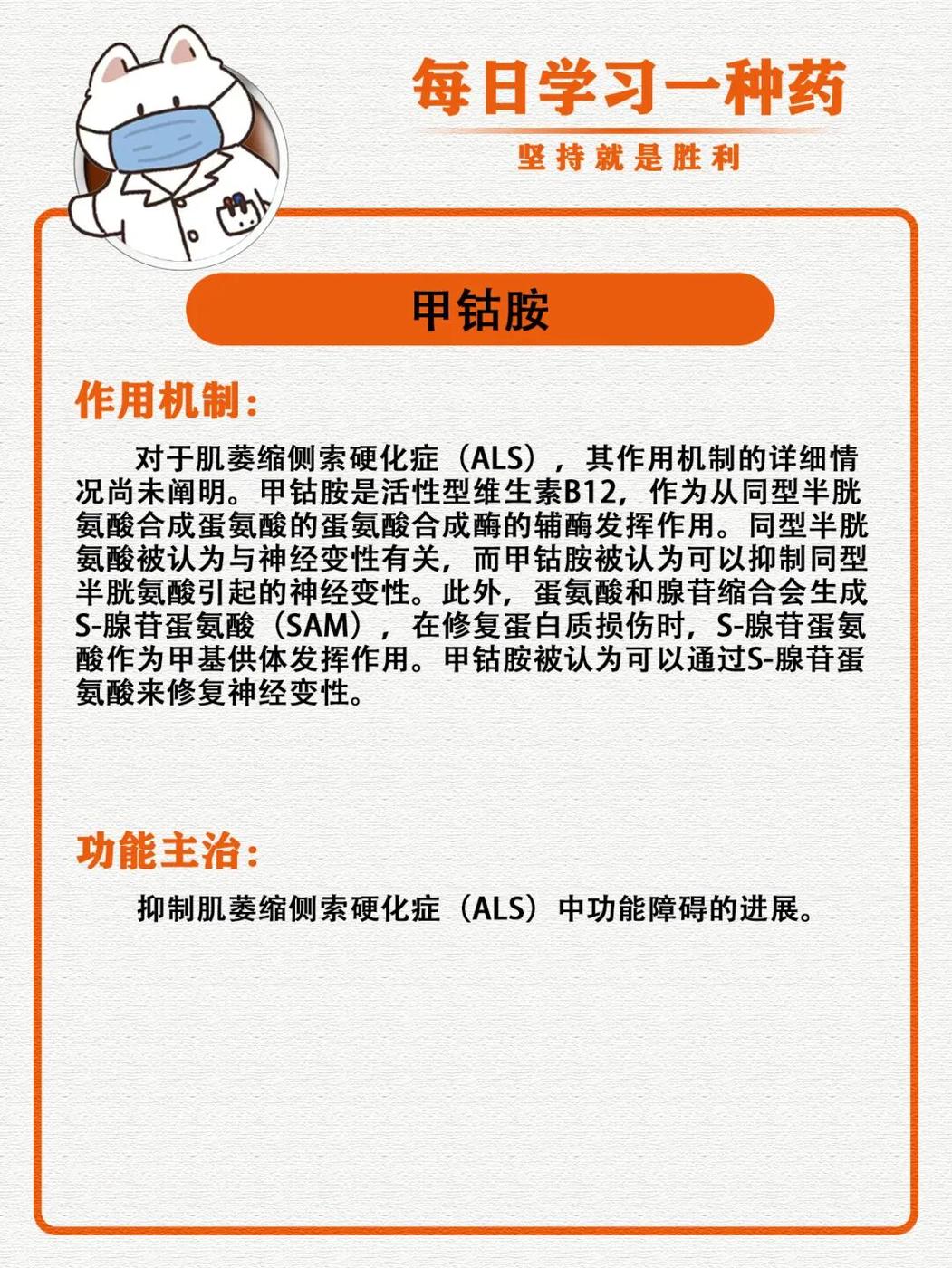
Mechanism of action: Detailed information on the mechanism of action for amyotrophic lateral sclerosis (ALS). Moreover, it has not yet been clarified. Methylamine is the active form of vitamin B12, as it is derived from homocysteine Amino synthesis: Methionine synthetase coenzyme plays a role. Homocystis Acids are believed to be related to neurodegeneration, while methylamine is thought to inhibit homoforms Neurodegeneration caused by cysteine. Additionally, methionine and adenosine condensation are formed S-adenosylmethionine (SAM) is used to repair protein damage, and S-adenosylmethionine ammonia Acids act as methyl donors. Methylamine is believed to pass through S-adenosine eggs Acids to repair neurodegeneration. Functions and indications: Suppression of dysfunction progression in amyotrophic lateral sclerosis (ALS).
作用机制: 对于肌萎缩侧索硬化症(ALS),其作用机制的详细情 况尚未阐明。甲钻胺是活性型维生素B12,作为从同型半胱 氨酸合成蛋氨酸的蛋氨酸合成酶的辅酶发挥作用。同型半胱 氨酸被认为与神经变性有关,而甲钻胺被认为可以抑制同型 半胱氨酸引起的神经变性。此外,蛋氨酸和腺苷缩合会生成 S-腺苷蛋氨酸(SAM),在修复蛋白质损伤时,S-腺苷蛋氨 酸作为甲基供体发挥作用。甲钻胺被认为可以通过S-腺苷蛋 氨酸来修复神经变性。 功能主治: 抑制肌萎缩侧索硬化症(ALS)中功能障碍的进展。
Mechanism of action: Detailed information on the mechanism of action for amyotrophic lateral sclerosis (ALS). Moreover, it has not yet been clarified. Methylamine is the active form of vitam…