Urology & Kidney · URINARY

Edaravone

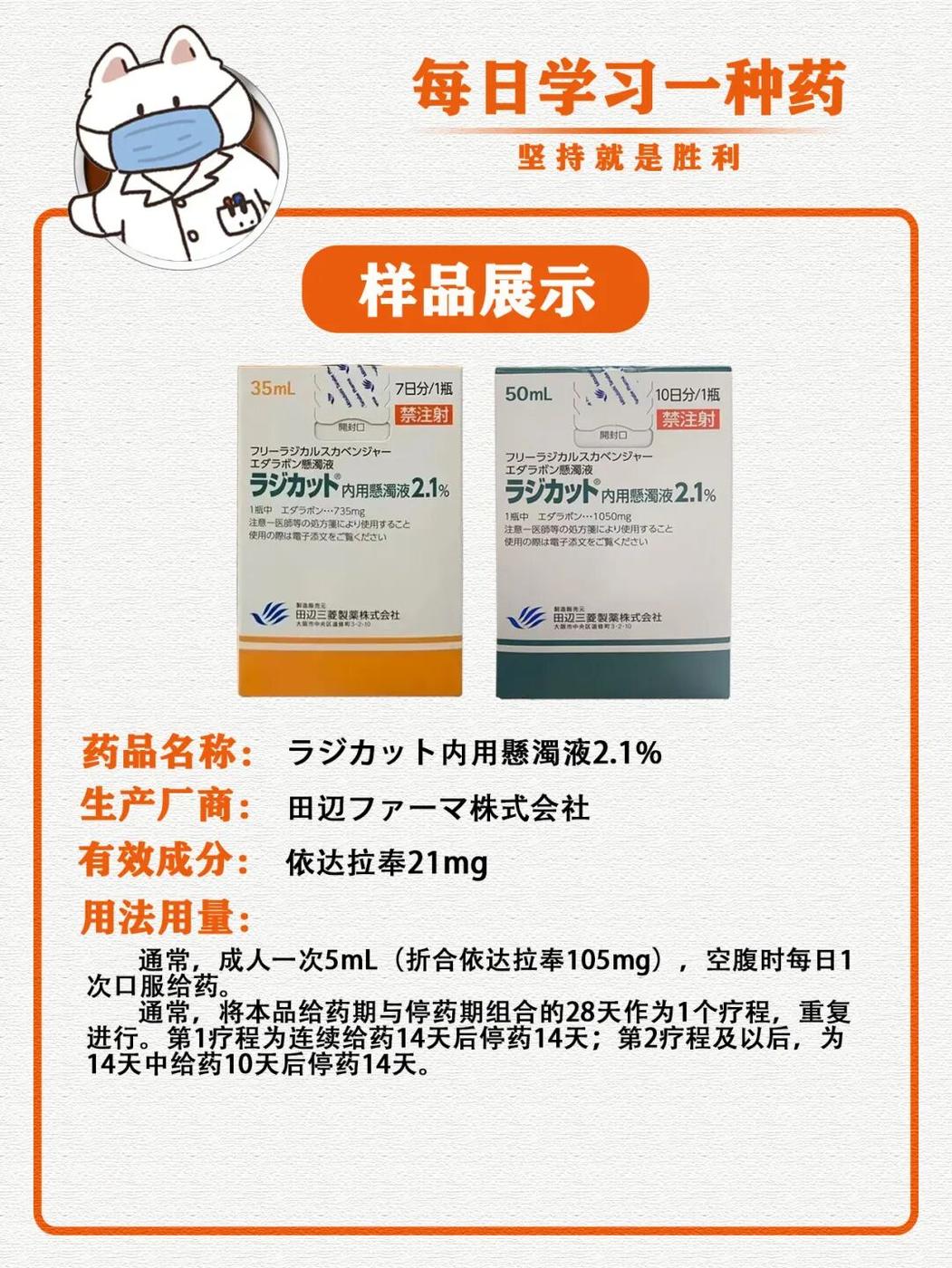
日本語原題:ラジカット内用懸濁液2.1%

Published2026-03-31 12:26 FormPowder Content9 sections / 2 images
English translation of the Japanese package insert is the main text; the Japanese original is shown alongside for verification. Use the language menu (top right) to read the page in another language. This site is for reference only — consult a doctor or pharmacist before use.
Section 1 · 01
English translation
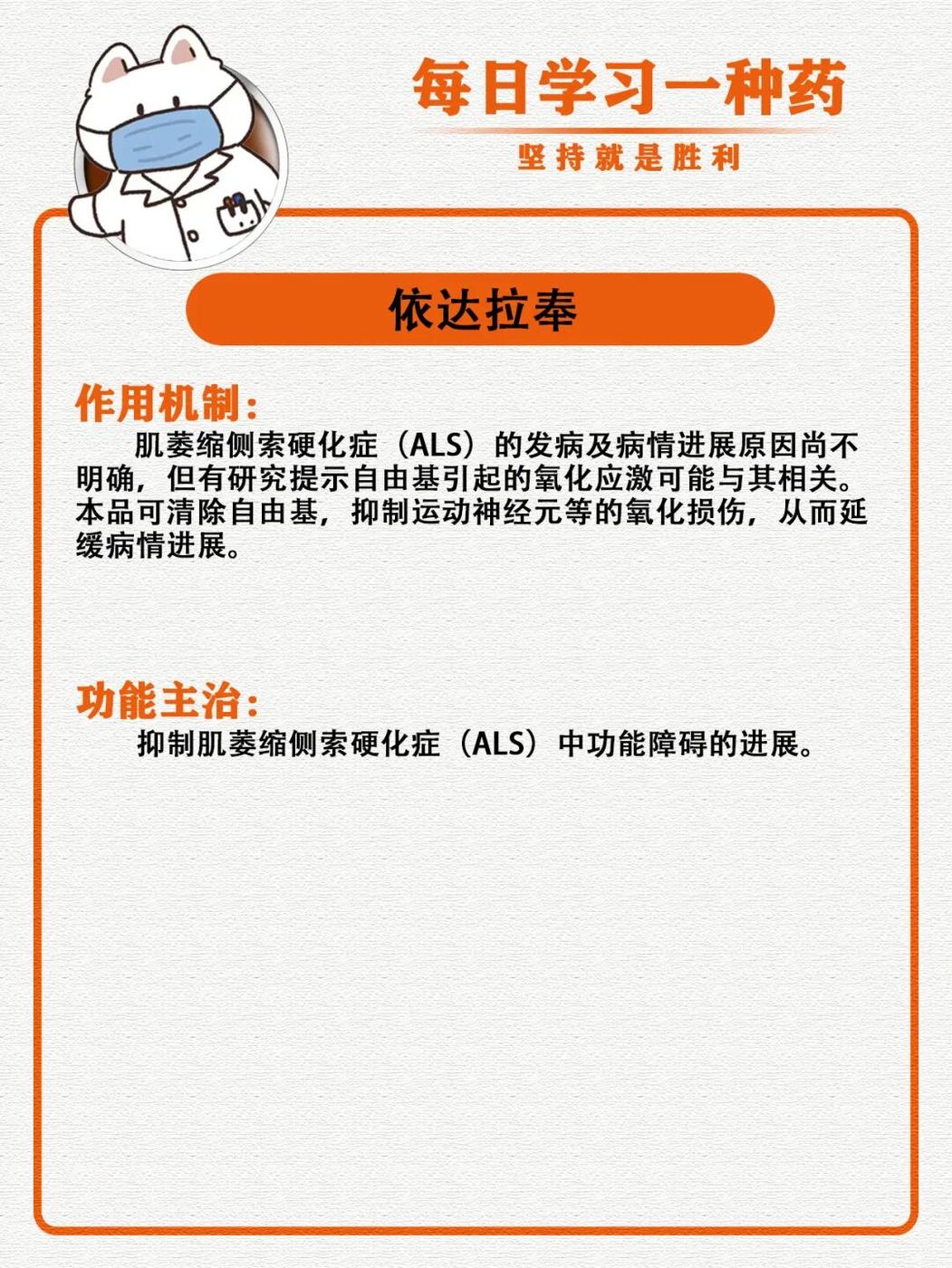
Feature Description The cause of ALS onset and progression is unknown, but oxidative stress caused by free radicals is suggested. This drug eliminates free radicals and suppresses oxidative damage to motor neurons and other cells, thereby delaying disease progression.
Section 2 · 02
English translation
Specifications Bottles: 35mL, 50mL.
Section 3 · 03
English translation
Characteristics White suspension.
Section 4 · 04
English translation
Ingredient Information Active ingredient content (per 1mL): Nippon Edarabone 21mg. Additives: polyvinyl alcohol (partial saponide), xanthan gum, sodium bisulfite, L-cysteine hydrochloride hydrate, D-sorbitol, cimethicone emulsion, pH adjuster.
Section 5 · 05
English translation
Indications Suppression of progression of functional impairment in amyotrophic lateral sclerosis (ALS).
Section 6 · 06
English translation
Dosage and Administration Typically, adults are given 5 mL orally once daily on an empty stomach with an empty stomach. Typically, one cycle consists of a combined 28-day treatment period and a withdrawal period, and this cycle is repeated. After the first cour of 14 consecutive days of administration, the course is followed by a 14-day break; from the second cour onward, a 14-day break is followed by a 14-day interval of 10 days of administration.
Section 7 · 07
English translation
Notes 1. This drug should be administered in collaboration with a physician with sufficient knowledge of this drug and experience in ALS treatment. 2. When administering, provide sufficient explanations of side effects of this drug to the patient or a suitable substitute, and clearly explain that the dosage and administration combine the administration and withdrawal periods. 3. Acute renal injury or worsening renal dysfunction, severe liver damage, disseminated intravascular coagulation syndrome (DIC), and potentially fatal progression. Severe cases have been reported where the injectable simultaneously causes kidney dysfunction, liver dysfunction, blood disorders, and other symptoms. (1) Since abnormal test values may appear early at the start of administration, kidney function tests for BUN, creatinine, AST, ALT, LDH, CK, red blood cells, platelets, liver function, and blood tests should be performed before administration. Regularly perform kidney function tests, liver function tests, and blood tests during administration of this drug. Continue thorough observation even after administration. (2) Since muscle atrophy may cause a decrease in serum creatinine levels due to disease progression, do not compare temporary serum creatinine levels with reference values; instead, observe the trend of serum creatinine levels and check for any signs of worsening. Also, since BUN values fluctuate depending on body water levels and other factors, rather than comparing a temporary BUN value with a reference value, observe the trend of BUN values to check for any signs of worsening. (3) For patients with muscle atrophy, perform renal function assessments less affected by muscle mass by regularly measuring serum creatinine and BUN levels before and during treatment, as well as estimating glomerular filtration by serum cystitin C and calculating creatinine clearance through urine storage. (4) If complications such as infections develop during administration and antibiotics are used concomitantly, carefully consider whether to continue administration, and if continuing administration, conduct frequent examinations. Also, after completing administration, perform frequent tests to ensure thorough observation.
Section 8 · 08
English translation
Side Effects 1. Acute kidney injury (frequency unknown), nephrotic syndrome (frequency unknown) If symptoms such as renal impairment or oliguria are observed, immediately discontinue administration and provide appropriate treatment in cooperation with a physician with sufficient knowledge and experience in renal dysfunction treatment. 2. Fulminant hepatitis (frequency unknown), liver dysfunction (frequency unknown), jaundice (frequency unknown) Severe hepatitis such as fulminant hepatitis, liver dysfunction with significant elevations of AST, ALT, ALP, γ-GTP, LDH, bilirubin, etc., and jaundice may occur. 3. Thrombocytopenia (frequency unknown), granulocytopenia (frequency unknown) 4. Disseminated intravascular coagulation (DIC) (frequency unknown) If blood findings or symptoms suggestive of disseminated intravascular coagulation appear, discontinue administration and take appropriate measures. 5. Acute lung injury (frequency unknown) Acute lung injury accompanied by fever, cough, difficulty breathing, and abnormal chest X-rays may occur, so closely monitor the patient's condition. If such symptoms appear, discontinue administration and take appropriate measures such as corticosteroid therapy. 6. Rhabdomyolysis (frequency unknown) If muscle pain, weakness, increased CK, or increased myoglobin in blood and urine are observed, discontinue administration and take appropriate measures. 7. Shock, anaphylaxis (both frequency unknown) Shock and anaphylaxis (urticaria, low blood pressure, difficulty breathing, etc.) may occur. 8. Other side effects (1) Hypersensitivity: rash, swelling, erythema (erythema multiforme, exudative erythema, etc.), redness, swelling, itching. (2) Blood: red blood cell count, leukocytosis, leukopenia, hematocrit decrease, hemoglobin decrease, platelet count, thrombocytopenia. (3) Liver: increased ALT, increased AST, increased total bilirubin, increased LDH, increased ALP, increased γ-GTP, bilirubinuria, and urobilinogen positive. (4) Kidneys: increased BUN, increased serum uric acid, decreased serum uric acid, proteinuria, hematuria, polyuria, increased creatinine. (5) Digestive system: diarrhea, nausea, vomiting. (6) Systemic symptoms: fatigue and lethargy. (7) Others: fever, heat sensation, headache, increased blood pressure, increased serum cholesterol, decreased serum cholesterol, increased triglycerides, decreased total serum protein, increased CK, decreased CK, increased serum potassium, decreased serum potassium, decreased serum potassium, decreased serum calcium, positive urinary glucose.
Section 9 · 09
English translation
taboo 1. Patients with severe renal impairment 2. Patients with a history of hypersensitivity to any component of this drug

Source images

2 images

Need help sourcing Japanese medicines or OEM production?

💬