Trastuzumab Deruxtecan
日本語原題:エンハーツ点滴静注用100mg
Trastuzumab delaxecan (genetically modified) 107mg.
Source images
2 imagesThe artwork keeps its original Japanese/Chinese lettering. Open “Text in this image” under a picture to read what it says in your language (machine-read, may contain errors).
Text in this image machine-read · may contain errors
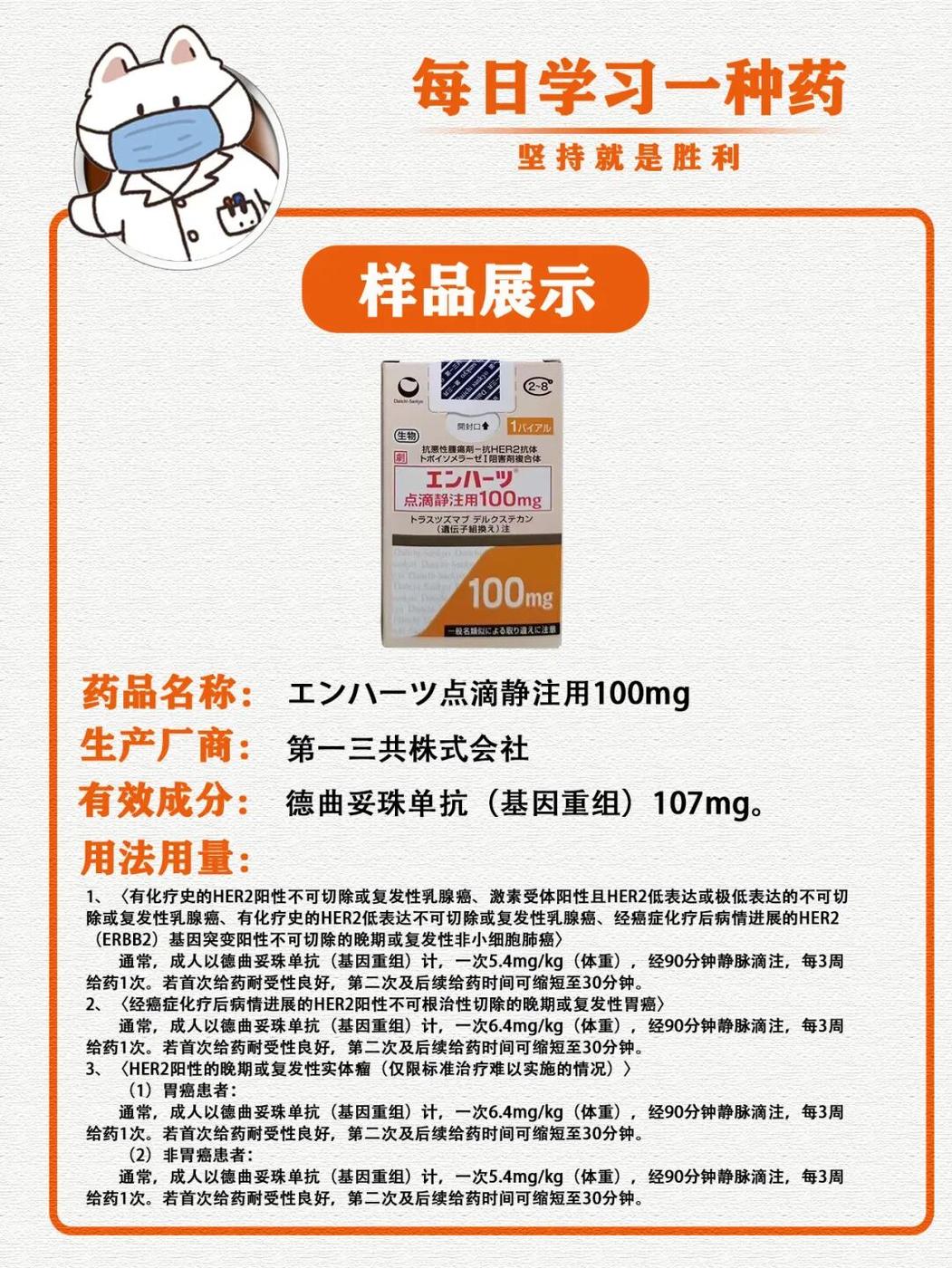
Anti-Beneficial Jar Plug Piercer Anti-HER2 Antibody 100mg for intravenous drip トラスッズマプデルクステカン 100mg Koun Hearts Intravenous Injection 100mg Drug Name: Manufacturer: Daiichi Sankyo Co., Ltd Active ingredients: Detrastuzumab (recombinant) 107mg. Dosage and administration: 1. HER2-positive, unresectable or recurrent breast cancer < a history of chemotherapy, hormone receptor-positive and unresectable with low or very low HER2 expression Except for recurrent breast cancer, low expression of HER2 in patients with a history of chemotherapy, unresectable or recurrent breast cancer, and HER2 that progressed after chemotherapy (ERBB2) gene mutation-positive, unresectable advanced or recurrent non-small cell lung cancer) Typically, adults receive detrastuzumab (recombinant) at 5.4 mg/kg (body weight) intravenously every 3 weeks after 90 minutes Administer once per dose. If the first dose is well tolerated, the second and subsequent dosing times can be shortened to 30 minutes. 2. "HER2-positive, irresecticable advanced or recurrent gastric cancer with disease progression after chemotherapy" Typically, adults receive detrastuzumab (recombinant) at 6.4 mg/kg (body weight) per dose, administered intravenously every 90 minutes every 3 weeks 3. "HER2-positive advanced or recurrent solid tumors (limited to cases where standard treatment is difficult to implement)" (1) Stomach cancer patients: (2) Patients who are not gastric cancer
抗惠性罐塞刺一抗HER2抗体 点滴静注用100mg トラスッズマプデルクステカン 100mg 工ンハーツ点滴静注用 100mg 药品名称: 生产厂商: 第一三共株式会社 有效成分: 德曲妥珠单抗(基因重组)107mg。 用法用量: 1、<有化疗史的HER2阳性不可切除或复发性乳腺癌、激素受体阳性且HER2低表达或极低表达的不可切 除或复发性乳腺癌、有化疗史的HER2低表达不可切除或复发性乳腺癌、经癌症化疗后病情进展的HER2 (ERBB2)基因突变阳性不可切除的晚期或复发性非小细胞肺癌) 通常,成人以德曲妥珠单抗(基因重组)计,一次5.4mg/kg(体重),经90分钟静脉滴注,每3周 给药1次。若首次给药耐受性良好,第二次及后续给药时间可缩短至30分钟。 2、《经癌症化疗后病情进展的HER2阳性不可根治性切除的晚期或复发性胃癌》 通常,成人以德曲妥珠单抗(基因重组)计,一次6.4mg/kg(体重),经90分钟静脉滴注,每3周 3、《HER2阳性的晚期或复发性实体瘤(仅限标准治疗难以实施的情况)) (1)胃癌患者: (2)非胃癌患者
Anti-Beneficial Jar Plug Piercer Anti-HER2 Antibody 100mg for intravenous drip トラスッズマプデルクステカン 100mg Koun Hearts Intravenous Injection 100mg Drug Name: Manufacturer: Daiichi Sankyo Co., Ltd A…
Text in this image machine-read · may contain errors
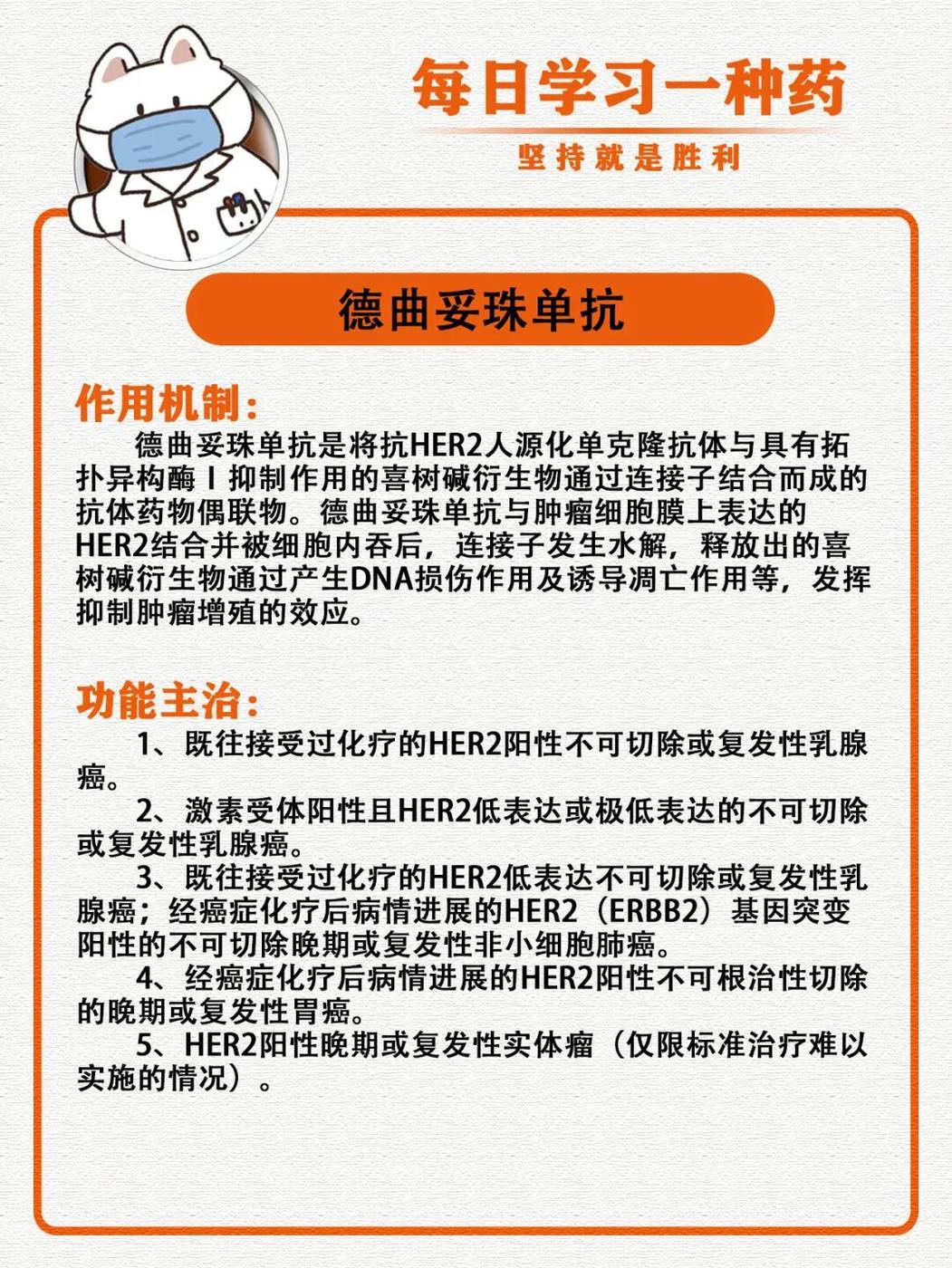
Detrastuzumab Mechanism of action: Detrastuzumab is a combination of humanized monoclonal antibodies against HER2 and has a unique character Camptothecin derivatives that inhibit psiisomerase are formed by linker binding Antibody-drug conjugates. Detrastuzumab is expressed on tumor cell membranes After HER2 binds and is engulfed by the cell, the linker undergoes hydrolysis, releasing the hypto Treeline derivatives play a role by causing DNA damage and inducing apotheosis Effects that inhibit tumor proliferation. Functions and indications: 1. HER2-positive, unresectable or recurrent breast in patients who have previously undergone chemotherapy 2. Hormone receptor-positive with low or very low HER2 expression and unresectable condition Or recurrent breast cancer. 3. Previously treated with chemotherapy with low HER2 expression and unresectable or recurrent breast HER2 (ERBB2) gene mutations in adenocarcinoma that progresses after cancer chemotherapy Positive, unresectable advanced or recurrent non-small cell lung cancer. 4. HER2-positive cases progressing after cancer chemotherapy cannot be cured and removed Advanced or recurrent gastric cancer. 5. HER2-positive advanced or recurrent solid tumors (limited to standard treatment difficulty). Implementation status).
德曲妥珠单抗 作用机制: 德曲妥珠单抗是将抗HER2人源化单克隆抗体与具有拓 扑异构酶|抑制作用的喜树碱衍生物通过连接子结合而成的 抗体药物偶联物。德曲妥珠单抗与肿瘤细胞膜上表达的 HER2结合并被细胞内吞后,连接子发生水解,释放出的喜 树碱衍生物通过产生DNA损伤作用及诱导调亡作用等,发挥 抑制肿瘤增殖的效应。 功能主治: 1、既往接受过化疗的HER2阳性不可切除或复发性乳腺 2、激素受体阳性且HER2低表达或极低表达的不可切除 或复发性乳腺癌。 3、既往接受过化疗的HER2低表达不可切除或复发性乳 腺癌经癌症化疗后病情进展的HER2(ERBB2)基因突变 阳性的不可切除晚期或复发性非小细胞肺癌。 4、经癌症化疗后病情进展的HER2阳性不可根治性切除 的晚期或复发性胃癌。 5、HER2阳性晚期或复发性实体瘤(仅限标准治疗难以 实施的情况)。
Detrastuzumab Mechanism of action: Detrastuzumab is a combination of humanized monoclonal antibodies against HER2 and has a unique character Camptothecin derivatives that inhibit psiisomeras…