Benidipine
日本語原題:ベニジピン塩酸塩錠4mg「NPI」
Source images
2 imagesThe artwork keeps its original Japanese/Chinese lettering. Open “Text in this image” under a picture to read what it says in your language (machine-read, may contain errors).
Text in this image machine-read · may contain errors
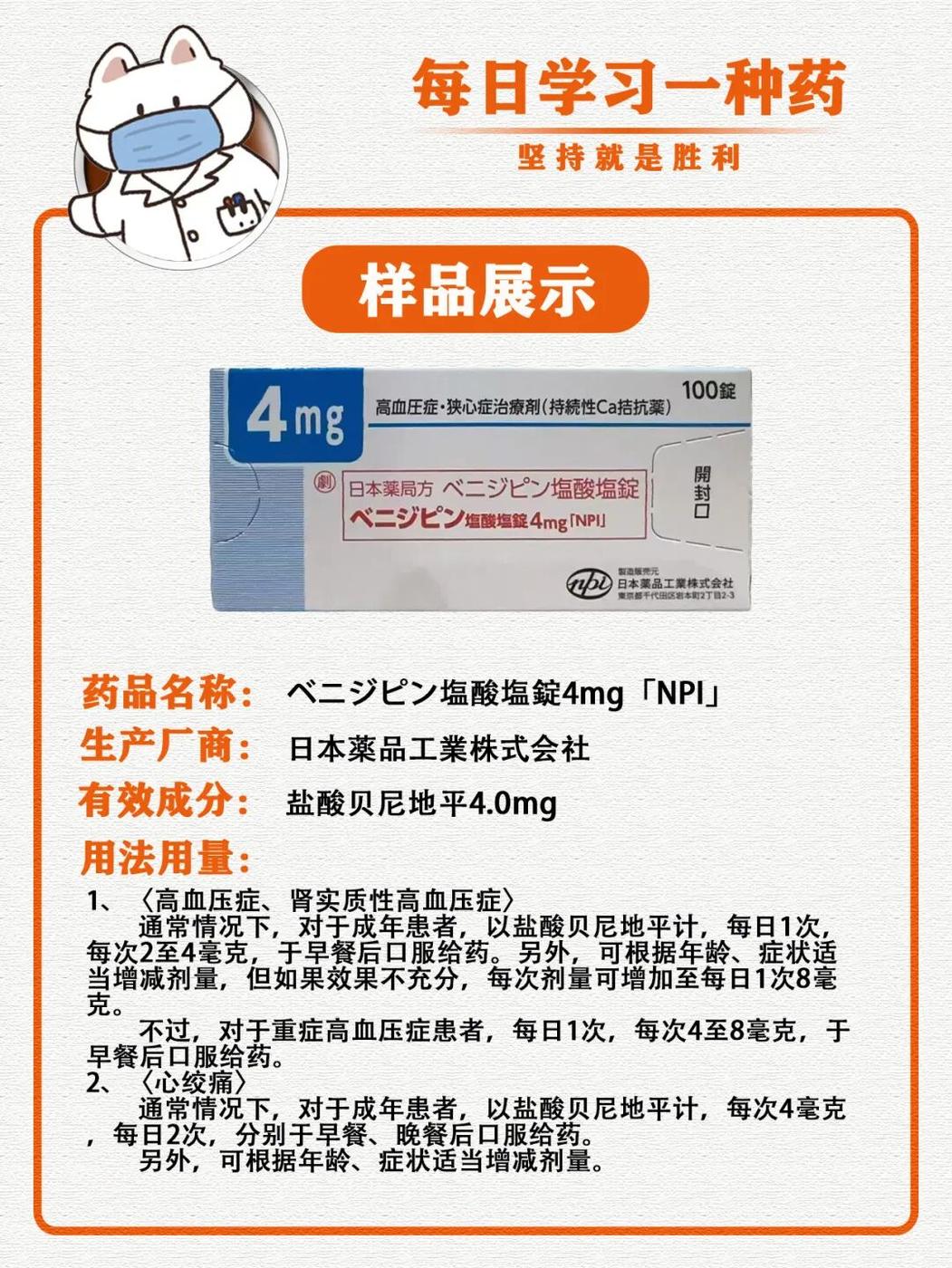
100 ingots Treatment for hypertension and angina (maintaining dominant calcium antagonist algae) Opening the seal ◎ Japanese Pharmacopoeia Benidipine Hydrochloride Tablets - sealed Nihon Sai Hinko Co., Ltd Drug Name: ^Disabisan Tablets 4mg [NPI] Manufacturer: Active ingredients: Benidipine hydrochloride 4.0 mg Dosage and administration: 1. "Hypertension, Renal Parenchymal Hypertension." Generally, for adult patients, take benidipine hydrochloride once daily, Take 2 to 4 mg orally after breakfast each time. Additionally, it can be adjusted according to age and symptoms When adjusting the dose, if the effect is insufficient, each dose can be increased to 8 mg once daily However, for patients with severe hypertension, 4 to 8 mg once daily is recommended Oral administration after breakfast. Typically, for adult patients, use 4 mg per dose as benidipine hydrochloride Twice daily, administered orally after breakfast and dinner. Additionally, dosage can be adjusted appropriately according to age and symptoms.
100锭 高血压症·狭心症治療劑(持統性Ca拮抗藻) 開封口 ◎ 日本薬局方べニジピン塩酸塩錠ー封 日本菜品工業株式会社 药品名称:^二沙匕酸锭4mg「NPI] 生产厂商: 有效成分: 盐酸贝尼地平4.0mg 用法用量: 1、《高血压症、肾实质性高血压症 通常情况下,对于成年患者,以盐酸贝尼地平计,每日1次, 每次2至4毫克,于早餐后口服给药。另外,可根据年龄、症状适 当增减剂量,但如果效果不充分,每次剂量可增加至每日1次8毫 不过,对于重症高血压症患者,每日1次,每次4至8毫克,于 早餐后口服给药。 通常情况下,对于成年患者,以盐酸贝尼地平计,每次4毫克 每日2次,分别于早餐、晚餐后口服给药。 另外,可根据年龄、症状适当增减剂量。
100 ingots Treatment for hypertension and angina (maintaining dominant calcium antagonist algae) Opening the seal ◎ Japanese Pharmacopoeia Benidipine Hydrochloride Tablets - sealed Nihon Sai…
Text in this image machine-read · may contain errors
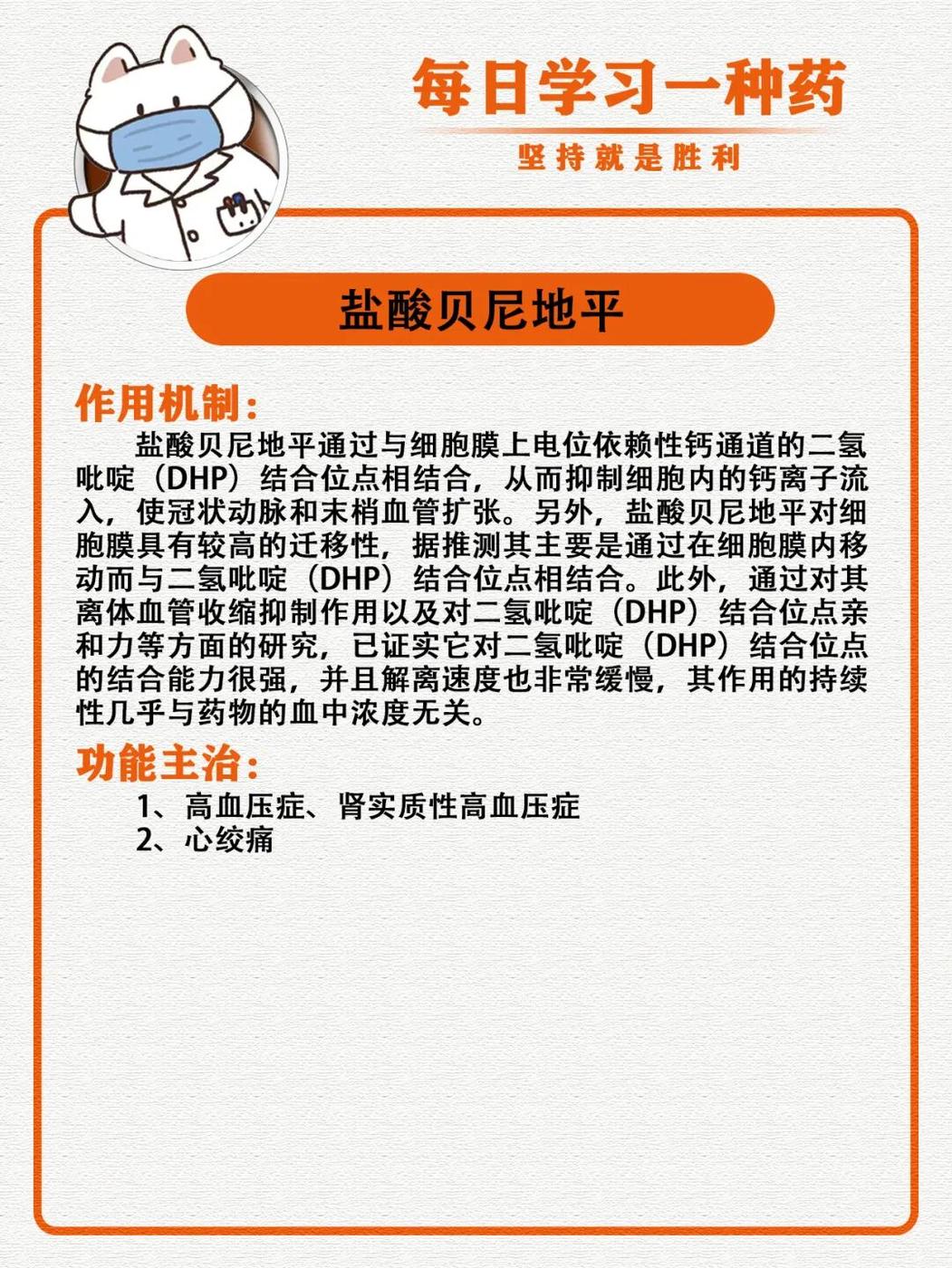
Benidipine hydrochloride Mechanism of action: Benidipine hydrochloride works through dihydrogen through voltage-dependent calcium channels on the cell membrane Pyridine (DHP) binds to the binding site, thereby inhibiting intracellular calcium flow Enter, causing the coronary arteries and perivascular vessels to dilate. Additionally, Benitipine hydrochloride is fine to fine The cell membrane has high mobility, presumably mainly by moving within the cell membrane and binds to the dihydropyridine (DHP) binding site. Moreover, through it Inhibits vasodility in vitro and has affinity for dihydropyridine (DHP) binding sites and other research have confirmed its ability to bind dihydropyridine (DHP). has a strong binding ability, and the dissociation rate is very slow, with a sustained effect Sex is almost unrelated to the blood concentration of the drug. Functions and indications: 1. Hypertension and renal parenchymal hypertension 2. Angina
盐酸贝尼地平 作用机制: 盐酸贝尼地平通过与细胞膜上电位依赖性钙通道的二氢 吡啶(DHP)结合位点相结合,从而抑制细胞内的钙离子流 入,使冠状动脉和未梢血管扩张。另外,盐酸贝尼地平对细 胞膜具有较高的迁移性,据推测其主要是通过在细胞膜内移 动而与二氢吡啶(DHP)结合位点相结合。此外,通过对其 离体血管收缩抑制作用以及对二氢吡啶(DHP)结合位点亲 和力等方面的研究,已证实它对二氢吡啶(DHP)结合位点 的结合能力很强,并且解离速度也非常缓慢,其作用的持续 性几乎与药物的血中浓度无关。 功能主治: 1、高血压症、肾实质性高血压症 2、心绞痛
Benidipine hydrochloride Mechanism of action: Benidipine hydrochloride works through dihydrogen through voltage-dependent calcium channels on the cell membrane Pyridine (DHP) binds to the bi…