Aspirin
日本語原題:アスピリン腸溶錠100mg「ZE」
Source images
2 imagesThe artwork keeps its original Japanese/Chinese lettering. Open “Text in this image” under a picture to read what it says in your language (machine-read, may contain errors).
Text in this image machine-read · may contain errors
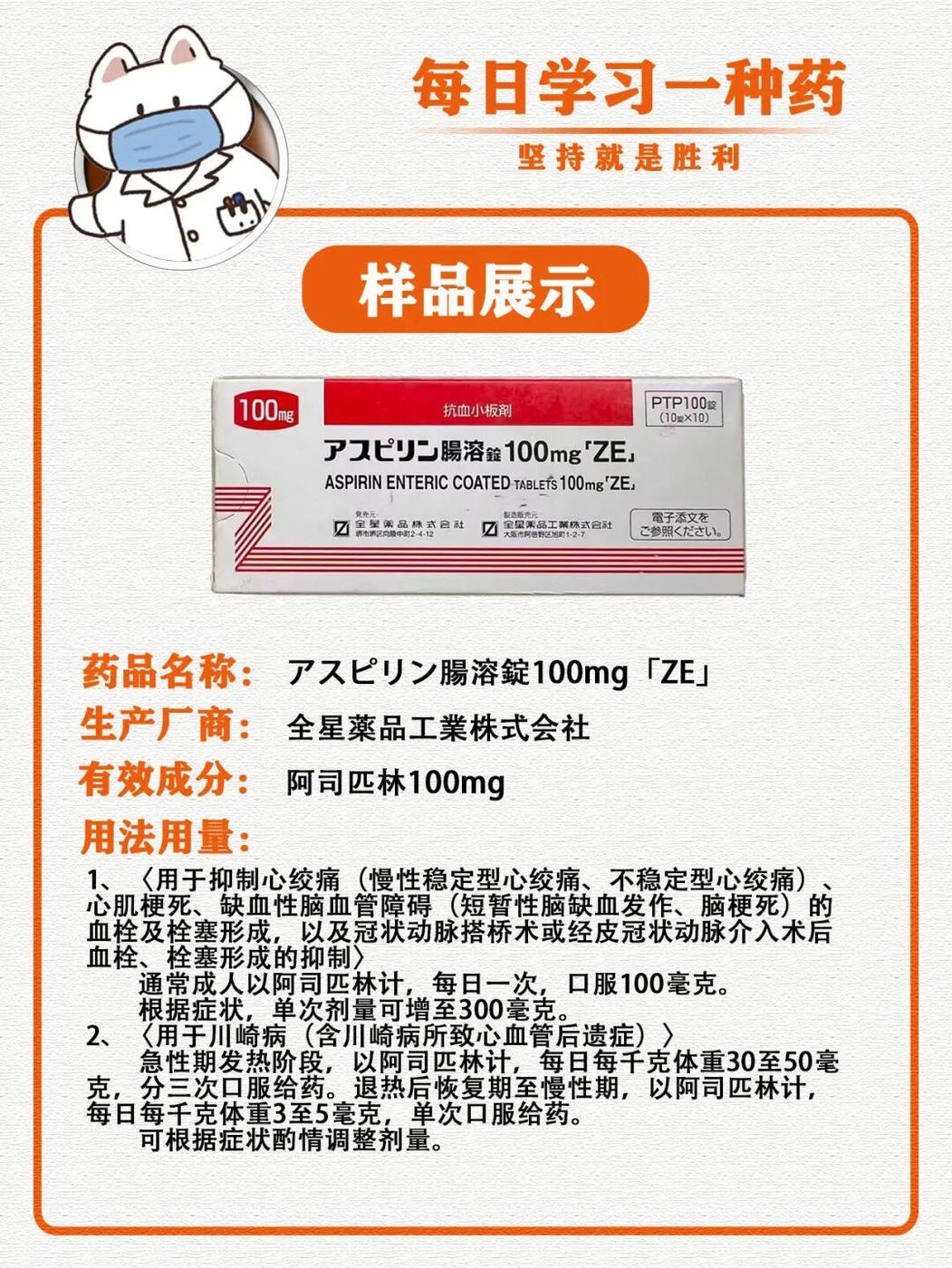
100mg PTP 100 yuan Antiplatelet P-Jiuqi J enteric-coated 100mg ZE ASPIRINENTERICCOATEDTABLETS100mg'ZE Electronic Wenlong added Please refer here. Drug Name: Aspirin Enteric-Coated Tablets 100mg "ZE" Manufacturer: Quanxing Pharmaceutical Industry Co., Ltd Active ingredient: 阝 Aspirin 100mg Dosage and administration: 1. "Used to suppress angina pectoris (chronic stable angina, unstable angina)" myocardial infarction and ischemic cerebrovascular disorders (transient ischemic attack, cerebral infarction). Thrombosis and embolism formation, as well as after coronary artery bypass grafting or percutaneous coronary intervention Inhibition of Thrombosis and Embolism Formation Typically, adults take 100 mg orally once daily as aspirin. Depending on symptoms, a single dose can be increased to 300 mg. "For Kawasaki Disease (including cardiovascular sequelae caused by Kawasaki disease)" During the acute fever phase, calculated with aspirin, the daily dose is 30 to 50 milligrams per kilogram of body weight Administered orally in three doses. From the recovery period after fever reduction to the chronic phase, calculated with aspirin, Take 3 to 5 mg per kg body weight orally as a single dose. Dosage can be adjusted according to symptoms.
100mg PTP100元 抗血小板 P久七J肠溶100mgZE ASPIRINENTERICCOATEDTABLETS100mg'ZE 電子添文龙 こ参照ください。 药品名称: アスピリン腸溶錠 100mg 「 ZE 」 生产厂商:全星藥品工業株式会社 有效成分:阝 阿司匹林100mg 用法用量: 1、《用于抑制心绞痛(慢性稳定型心绞痛、不稳定型心绞痛) 心肌梗死、缺血性脑血管障碍(短暂性脑缺血发作、脑梗死)的 血栓及栓塞形成,以及冠状动脉搭桥术或经皮冠状动脉介入术后 血栓、栓塞形成的抑制》 通常成人以阿司匹林计,每日一次,口服100毫克。 根据症状,单次剂量可增至300毫克。 《用于川崎病(含川崎病所致心血管后遗症)) 急性期发热阶段,以阿司匹林计,每日每千克体重30至50毫 克,分三次口服给药。退热后恢复期至慢性期,以阿司匹林计, 每日每千克体重3至5毫克,单次口服给药。 可根据症状酌情调整剂量。
100mg PTP 100 yuan Antiplatelet P-Jiuqi J enteric-coated 100mg ZE ASPIRINENTERICCOATEDTABLETS100mg'ZE Electronic Wenlong added Please refer here. Drug Name: Aspirin Enteric-Coated Tablets 10…
Text in this image machine-read · may contain errors
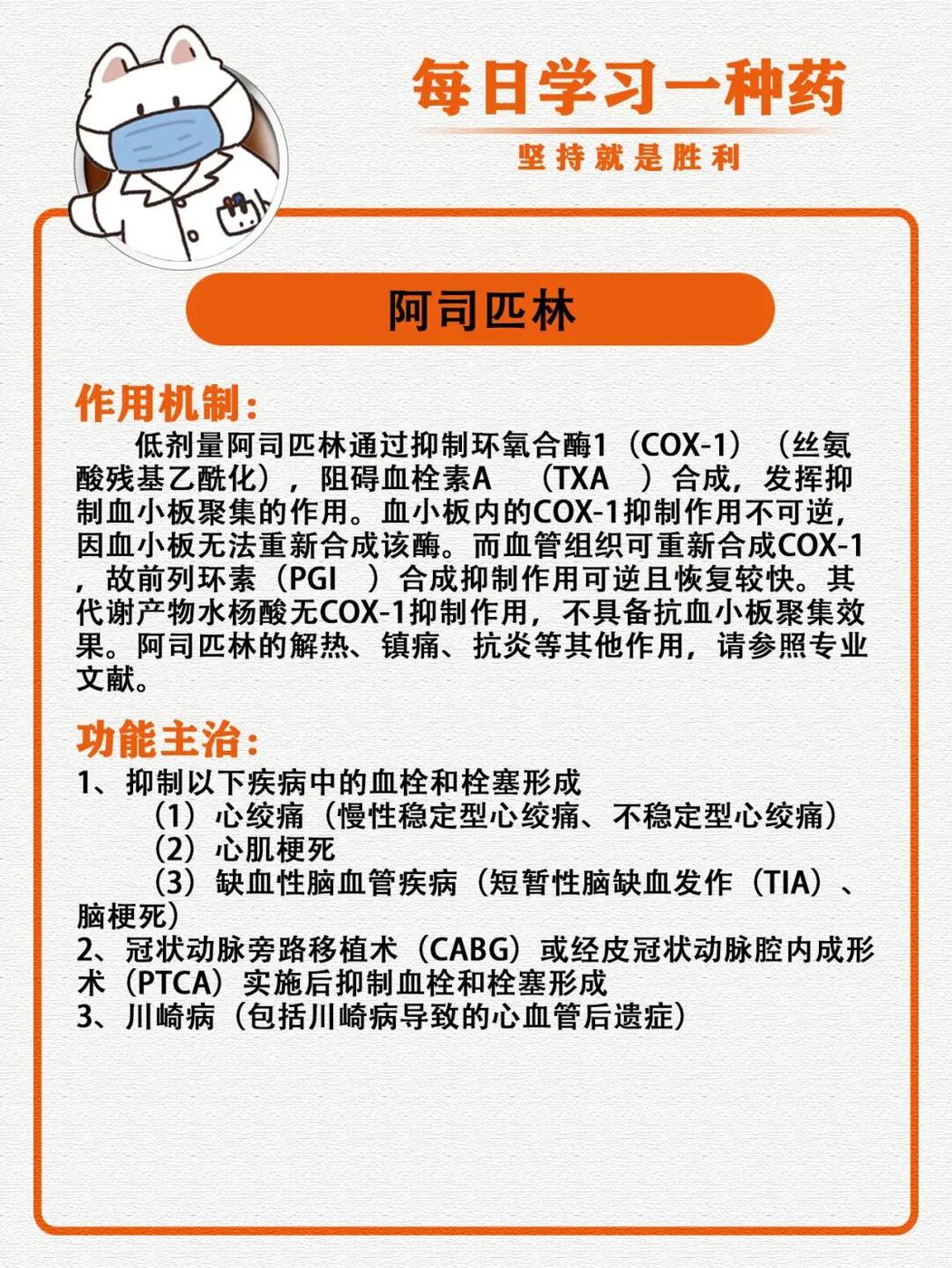
Mechanism of action: Low-dose aspirin works by inhibiting cyclooxygenase 1 (COX-1) (seramine). Acetylation of acid residues), blocking the synthesis of thromboxane A (TXA), thereby inhibiting Helps prevent platelet aggregation. COX-1 inhibition within platelets is irreversible, This is because platelets cannot resynthesize this enzyme. Vascular tissue can resynthesize COX-1 Therefore, the inhibitory effect on prostacyclin (PGI) synthesis is reversible and recovers quickly. It The metabolite salicylic acid has no COX-1 inhibitory effect and does not have antiplatelet aggregation effects Fruit. For aspirin's antipyretic, analgesic, anti-inflammatory effects, and other effects, please refer to the specialist Functions and indications: 1. Inhibits thrombosis and embolism formation in the following diseases (1) Angina pectoris (chronic stable angina, unstable angina) (2) Myocardial infarction (3) Ischemic cerebrovascular disease (transient ischemic attack (TIA, cerebral infarction) 2. Coronary artery bypass grafting (CABG) or percutaneous coronary endovascular reconstruction After PTCA is performed, thrombosis and embolism formation are suppressed 3. Kawasaki disease (including cardiovascular sequelae caused by Kawasaki disease) Aspirin
作用机制: 低剂量阿司匹林通过抑制环氧合酶1(COX-1)(丝氨 酸残基乙酰化),阻碍血栓素A(TXA)合成,发挥抑 制血小板聚集的作用。血小板内的COX-1抑制作用不可逆, 因血小板无法重新合成该酶。而血管组织可重新合成COX-1 故前列环素(PGI)合成抑制作用可逆且恢复较快。其 代谢产物水杨酸无COX-1抑制作用,不具备抗血小板聚集效 果。阿司匹林的解热、镇痛、抗炎等其他作用,请参照专业 功能主治: 1、抑制以下疾病中的血栓和栓塞形成 (1)心绞痛(慢性稳定型心绞痛、不稳定型心绞痛) (2)心肌梗死 (3)缺血性脑血管疾病(短暂性脑缺血发作(TIA、 脑梗死) 2、冠状动脉旁路移植术(CABG)或经皮冠状动脉腔内成形 术(PTCA)实施后抑制血栓和栓塞形成 3、川崎病(包括川崎病导致的心血管后遗症) 阿司匹林
Mechanism of action: Low-dose aspirin works by inhibiting cyclooxygenase 1 (COX-1) (seramine). Acetylation of acid residues), blocking the synthesis of thromboxane A (TXA), thereby inhibitin…