Urology & Kidney · URINARY

Tadalafil

日本語原題:タダラフィル錠5mgZA「サワイ」

Published2026-07-30 13:12 Makerサワイ FormTablet Content10 sections / 1 images
English translation of the Japanese package insert is the main text; the Japanese original is shown alongside for verification. Use the language menu (top right) to read the page in another language. This site is for reference only — consult a doctor or pharmacist before use.
Section 1 · 01
English translation
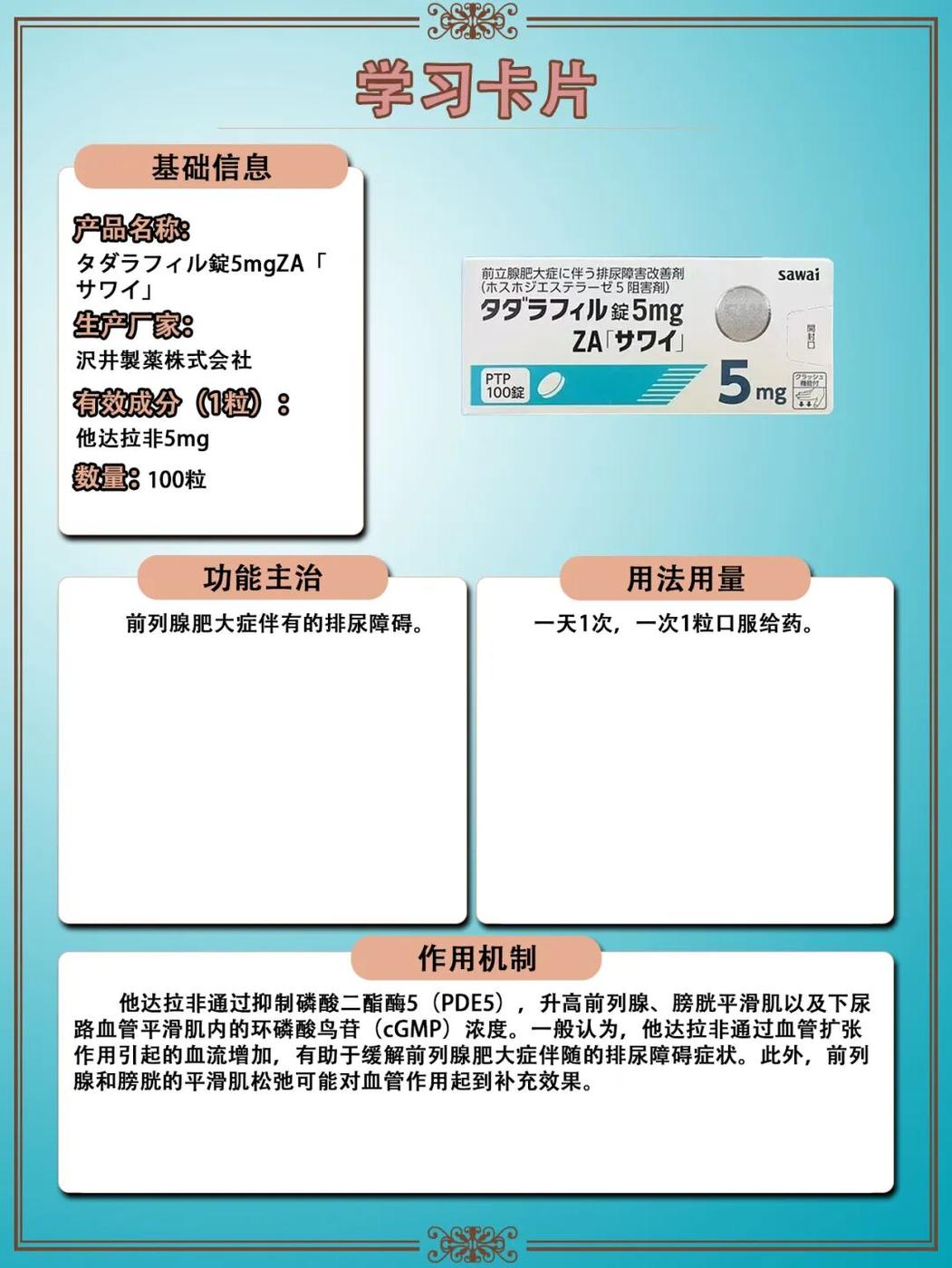
Feature Description By inhibiting PDE5, tadalafil increases cGMP concentrations in the smooth muscle of the prostate, bladder, and lower urinary tract vessels. The increase in blood flow mediated by tadalafil's vasodilatory effect is thought to contribute to alleviating symptoms of urinary disorders associated with benign prostatic hyperplasia. Additionally, relaxation of smooth muscles in the prostate and bladder may complement their effects on blood vessels.
Section 2 · 02
English translation
Aluminum-plastic blister packaging: 100 pieces (10 tablets× 10 blisters).
Section 3 · 03
English translation
Characteristics White, film-coated lock with split lines.
Section 4 · 04
English translation
Ingredient Information Active ingredient [per tablet]: Tadalafil 5mg. Additives: Carnauba Wax, Sodium Croscarmellos, Crystalline Cellulose, Titanium Oxide, Mg Stearate, Talc, Lactose, Hydroxypropyl Cellulose, Hypromellose, Macrogol 6000, Sodium Lauryl Sulfate.
Section 5 · 05
English translation
Indications Urinary disorders associated with benign prostatic hyperplasia.
Section 6 · 06
English translation
Dosage and Administration Typically, adults are given 5 mg orally as tadalafil once daily.
Section 7 · 07
English translation
Notes 1. Like other phosphodiesterase (PDE)5 inhibitors, this drug has vasodilatory effects, so transient mild blood pressure may occur. Before administering this drug, thoroughly confirm the presence or absence of cardiovascular disorders. Prolonged erections of 2 to 4 hours or more, or continuous erections (painful erections lasting more than 6 hours), have been very rarely reported abroad. If immediate treatment for priapism is not performed promptly, it can damage the penile tissue or permanently impair erectile function. Therefore, if an erection persists for more than 4 hours, immediately consult a doctor. 3. If a sudden decrease in vision or sudden loss of vision occurs after administration with this drug, instruct the patient to discontinue this drug and promptly consult an ophthalmology specialist. 4. Clinical trials have shown dizziness and visual impairment, so caution is advised when operating dangerous machinery such as working at heights or driving automobiles. 5. If sudden hearing loss or sudden hearing loss (sometimes accompanied by tinnitus or dizziness) occurs after administration, instruct the patient to stop taking this drug and promptly consult an ENT specialist. 6. Clinical efficacy when used in combination with other benign prostatic hyperplasia drugs has not been confirmed domestically.
Section 8 · 08
English translation
Side Effects 1. Allergies (frequency unknown) Rashes, urticaria, facial edema, exfoliative dermatitis, Stevens-Johnson syndrome, and others may appear. 2. Other side effects (1) Cardiovascular system: palpitations, hot flashes, flushing, myocardial infarction, chest pain, sudden cardiac death, syncope, hypotension. (2) Sensory organs: eye pain, fog vision, conjunctival congestion, retinal artery occlusion, retinal venous occlusion, eyelid swelling, visual field defects, non-arteritis anterior ischemic optic neuropathy, sudden hearing loss, central serous chorioretinopathy. (3) Digestive system: indigestion, gastroesophageal reflux disease, diarrhea, gastritis, abdominal pain. (4) Kidneys: Decreased renal creatinine clearance. (5) Musculoskeletal structure: muscle pain, back pain, limb pain. (6) Mental and nervous system: headache, floating dizziness, migraine, stroke. (7) Urinary and reproductive organs: enhanced erection, spontaneous penile erection, priapism, prolongation of erection. (8) Respirator: difficulty breathing, nosebleeds. (9) Skin: Hyperhidrosis. (10) Others: CK rises.
Section 9 · 09
English translation
taboo 1. Patients with a history of hypersensitivity to any component of this drug 2. Patients receiving nitric acid agents or nitric oxide (NO) donors (nitroglycerin, amyl nitrite, isosorbide nitrate, nicorandyl, etc.) 3. Patients receiving soluble guanylate cyclase (sGC) agonists (riociguat) 4. Patients with the following cardiovascular disorders [These patients were excluded from clinical trials. ] (1) Patients with unstable angina (2) Patients with heart failure (NYHA classification grade III or higher) (3) Individuals with poorly controlled arrhythmias, hypotension (blood pressure < 90/50 mmHg), or uncontrolled hypertension (resting blood pressure > 170/100 mmHg) (4) Patients with a history of myocardial infarction within the last 3 months (5) Patients with a history of cerebral infarction or cerebral hemorrhage within the last 6 months 5. Patients with severe kidney impairment 6. Patients with severe liver impairment
Section 10 · 10
English translation
Warning 1. Concurrent use of this drug with nitrate agents or nitric oxide (NO) donors (nitroglycerin, amyl nitrite, isosorbide nitrate, nicolangyl, etc.) may enhance its antihypertensive effect and excessively lower blood pressure. Therefore, before administration of this drug, make sure that no nitrate or nitric oxide (NO) donors have been administered, Be extremely careful not to administer nitric acid or nitric oxide (NO) donors during and after administration of this drug. 2. Serious cardiovascular adverse events such as myocardial infarction, including fatal cases, have been reported. Therefore, before administration of this drug, thoroughly confirm the presence or absence of cardiovascular disorders.

Source images

1 images

Need help sourcing Japanese medicines or OEM production?

💬