Bezafibrate
日本語原題:ベザトールSR錠100mg
1 tablet of Chunichi Bureau Bezafibrate 100mg.
Source images
1 imagesThe artwork keeps its original Japanese/Chinese lettering. Open “Text in this image” under a picture to read what it says in your language (machine-read, may contain errors).
Text in this image machine-read · may contain errors
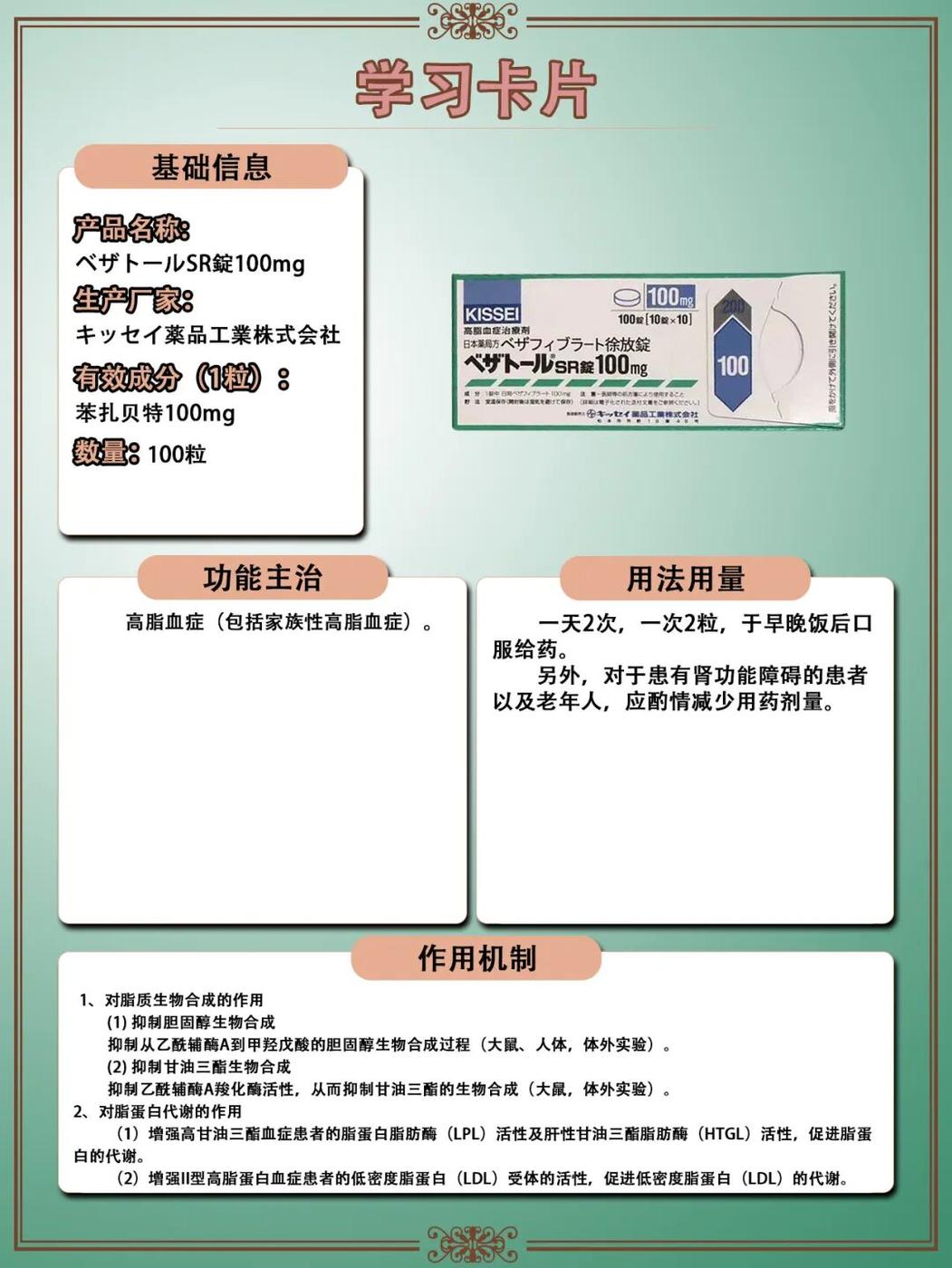
Basic information Product Name: Vesatol SR Tablets 100mg Manufacturer: KISSEI 100 bags [10 bags×10] Kissei Pharmaceutical Co., Ltd Japan "Bezafibrate Sustained-Release Tablets." #卜-sR tablets 100mg Active ingredient (1 capsule): Benzafib 100mg Quantity: 100 capsules Functions and indications Usage and dosage Hyperlipidemia (including familial hyperlipidemia). Take twice a day, 2 capsules each time, after breakfast and dinner Administer the medication. Additionally, for patients with kidney dysfunction, and elderly people should reduce the dosage as appropriate. Mechanism of action 1. Effects on lipid biosynthesis (1) Inhibits cholesterol biosynthesis Inhibits cholesterol biosynthesis from acetyl-CoA to mevalonate (rats, humans, in vitro experiments). (2) Inhibits triglyceride biosynthesis Inhibits acetyl-CoA carboxylase activity, thereby inhibiting triglyceride biosynthesis (rats, in vitro experiment). 2. Effects on lipoprotein metabolism (1) Enhance the activity of lipoprotein lipase (LPL) and hepatic triglyceride lipase (HTGL) in patients with hypertriglyceridemia, promoting the promotion of fatty eggs White metabolism. (2) Enhancing the activity of low-density lipoprotein (LDL) receptors in patients with type I hyperlipoproteinemia, promoting LDL metabolism.
基础信息 产品名称: べザトール SR 錠 100mg 生产厂家: KISSEI 100袋[10袋×10] キッセイ薬品工業株式会社 日 “ べザフィブラート徐放錠 #卜-sR锭100mg 有效成分(1粒): 苯扎贝特100mg 数量:100粒 功能主治 用法用量 高脂血症(包括家族性高脂血症)。 一天2次,一次2粒,于早晚饭后口 服给药。 另外,对于患有肾功能障碍的患者 以及老年人,应酌情减少用药剂量。 作用机制 1、对脂质生物合成的作用 (1)抑制胆固醇生物合成 抑制从乙酰辅酶A到甲羟戊酸的胆固醇生物合成过程(大鼠、人体,体外实验)。 (2)抑制甘油三酯生物合成 抑制乙酰辅酶A羧化酶活性,从而抑制甘油三酯的生物合成(大鼠,体外实验)。 2、对脂蛋白代谢的作用 (1)增强高甘油三酯血症患者的脂蛋白脂肪酶(LPL)活性及肝性甘油三酯脂肪酶(HTGL)活性,促进脂蛋 白的代谢。 (2)增强I型高脂蛋白血症患者的低密度脂蛋白(LDL)受体的活性,促进低密度脂蛋白(LDL)的代谢。
Basic information Product Name: Vesatol SR Tablets 100mg Manufacturer: KISSEI 100 bags [10 bags×10] Kissei Pharmaceutical Co., Ltd Japan "Bezafibrate Sustained-Release Tablets." #卜-sR tablet…