Endocrine & Metabolic · ENDOCRINE

Anamorelin Hydrochloride

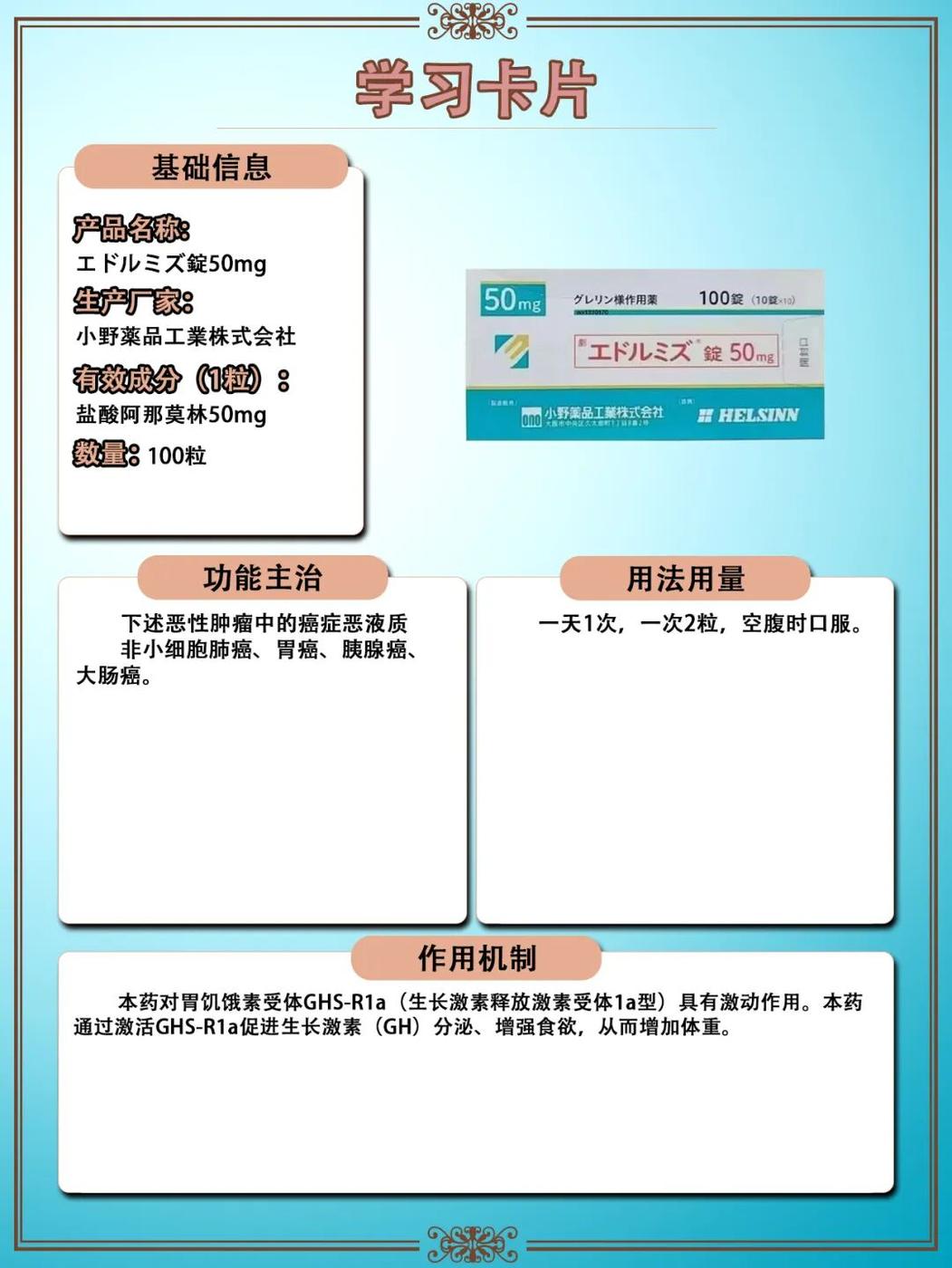
日本語原題:エドルミズ錠50mg

Published2026-08-26 14:41 FormTablet Content10 sections / 1 images
Ingredients / strength:
Each tablet contains 50mg of anamorelin hydrochloride.
English translation of the Japanese package insert is the main text; the Japanese original is shown alongside for verification. Use the language menu (top right) to read the page in another language. This site is for reference only — consult a doctor or pharmacist before use.
Section 1 · 01
English translation
Feature Description This drug works on the ghrelin receptor GHS-R1a (growth hormone release-promoting factor receptor type 1a). This drug promotes the secretion of growth hormone (GH) through activation of GHS-R1a, thereby increasing appetite and leading to weight gain.
Section 2 · 02
English translation
100 tablets [10 tablets (PTP packaging) ×10 blisters].
Section 3 · 03
English translation
Characteristics Light yellow, film-coated locks.
Section 4 · 04
English translation
Ingredient Information Active ingredient: 50mg of anamorelin hydrochloride per tablet. Additives: crystalline cellulose, croscarmellose sodium, light anhydride silica, magnesium stearate, hypromellose, titanium oxide, talc, yellow trioxide.
Section 5 · 05
English translation
Indications Cancer cachexia in the following malignant tumors Non-small cell lung cancer, stomach cancer, pancreatic cancer, colorectal cancer.
Section 6 · 06
English translation
Dosage and Administration Typically, adults are given 100 mg of anamorelin hydrochloride orally once daily on an empty stomach.
Section 7 · 07
English translation
Notes 1. This drug has an inhibitory effect on sodium channels, thus acting inhibitively on the stimulus conduction system. Since ECG abnormalities (pronounced PR intervals or QRS width prolongation, QT interval prolongation, etc.) may occur after administration, ECG, pulse, blood pressure, cardiothoracic ratio, electrolytes, etc., should be regularly measured before and during administration. If abnormalities are observed, appropriate measures such as discontinuing administration should be taken. Special caution is required during the initial phase of administration of this drug. 2. High blood sugar may occur, so regularly measure blood glucose and urine glucose before and during the start and duration of this drug. 3. Since liver dysfunction may occur, regular liver function tests should be performed before and during the start of administration of this drug.
Section 8 · 08
English translation
Side Effects 1. Suppression of the stimulus conduction system (10.7%) Abnormal ECG (such as prolonged PR interval or QRS width, prolonged QT interval, etc.), atrioventricular block, tachycardia, bradycardia, palpitations, hypotension, and supraventricular premature contractions may appear. 2. Hyperglycemia (4.3%), worsening diabetes (4.3%) Pay attention to symptoms such as dry mouth and frequent urination, and take appropriate measures such as administering insulin, oral hypoglycemic agents, or discontinuing this medication as needed. 3. Liver dysfunction (6.4%) Liver dysfunction accompanied by elevated levels of AST, ALT, ALP, γ-GTP, and blood bilirubin may occur. 3. Other side effects (1) Blood and lymphatic system disorders: lymphopenia. (2) Ear and labyrinth disorders: sudden hearing loss. (3) Endocrine disorders: increased ACTH. (4) Eye disorders: eye redness, foggy vision, dry eye syndrome. (5) Gastrointestinal disorders: nausea, diarrhea, abdominal pain, tooth decay, gastrointestinal bleeding, stomatitis, vomiting, abdominal bloating, cheilitis, esophageal pain. (6) General disorders: fatigue, edema, fever, weakness, chest pain, facial edema, dry mouth, abnormal sensations, and heat sensation. (7) Infections: gingivitis, pharyngitis. (8) Metabolic and nutritional disorders: impaired glucose tolerance, positive urine glucose, hypertriglyceridemia, reduced crawl, increased cholesterol, increased potassium, decreased sodium, increased triglycerides. (9) Musculoskeletal and connective tissue disorders: muscle weakness, spinal canal stenosis, muscle spasticity. (10) Mental and neurological disorders: headache, loss of consciousness, delirium, floating vertigo, taste disturbances, peripheral neuropathy, drowsiness, insomnia. (11) Renal and urinary tract disorders: positive proteinuria and blood in urine. (12) Respiratory, thoracic, and mediastinal disorders: dyspnea, pleural effusion. (13) Skin and subcutaneous tissue disorders: rash, hyperhidrosis, pruritus, cold sweats, skin peeling. (14) Vascular disorders: hypertension, hot flashes, elevated blood pressure. (15) Others: increased glycohemoglobin, increased blood glucose, increased LDH, gynecomastia, prostatitis.
Section 9 · 09
English translation
taboo 1. Patients with a history of hypersensitivity to any component of this drug 2. Patients with congestive heart failure [May suppress cardiac function and worsen symptoms. ] 3. Patients with myocardial obstruction or angina pectoris [may suppress cardiac function and worsen symptoms. ] 4. Patients with severe impulse conduction system disorders (such as complete atrioventricular block) [This drug has sodium channel blockade effects, so it acts suppressively on the immoral conduction system and may worsen the condition. ] 5. Patients currently receiving the following drugs: clarithromycin, itraconazole, voriconazole, ritonavir-containing preparations, cobicistat-containing preparations, and ensitrelvil-fumaric acid 6. Patients with moderate or severe hepatic impairment (Child-Pugh classifications B and C) [Since the liver mainly contributes to the elimination of this drug from the body, blood levels may rise, potentially leading to suppression of the stimulus conduction system. ] 7. Patients who have difficulty ingesting oral food due to organic abnormalities of the digestive tract, such as gastrointestinal obstruction.
Section 10 · 10
English translation
Warning This drug should only be administered to cases where it is deemed appropriate for use under the supervision and experience of physicians with sufficient knowledge and experience in diagnosing and treating cancer cachexia. Also, before starting this drug, fully explain the benefits and risks of this drug to the patient or their family, confirm that they have understood it, and begin administration only after commencing it.

Source images

1 images

Need help sourcing Japanese medicines or OEM production?

💬