Thiamine + riboflavin + ascorbic acid
日本語原題:プレビタS注射液
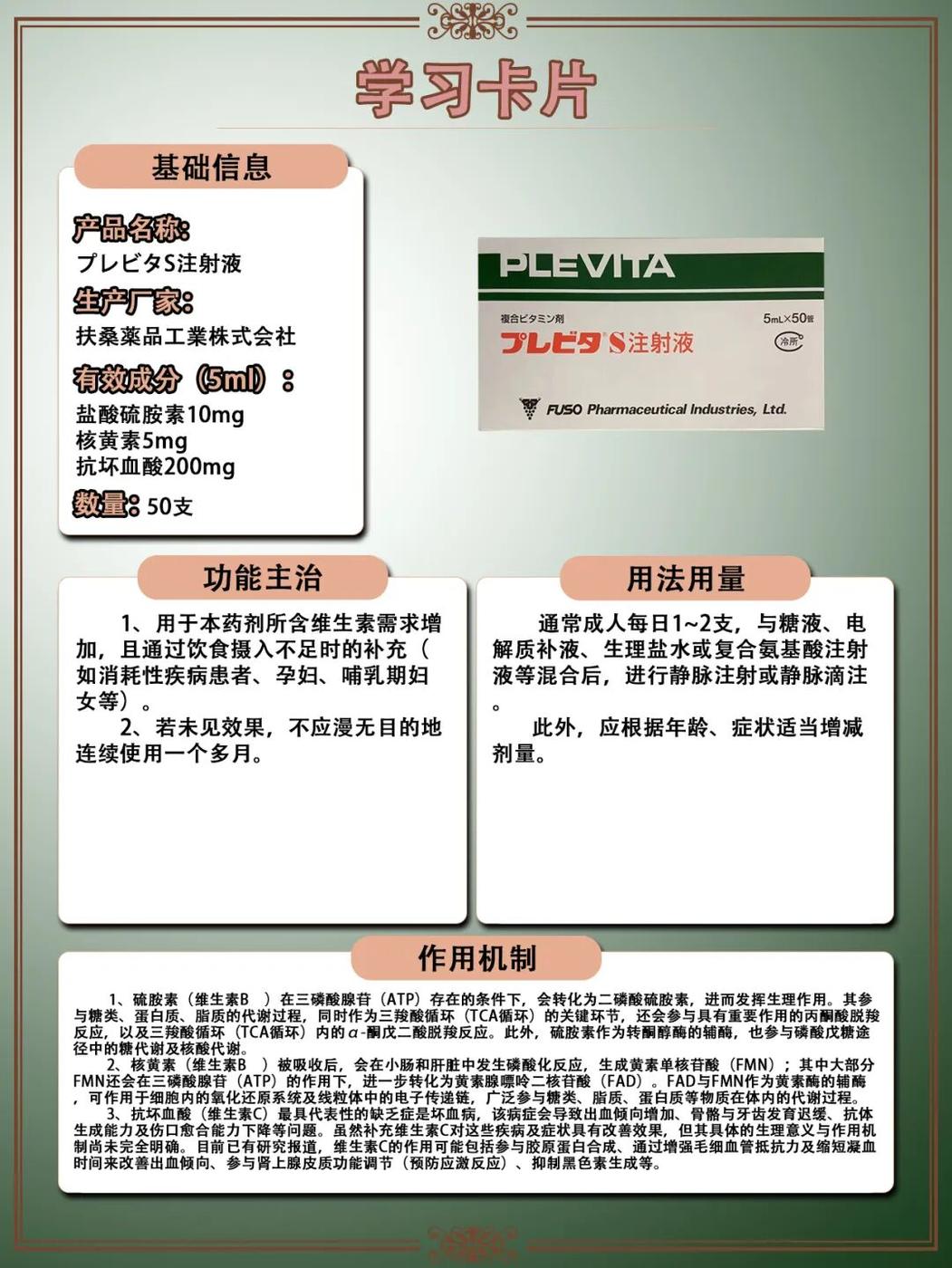
In one tube, 10 mg of Japanese-grade thiamine chloride hydrochloride, 6.355 mg of Japanese-prepared riboflavin phosphate sodium ester (5 mg as riboflavin), and 200 mg of Japanese-prepared ascorbic acid.
Source images
1 imagesThe artwork keeps its original Japanese/Chinese lettering. Open “Text in this image” under a picture to read what it says in your language (machine-read, may contain errors).
Text in this image machine-read · may contain errors
Basic information Product Name: Previta S Injection PLEVITA Manufacturer: Fusoh Goods Industry Co., Ltd Vitamin B was restored Active ingredients (5ml): FUso Pharmaceutical Industries, Ltd. Thiamine hydrochloride 10mg Riboflavin 5mg Ascorbic acid 200mg Quantity: 50 pieces Functions and indications Usage and dosage 1. Used for increased demand for vitamins contained in this medicine Usually, adults take 1~2 vials daily, with sugar solution and electricity Additionally, supplementation is provided when dietary intake is insufficient ( Lysate rehydration, saline, or compound amino acid injections Such as patients with wasting diseases, pregnant women, and breastfeeding women After mixing the liquid, intravenous injection or intravenous infusion is administered females, etc.). 2. If no results are seen, do not aimlessly Additionally, adjustments should be appropriately adjusted according to age and symptoms Used continuously for over a month. Mechanism of action 1. Thiamine (vitamin B) converts into thiamine diphosphate in the presence of adenosine triphosphate (ATP), thereby exerting physiological effects. Its reference Along with the metabolism of carbohydrates, proteins, and lipids, it is also a key link in the tricarboxylic acid cycle (TCA cycle), and also participates in the important decarboxylation of pyruvate and the α-ketoglutarate decarboxylation reaction within the tricarboxylic acid cycle (TCA cycle). Additionally, thiamine, as a coenzyme of ketolase, also participates in the pentose phosphate pathway Glucose metabolism and nucleic acid metabolism in the pathway. 2. After riboflavin (vitamin B) is absorbed, phosphorylation reactions occur in the small intestine and liver to form flavin mononucleotide (FMN); Most of them FMN is further converted into flavin adenine dinucleotide (FAD) under the action of adenosine triphosphate (ATP). FAD and FMN serve as coenzymes for flavinase , can act on the redox system within cells and the electron transport chain in mitochondria, widely participating in the metabolism of carbohydrates, lipids, proteins, and other substances in the body. 3. The most representative deficiency of ascorbic acid (vitamin C) is scurvy, which leads to increased bleeding tendencies, delayed bone and tooth development, and antibodies Issues such as reduced generation and wound healing ability. Although supplementing vitamin C can improve these diseases and symptoms, its specific physiological significance and mechanism of action are important Time to improve bleeding tendency, participate in adrenal cortex function regulation (prevent stress responses), and inhibit melanin production.
基础信息 产品名称: プレビタ S 注射液 PLEVITA 生产厂家: 扶桑品工業株式会社 復ビタミン第 有效成分(5ml: FUso Pharmaceutical Industries, Ltd. 盐酸硫胺素10mg 核黄素5mg 抗坏血酸200mg 数量:50支 功能主治 用法用量 1、用于本药剂所含维生素需求增 通常成人每日1~2支,与糖液、电 加,且通过饮食摄入不足时的补充( 解质补液、生理盐水或复合氨基酸注射 如消耗性疾病患者、孕妇、哺乳期妇 液等混合后,进行静脉注射或静脉滴注 女等)。 2、若未见效果,不应漫无目的地 此外,应根据年龄、症状适当增减 连续使用一个多月。 作用机制 1、硫胺素(维生素B)在三磷酸腺苷(ATP)存在的条件下,会转化为二磷酸硫胺素,进而发挥生理作用。其参 与糖类、蛋白质、脂质的代谢过程,同时作为三羧酸循环(TCA循环)的关键环节,还会参与具有重要作用的丙酮酸脱羧 反应,以及三羧酸循环(TCA循环)内的α-酮戊二酸脱羧反应。此外,硫胺素作为转酮醇酶的辅酶,也参与磷酸戊糖途 径中的糖代谢及核酸代谢。 2、核黄素(维生素B)被吸收后,会在小肠和肝脏中发生磷酸化反应,生成黄素单核苷酸(FMN);其中大部分 FMN还会在三磷酸腺苷(ATP)的作用下,进一步转化为黄素腺嘌呤二核苷酸(FAD)。FAD与FMN作为黄素酶的辅酶 ,可作用于细胞内的氧化还原系统及线粒体中的电子传递链,广泛参与糖类、脂质、蛋白质等物质在体内的代谢过程。 3、抗坏血酸(维生素C)最具代表性的缺乏症是坏血病,该病症会导致出血倾向增加、骨骼与牙齿发育迟缓、抗体 生成能力及伤口愈合能力下降等问题。虽然补充维生素C对这些疾病及症状具有改善效果,但其具体的生理意义与作用机 时间来改善出血倾向、参与肾上腺皮质功能调节(预防应激反应)、抑制黑色素生成等。
Basic information Product Name: Previta S Injection PLEVITA Manufacturer: Fusoh Goods Industry Co., Ltd Vitamin B was restored Active ingredients (5ml): FUso Pharmaceutical Industries, Ltd. …